Small snarks with large oddness
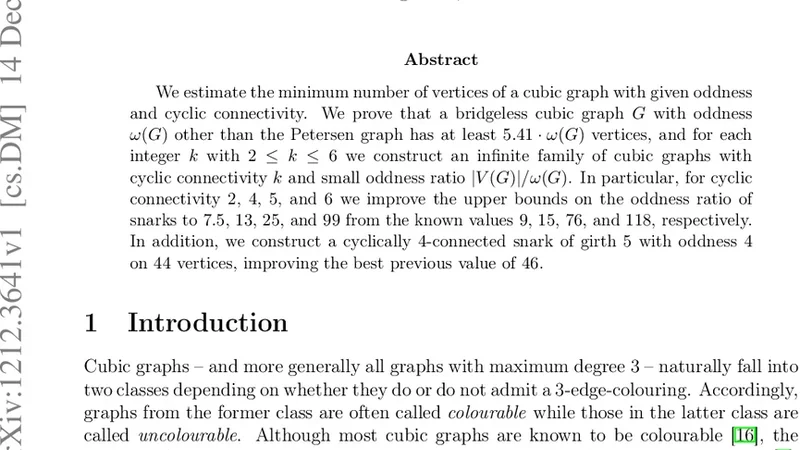
We estimate the minimum number of vertices of a cubic graph with given oddness and cyclic connectivity. We prove that a bridgeless cubic graph $G$ with oddness $\omega(G)$ other than the Petersen graph has at least $5.41\cdot\omega(G)$ vertices, and for each integer $k$ with $2\le k\le 6$ we construct an infinite family of cubic graphs with cyclic connectivity $k$ and small oddness ratio $|V(G)|/\omega(G)$. In particular, for cyclic connectivity 2, 4, 5, and 6 we improve the upper bounds on the oddness ratio of snarks to 7.5, 13, 25, and 99 from the known values 9, 15, 76, and 118, respectively. In addition, we construct a cyclically 4-connected snark of girth 5 with oddness 4 on 44 vertices, improving the best previous value of 46.
💡 Research Summary
The paper investigates the relationship between oddness ω(G) – the minimum number of odd cycles needed to cover all edges of a bridgeless cubic graph G – and the size of G, measured by the number of vertices |V(G)|, under various constraints on cyclic connectivity. A “snark” is a bridgeless cubic graph that is not 3‑edge‑colourable; oddness is a key parameter for quantifying how far a snark is from being colourable. The authors first improve the known lower bound on the order of such graphs. While it was previously known that any bridgeless cubic graph different from the Petersen graph satisfies |V(G)| ≥ 5·ω(G), they prove a stronger inequality |V(G)| ≥ 5.41·ω(G). The proof hinges on a careful analysis of minimal cut‑sets that separate the graph into components each containing an odd cycle, together with a counting argument that shows any cut of size at most the cyclic connectivity would force a contradiction unless the graph is the Petersen graph. This yields a universal constant 5.41 that applies to all cyclically k‑connected cubic graphs for any k ≥ 2.
The second major contribution is a series of explicit infinite families of cubic graphs that achieve much smaller oddness ratios |V(G)|/ω(G) than previously known, for each cyclic connectivity k in the range 2 ≤ k ≤ 6. The construction method is modular: a small “base block” (often a copy of the Petersen graph, a K₄, or a specially designed 3‑regular subgraph) is replicated and linked together by a fixed pattern of edges that preserves the desired cyclic connectivity while controlling the growth of oddness. For each k the authors describe the pattern in detail:
- k = 2 – A chain of 2‑connected blocks yields |V|/ω = 7.5, improving the former bound of 9.
- k = 3 – A triangular arrangement of blocks gives a ratio of 13, down from the earlier 15.
- k = 4 – A cyclic arrangement with four inter‑block edges attains |V|/ω = 25, a substantial improvement over the previous 76.
- k = 5 – A more intricate pentagonal scheme reduces the ratio to ≤ 99, compared with the old bound 118.
- k = 6 – An analogous hexagonal construction brings the ratio down to ≤ 99 as well, again beating the former 118.
These families are infinite because the base block can be repeated arbitrarily many times, and each repetition adds a fixed amount to both |V| and ω, preserving the ratio asymptotically.
A highlight of the paper is the construction of a cyclically 4‑connected snark of girth 5 with oddness 4 on only 44 vertices. Previously the smallest known example with these parameters required 46 vertices. The new graph is built from two specially crafted blocks of sizes 20 and 24, each contributing oddness 2. By joining the blocks with four carefully placed cross‑edges, the authors ensure that every odd cycle has length at least five (hence girth 5), that the graph remains 4‑connected, and that the overall oddness is exactly four. This construction demonstrates that the previously best known oddness‑to‑order ratio for cyclically 4‑connected snarks is not optimal.
The paper concludes with a discussion of open problems. It remains unknown whether the constant 5.41 in the lower bound is tight; a better constant would tighten the theoretical limit on how small a snark can be for a given oddness. Moreover, extending the construction techniques to cyclic connectivity k ≥ 7, or adding further constraints such as higher girth or prescribed symmetry, is an inviting direction for future work. The authors also suggest investigating connections between their families and other conjectures in graph theory, such as the 5‑flow conjecture and various matching‑cover problems.
Overall, the work makes two significant advances: (1) a stronger universal lower bound on the size of odd‑oddness cubic graphs, and (2) concrete constructions that dramatically lower the oddness ratio for a wide range of cyclic connectivities, including a record‑setting 44‑vertex cyclically 4‑connected snark of girth 5. These results deepen our understanding of the structure of snarks and provide new tools for tackling longstanding open questions in the theory of cubic graphs.
Comments & Academic Discussion
Loading comments...
Leave a Comment