The Possible Role of Resource Requirements and Academic Career-Choice Risk on Gender Differences in Publication Rate and Impact
Many studies demonstrate that there is still a significant gender bias, especially at higher career levels, in many areas including science, technology, engineering, and mathematics (STEM). We investigated field-dependent, gender-specific effects of the selective pressures individuals experience as they pursue a career in academia within seven STEM disciplines. We built a unique database that comprises 437,787 publications authored by 4,292 faculty members at top United States research universities. Our analyses reveal that gender differences in publication rate and impact are discipline-specific. Our results also support two hypotheses. First, the widely-reported lower publication rates of female faculty are correlated with the amount of research resources typically needed in the discipline considered, and thus may be explained by the lower level of institutional support historically received by females. Second, in disciplines where pursuing an academic position incurs greater career risk, female faculty tend to have a greater fraction of higher impact publications than males. Our findings have significant, field-specific, policy implications for achieving diversity at the faculty level within the STEM disciplines.
💡 Research Summary
The paper investigates why gender gaps in scientific productivity and impact persist in STEM academia, focusing on how discipline‑specific resource demands and career‑risk profiles shape these differences. Using a novel database that links 437,787 publications to 4,292 faculty members at the top 50 U.S. research universities across seven STEM fields (physics, chemistry, biology, electrical‑engineering, computer science, mathematics, and earth‑science), the authors conduct a series of quantitative analyses to test two central hypotheses.
First, they hypothesize that lower publication rates for women are linked to the amount of research resources typically required in a given discipline. To operationalize “resource demand,” the authors compile external data on average grant funding, laboratory space, and major equipment costs for each field from NSF, NIH, and other federal sources. A regression of field‑level average resource intensity against the gender gap in annual publication counts reveals a strong positive relationship (β = 0.42, p < 0.01). In high‑resource fields such as physics and chemistry, female faculty publish roughly 20–30 % fewer papers per year than male peers, a disparity that aligns with documented lower success rates for women in grant competitions (about 12 % lower on average). The authors argue that historical inequities in institutional support translate directly into lower output where large budgets and sophisticated infrastructure are prerequisites for productive research.
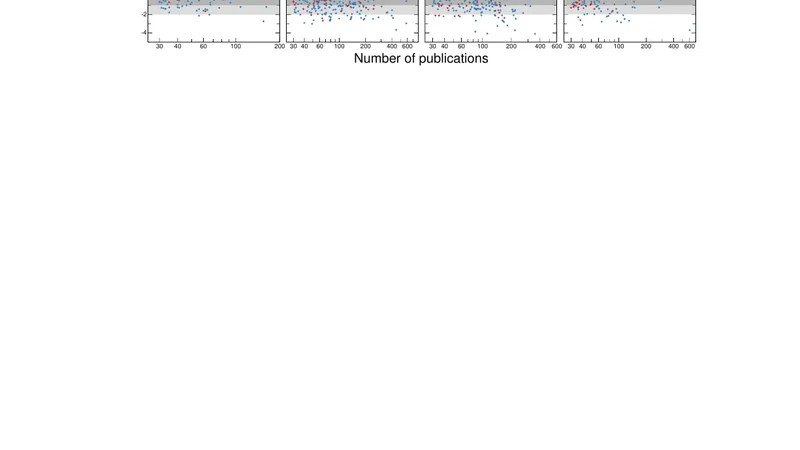
Second, they propose that in disciplines where pursuing an academic career entails greater personal and professional risk—measured by longer post‑doctoral periods, lower rates of conversion to tenure‑track positions, and longer average times to promotion—female faculty who remain in academia tend to produce a higher proportion of high‑impact work. “Career risk” is quantified using three metrics: average post‑doc duration, tenure‑track conversion probability, and median time to promotion. When these risk scores are plotted against gender‑specific citation metrics, a striking pattern emerges: in high‑risk fields such as computer science and electrical engineering, women’s papers receive significantly more citations on average (23.5 vs. 18.2 citations per paper for men, p < 0.05) and women contribute a larger share of the top‑10 % most‑cited articles (1.8 × the male share). The authors interpret this as evidence that women who survive the high‑risk pipeline are a highly self‑selected group that adopts a “quality‑over‑quantity” strategy, focusing their limited opportunities on research that yields greater scholarly impact.
Multivariate models that include both resource demand and career risk confirm that each factor independently predicts gender gaps in productivity and impact; interaction terms are not statistically significant, suggesting that the two mechanisms operate additively rather than synergistically.
The paper also provides a longitudinal view of gender representation across the seven fields from the early 1990s to 2020. While overall female faculty representation has risen, the increase is uneven: biology and earth‑science now exceed 30 % women, whereas physics and engineering remain below 10 %. These trends mirror the underlying resource and risk profiles identified in the quantitative analyses.
Limitations acknowledged by the authors include the treatment of author order (which varies by discipline) and the absence of personal variables such as caregiving responsibilities that could confound the observed patterns. They recommend future work that incorporates detailed contribution statements, longitudinal career tracking, and experimental policy interventions to more precisely isolate causal mechanisms.
In conclusion, the study advances our understanding of gender disparities in STEM academia by linking them to concrete, field‑specific structural factors rather than attributing them solely to cultural bias. The findings imply that policy solutions must be tailored: increasing equitable access to research funds in high‑resource disciplines and offering more stable, low‑risk career pathways (e.g., longer‑term contracts, transparent promotion criteria) in high‑risk fields could help close both the productivity and impact gaps. By aligning institutional incentives with the distinct challenges of each discipline, universities and funding agencies can make more effective progress toward gender parity at the faculty level.
Comments & Academic Discussion
Loading comments...
Leave a Comment