Hadwigers conjecture for graphs with infinite chromatic number
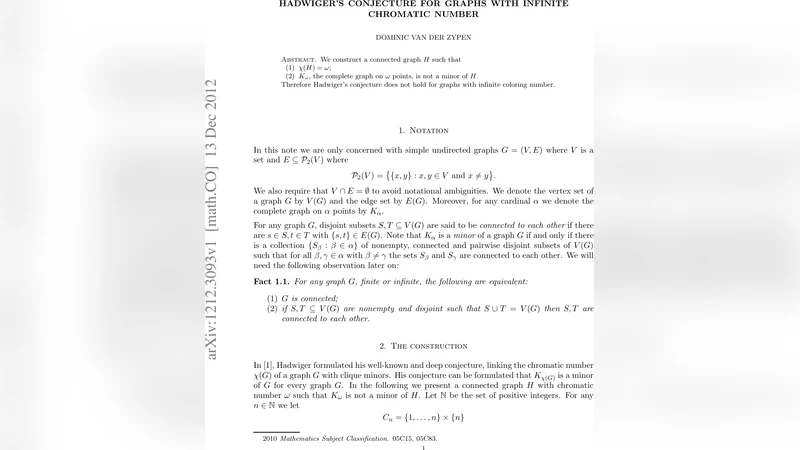
We construct a connected graph H such that (1) \chi(H) = \omega; (2) K_\omega, the complete graph on \omega points, is not a minor of H. Therefore Hadwiger’s conjecture does not hold for graphs with infinite coloring number.
💡 Research Summary
The paper addresses the natural question of whether Hadwiger’s conjecture, a cornerstone of finite graph theory, can be extended to graphs whose chromatic number is infinite. Hadwiger’s conjecture states that for any finite graph G, if the chromatic number χ(G) is at least t, then G contains the complete graph K_t as a minor. While the conjecture remains open for finite graphs, the authors demonstrate that a straightforward generalisation to infinite graphs fails dramatically.
The authors construct a concrete, connected graph H with the following properties: (1) χ(H)=ℵ₀, i.e., the smallest number of colours needed to properly colour H is countably infinite; (2) the countably infinite complete graph K_ℵ₀ is not a minor of H. The construction proceeds by partitioning the vertex set into countably many “clusters’’ indexed by natural numbers. Formally, V(H)=⋃_{n∈ℕ}({n}×ℕ). For each fixed n, the set {n}×ℕ induces a copy of the infinite complete graph K_ℵ₀; edges are added between every pair of vertices within the same cluster. Between distinct clusters the authors insert only a single “bridge’’ edge, for example connecting (n,0) to (n+1,0). Consequently, the clusters form a linear chain, each internally a dense infinite clique, while inter‑cluster connectivity is extremely sparse.
To prove χ(H)=ℵ₀, the authors argue that any finite colour set cannot colour H. Within any single cluster a proper colouring of K_ℵ₀ already requires infinitely many colours, because each vertex is adjacent to every other vertex in the same cluster. Moreover, the solitary bridge edges prevent the reuse of colours across different clusters: a colour used on a vertex of one cluster would conflict with the unique neighbour in the adjacent cluster. Hence an infinite palette is indispensable, and a straightforward ℵ₀‑colouring (assign colour i to vertex (n,i)) shows that ℵ₀ colours suffice.
The non‑existence of a K_ℵ₀ minor is established by analysing the definition of a minor in the infinite setting. To obtain K_ℵ₀ as a minor, one must select ℵ₀ pairwise‑disjoint connected subgraphs of H, contract each to a single vertex, and ensure that every pair of contracted vertices is joined by an edge. In H, any two distinct clusters are linked by at most one edge (the bridge). Consequently, if we try to assign each vertex of K_ℵ₀ to a distinct cluster, the required edges between the contracted vertices are missing: the bridge provides only a single adjacency, far short of the complete adjacency required. Even more elaborate selections of subgraphs cannot overcome this bottleneck because any subgraph that spans more than one cluster inevitably contains the bridge, and the bridge can be used only once per pair of clusters. Thus no collection of ℵ₀ disjoint connected subgraphs can be contracted to yield K_ℵ₀, proving that K_ℵ₀ is not a minor of H.
This construction furnishes a clean counterexample to the infinite‑chromatic‑number version of Hadwiger’s conjecture. It shows that, unlike the finite case, a high (indeed infinite) chromatic number does not guarantee the presence of a large complete minor. The result forces a reevaluation of how chromatic number and minor containment interact in the infinite realm.
In the discussion, the authors highlight several implications. First, the failure of the conjecture in the infinite setting underscores a fundamental structural divergence between finite and infinite graphs. Second, the example suggests that additional constraints—such as local finiteness (each vertex having finite degree), bounded degree, or specific combinatorial regularities—might be necessary to recover a Hadwiger‑type statement for infinite graphs. The paper proposes future research directions, including (a) identifying classes of infinite graphs for which a modified Hadwiger conjecture holds, (b) exploring the role of set‑theoretic axioms (e.g., the continuum hypothesis) in the existence of large minors, and (c) developing new tools that blend infinite graph theory with descriptive set theory to better understand minor‑closed properties in the infinite context.
Overall, the paper delivers a concise yet powerful negative answer to the question of extending Hadwiger’s conjecture to graphs with infinite chromatic number, while opening a rich avenue for further investigation into the delicate interplay between colouring and minor containment beyond the finite world.
Comments & Academic Discussion
Loading comments...
Leave a Comment