The application of cause effect graph for the college placement process
This paper presents a case study on the application of cause effect graph for representing the college placement process. This paper begins with giving a brief overview of the college placement process which will serve as the basis for developing the cause effect graph and the decision table for the same in a systematic manner. Finally, it concludes with the design of test cases thus giving a complete and clear representation about the application of cause-effect graph in the software testing domain.
💡 Research Summary
The paper presents a case study that applies the Cause‑Effect Graph (CEG) technique to the college placement process, demonstrating how this formal testing method can be used to model complex business rules, generate decision tables, and derive systematic test cases. The authors begin by outlining the typical workflow of a college placement system, which includes student application submission, eligibility verification (academic performance, major suitability, and prerequisite qualifications), company‑student matching, interview scheduling, final offer issuance, and post‑placement management such as re‑application restrictions. Each of these steps is broken down into a set of input conditions (the “causes”) and expected system responses (the “effects”).
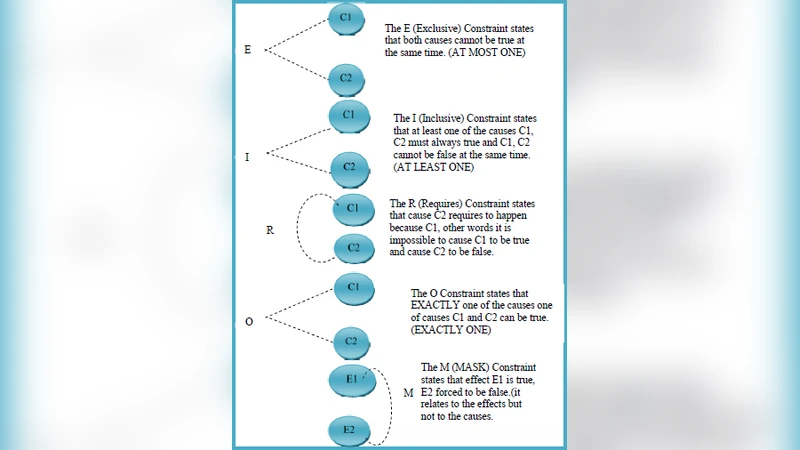
Using these identified causes, the authors construct a CEG where logical operators (AND, OR, NOT) and constraints (mutual exclusion, inclusion) explicitly capture the relationships among conditions. For instance, the graph encodes that both “minimum GPA met” AND “major matches company requirement” must be true before a “company proposal is sent” can occur, while a “failed interview” triggers a “re‑application restriction” via a NOT relationship. The graphical representation makes implicit business policies visible and facilitates reasoning about all possible condition combinations.
From the completed graph, a decision table is derived. Each row corresponds to a unique combination of cause truth values, and each column represents a potential effect. Redundant rows are eliminated through standard minimization techniques, resulting in a compact set of test scenarios that achieve full condition coverage and decision coverage. In the study, six primary causes lead to 64 theoretical combinations, but only twelve essential test cases are needed to cover all logical paths.
The authors then map these twelve cases to concrete test data (student records, company requirements, interview outcomes) and execute them against a prototype placement management system. All observed outcomes match the expected effects, confirming that the CEG‑derived test suite can detect specification violations early and reduce the risk of missing edge cases.
The paper highlights several contributions: (1) it demonstrates the feasibility of applying CEG to an educational‑administrative domain rather than traditional hardware or pure software systems; (2) it shows how CEG can be tightly integrated with decision tables to produce a minimal yet comprehensive test set; (3) it provides traceability from high‑level requirements through the graph to executable test cases, improving communication among stakeholders (students, faculty, recruiters, and placement officers).
Limitations are also discussed. The graph construction is manual and may become labor‑intensive for larger, more intricate systems. The study lacks integration with automated CEG generation tools, and it does not present quantitative metrics such as defect detection rate or cost savings compared to conventional testing approaches. Consequently, while the methodology is sound, its scalability and economic impact remain to be validated.
Future work suggested includes developing domain‑specific languages or modeling tools to automate CEG creation, linking the graph‑based test design with existing test‑management platforms, and conducting broader empirical studies to measure efficiency gains. In conclusion, the paper successfully applies cause‑effect graphing to the college placement process, offering a clear, repeatable pathway from requirement analysis to test case generation, and thereby contributing a valuable example of model‑based testing in a real‑world, non‑technical domain.
Comments & Academic Discussion
Loading comments...
Leave a Comment