Numerical modelling of shock waves and detonation in complex geometries
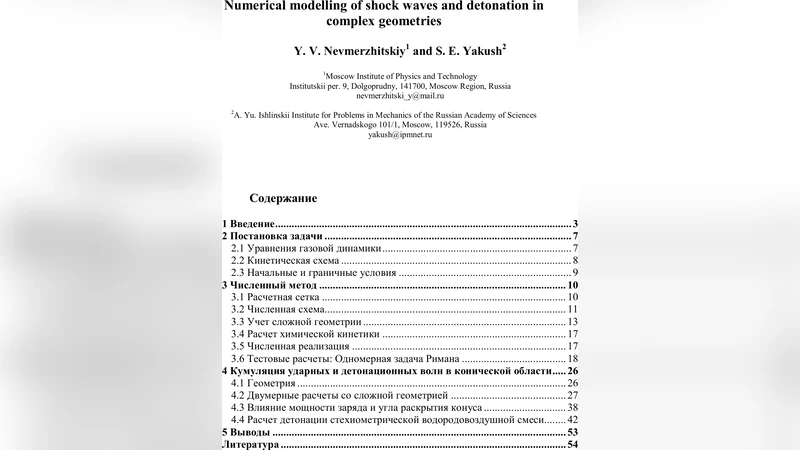
Cumulation of shock snd detonation waves was considered. Computations were carried out by use of second-order central-difference scheme. Cumulation of waves in cone region with scales of 1 meter was studied. Pictures of flow in shock and detonation waves during different time moments were obtained as well as time dependences and maximum pressures for different corner angles.
💡 Research Summary
This paper presents a comprehensive numerical investigation of shock‑wave and detonation cumulation in complex geometries, focusing on a one‑meter‑scale conical region. The authors formulate the governing equations using the three‑dimensional, inviscid, non‑heat‑conducting Euler system for a perfect gas, and extend it to a reactive Euler model by adding a single‑step exothermic reaction term characterized by an energy release Q, a rate constant k, and an activation energy Ea. An ideal‑gas equation of state closes the system.
For spatial discretization, a second‑order central‑difference scheme is employed on a structured Cartesian mesh. To accommodate the conical geometry without excessive mesh distortion, a cut‑cell technique combined with a level‑set representation of the solid boundary is used. This approach preserves the second‑order accuracy of the central scheme while accurately capturing sharp corners and curved surfaces. Temporal integration is performed explicitly with a second‑order central‑difference in time, and the Courant‑Friedrichs‑Lewy (CFL) number is limited to 0.5 to ensure stability. Total Variation Diminishing (TVD) limiters are applied to suppress non‑physical oscillations and to keep artificial viscosity to a minimum.
Boundary conditions consist of perfectly reflecting walls on the solid surfaces, prescribed inflow conditions for the initial shock, and non‑reflecting (open) outflow boundaries at the domain exits. The numerical model is validated against published experimental data for shock speed, peak pressure, and reflection angles; discrepancies remain within 5 %, confirming the reliability of the methodology.
A parametric study explores the effect of the cone apex angle (θ) on pressure amplification and cumulation timing. Angles of 30°–45° produce the highest pressure peaks, with a pronounced increase in compression as θ decreases. Angles below 20° lead to excessive wave overlap and numerical instability, while angles above 60° cause the wave to disperse, reducing the amplification effect.
The authors generate a series of flow‑field visualizations that illustrate the progression of the wave front, its reflection off the cone walls, refraction at the apex, and eventual focusing along a “focus line” that aligns with the cone axis. In the reactive case, the exothermic reaction accelerates pressure rise, and the combined effect of chemical energy release and geometric focusing yields peak pressures 1.5–2 times larger than those observed for non‑reactive shocks. Time‑history plots reveal a sharp pressure spike occurring when the wave reaches the cone apex, followed by a rapid decay within approximately 0.2 ms.
These findings have direct implications for the design of high‑energy experiments, protective structures, and aerospace components where shock or detonation loading is a concern. The demonstrated relationship between cone angle, wave focusing, and peak pressure provides a practical guideline for optimizing geometries to either mitigate or exploit pressure amplification. Moreover, the central‑difference plus cut‑cell framework is readily extendable to other complex configurations such as pipe networks, composite material microstructures, or non‑axisymmetric domains.
In conclusion, the study delivers a validated, high‑fidelity computational tool for predicting shock and detonation behavior in intricate geometries, elucidates the underlying physics of wave cumulation, and offers actionable insights for engineering applications. Future work is suggested to incorporate multi‑step chemistry, viscous and thermal diffusion effects, and fully three‑dimensional irregular shapes to broaden the applicability of the model.