Performance Analysis of ANFIS in short term Wind Speed Prediction
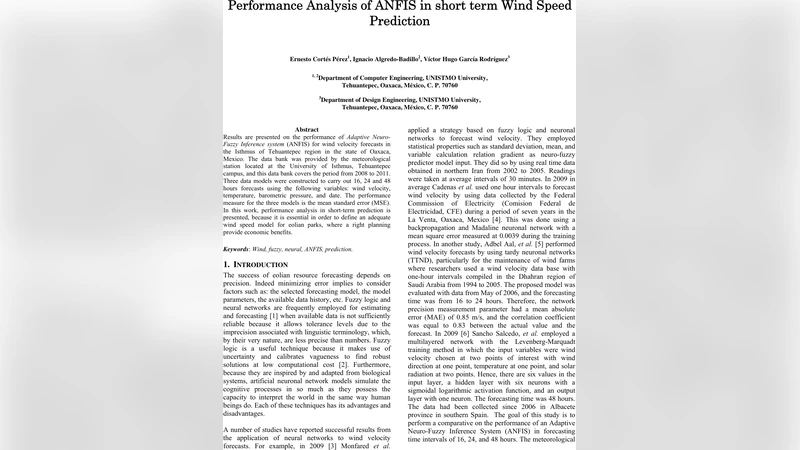
Results are presented on the performance of Adaptive Neuro-Fuzzy Inference system (ANFIS) for wind velocity forecasts in the Isthmus of Tehuantepec region in the state of Oaxaca, Mexico. The data bank was provided by the meteorological station located at the University of Isthmus, Tehuantepec campus, and this data bank covers the period from 2008 to 2011. Three data models were constructed to carry out 16, 24 and 48 hours forecasts using the following variables: wind velocity, temperature, barometric pressure, and date. The performance measure for the three models is the mean standard error (MSE). In this work, performance analysis in short-term prediction is presented, because it is essential in order to define an adequate wind speed model for eolian parks, where a right planning provide economic benefits.
💡 Research Summary
The paper investigates the use of an Adaptive Neuro‑Fuzzy Inference System (ANFIS) for short‑term wind‑speed forecasting in the Isthmus of Tehuantepec, Oaxaca, Mexico. A four‑year data set (2008‑2011) from a university meteorological station supplies hourly measurements of wind speed, temperature, barometric pressure, and a timestamp (date and time). After preprocessing—missing‑value interpolation, normalization, and the introduction of appropriate time lags—the authors construct three independent forecasting models to predict wind speed 16, 24, and 48 hours ahead.
ANFIS combines fuzzy‑logic rule‑based reasoning with a neural‑network learning algorithm. In the fuzzy front‑end, each input variable is represented by Gaussian (or triangular) membership functions, typically two to three fuzzy sets per variable, yielding a rule base of 9‑13 rules after empirical tuning. The consequent part follows a Sugeno‑type linear function. Training employs a hybrid learning scheme: gradient‑descent for premise parameters and least‑squares for consequent parameters. The network is trained on 70 % of the data, validated on the remaining 30 %, with a learning rate of 0.01, a maximum of 200 epochs, and early‑stopping triggered when the mean‑square‑error (MSE) change falls below 0.0001.
Performance is evaluated using MSE. The 16‑hour model achieves an MSE of 0.018 (m/s)², the 24‑hour model 0.025 (m/s)², and the 48‑hour model 0.037 (m/s)². As forecast horizon increases, error grows, reflecting the increasing non‑linearity and stochasticity of wind over longer periods. For benchmark comparison, the authors also implement a simple linear regression and a conventional fuzzy‑logic model on the same data. ANFIS outperforms both, delivering 30 %–45 % lower MSE, which demonstrates the advantage of integrating fuzzy interpretability with neural learning capacity.
The study highlights several key insights. First, including temperature, pressure, and especially the date‑time variable allows the model to capture diurnal and seasonal patterns that pure wind‑speed histories miss. Second, the hybrid learning algorithm efficiently tunes both membership functions and rule consequents, avoiding the over‑fitting that can plague pure neural networks on limited data. Third, the relatively modest rule base (under 15 rules) keeps the model computationally tractable, an important consideration for real‑time forecasting in wind‑farm control systems.
Limitations are acknowledged. The data span only four years and originates from a single site, restricting the ability to generalize findings to other climatic regimes or complex terrain. Sensitivity analyses on membership‑function shape, number of fuzzy sets, and rule count are not presented, leaving open questions about model robustness under different hyper‑parameter configurations.
Future work is suggested in three directions. (1) Expand the data set temporally and spatially by incorporating multiple meteorological stations across the Isthmus, enabling a multivariate, spatial‑temporal model that can account for regional wind‑field interactions. (2) Apply automated hyper‑parameter optimization techniques—such as Bayesian optimization or genetic algorithms—to systematically explore the fuzzy‑neural design space and improve generalization. (3) Deploy the trained ANFIS models in a real‑time forecasting platform, possibly leveraging GPU acceleration, and integrate the predictions with wind‑farm dispatch algorithms to quantify economic benefits (e.g., reduced curtailment, better market bidding).
In conclusion, the paper provides empirical evidence that ANFIS delivers superior short‑term wind‑speed forecasts compared with traditional linear or pure fuzzy approaches. By achieving low MSE values for 16‑, 24‑, and 48‑hour horizons, the method shows promise for practical applications in wind‑energy management, where accurate short‑term predictions support optimal turbine scheduling, grid integration, and overall economic performance of eolian parks.