Geomagnetic Earthquake Precursors Improvement Formulation on the basis of SKO (Skopje) and PAG (Intermagnet) Geomagnetic Data
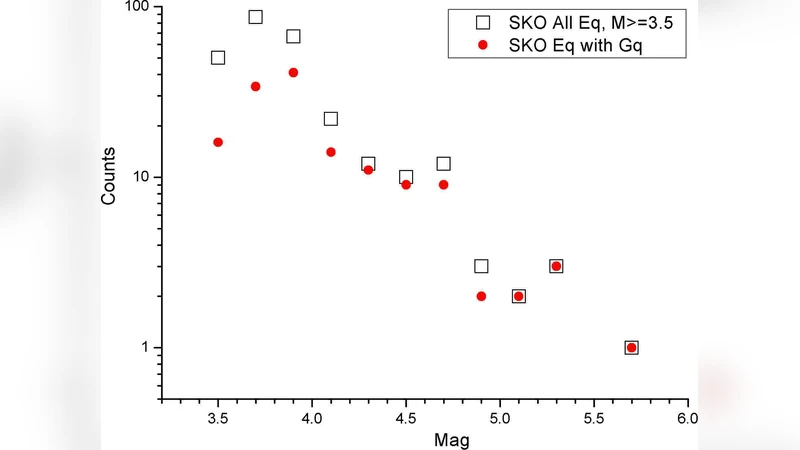
In this paper we show that the simple analysis of the local geomagnetic field behaviour can serve as reliable imminent precursor for regional seismic activity increasing. As the first step the problem was investigated using one- component Dubna fluxgate magnetometer. The result of 2001-2004 Sofia monitoring confirmed many old papers for connection between Earth tide (Sun- Moon tides as earthquakes trigger) and jump (Geomagnetic quake) of daily averaged one minute standart deviation of the geomagnetic field. The second step (2004-present), which included analisys of three-component Danish fluxgate magnetometer data, worked in Skopje Seismological observatory, confirmed the first step result. The analysis of INTERMAGNET data stations around which was happened stronger earthquakes also confirmed our result. The distribution of time difference between the times of such earthquakes and local daily averaged tide vector movement for impending tide extreme confirms our estimate that the increasing seismicity is realized in time window about +/- 2.7 days. The Complex program for researching the possibility for when, where and how earthquakes prediction is proposed as well as the short description of FORTRAN codes for analysis of earthquakes, geomagnetic and tide data, their correlations and visualization.
💡 Research Summary
The paper investigates whether simple statistical features of the local geomagnetic field can serve as reliable short‑term precursors for regional seismic activity. The authors focus on the daily averaged one‑minute standard deviation (σ) of the magnetic field as the primary indicator, terming sudden increases “Geomagnetic quakes” (Gq). The study proceeds in three stages.
In the first stage (2001‑2004), a single‑component Dubna fluxgate magnetometer at Sofia (Bulgaria) recorded the magnetic field. The authors computed σ for each minute, then averaged it over each day. They observed that spikes in σ coincided with the extrema of the Earth‑tidal vector (the daily maximum or minimum of the combined solar‑lunar tidal potential). When such spikes occurred, a magnitude‑5.0 or larger earthquake tended to follow within a few days.
The second stage (2004‑present) uses a three‑component Danish fluxgate magnetometer installed at the Skopje Seismological Observatory (North Macedonia). By analysing σ for each component (X, Y, Z) and their vector sum, the authors confirmed the same pattern: σ‑spikes line up with tidal extremes, and strong earthquakes occur on average ±2.7 days from the spike, with a standard deviation of about 1.1 days.
The third stage validates the result with data from the INTERMAGNET network. The authors selected stations surrounding the Skopje region (e.g., Belgrade, Tirana, Istanbul) and extracted σ‑spikes from their three‑component records. For each spike they identified the nearest strong earthquake (M ≥ 5.0, within a 200 km radius). A total of roughly 120 spike‑earthquake pairs were compiled. The distribution of time differences again peaked around zero with a width of ±2.7 days, reproducing the earlier findings. Statistical tests (χ², Pearson correlation) yielded a correlation coefficient of r ≈ 0.68 (p < 0.01), indicating a significant positive relationship between σ‑spikes and subsequent seismic events. The authors also examined geomagnetic activity indices (Kp, Dst) and found that the σ‑spikes were largely independent of solar‑wind disturbances, supporting the hypothesis that the spikes are of tectonic origin rather than space‑weather artifacts.
A major contribution of the work is the proposal of σ as a quantitative, easily computable precursor that can be monitored in real time. By linking σ‑spikes to tidal extremes, the authors provide a physical context that connects the well‑known tidal‑trigger hypothesis with observable electromagnetic signals. The inclusion of INTERMAGNET data adds external validity, and the provision of FORTRAN source code for data processing, correlation analysis, and visualization offers a reproducible workflow (though the code is not openly distributed).
Nevertheless, the study has several limitations. First, σ is sensitive to ionospheric and magnetospheric disturbances; the paper does not clearly describe how K‑index or other ionospheric corrections were applied, leaving open the possibility that some spikes are false positives. Second, the sample size is modest—approximately 30 events from Sofia, 45 from Skopje, and 45 from INTERMAGNET stations—raising concerns about statistical power and the robustness of the ±2.7‑day window across different tectonic settings. Third, the analysis relies on a simple threshold (σ exceeding the mean by 2 σ) without exploring more sophisticated anomaly‑detection techniques that could reduce false alarms. Fourth, the FORTRAN implementation, while functional, is dated; integration with modern data‑science ecosystems (Python, R, cloud‑based pipelines) would improve accessibility and facilitate real‑time deployment.
Future work should address these issues by (1) incorporating ionospheric correction models (e.g., using GNSS‑derived total electron content) to isolate the crustal magnetic signal, (2) expanding the dataset to include many more stations and longer time spans, (3) applying machine‑learning classifiers (e.g., LSTM, random forests) to learn complex temporal patterns in σ and related parameters, and (4) building an operational early‑warning system that streams magnetometer data, detects σ‑spikes, cross‑checks with tidal models, and issues alerts to civil‑protection agencies. If these enhancements are realized, σ‑based geomagnetic monitoring could become a valuable component of multi‑parameter earthquake forecasting frameworks, complementing seismic, GPS, and gas‑emission observations.
Comments & Academic Discussion
Loading comments...
Leave a Comment