A characterization of b-perfect graphs
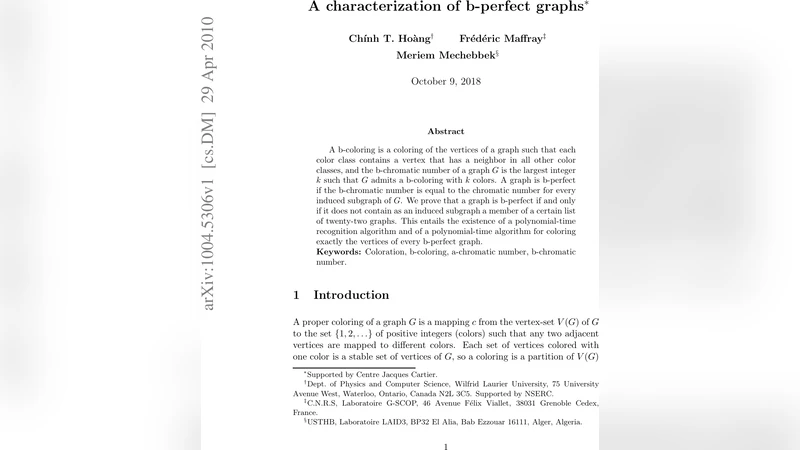
A b-coloring is a coloring of the vertices of a graph such that each color class contains a vertex that has a neighbor in all other color classes, and the b-chromatic number of a graph $G$ is the largest integer $k$ such that $G$ admits a b-coloring with $k$ colors. A graph is b-perfect if the b-chromatic number is equal to the chromatic number for every induced subgraph of $G$. We prove that a graph is b-perfect if and only if it does not contain as an induced subgraph a member of a certain list of twenty-two graphs. This entails the existence of a polynomial-time recognition algorithm and of a polynomial-time algorithm for coloring exactly the vertices of every b-perfect graph.
💡 Research Summary
The paper addresses the problem of characterizing b‑perfect graphs, a class defined through the notion of b‑coloring. A b‑coloring of a graph G is a proper vertex coloring with k colors such that each color class contains a vertex (called a b‑vertex) adjacent to at least one vertex of every other color class. The largest integer k for which G admits a b‑coloring is the b‑chromatic number φ(G). A graph is b‑perfect if, for every induced subgraph H of G, the b‑chromatic number equals the ordinary chromatic number χ(H). While several specific families (trees, complete bipartite graphs, etc.) were known to be b‑perfect, a complete structural description for arbitrary graphs had been missing.
The main contribution is a forbidden‑induced‑subgraph characterization: a graph G is b‑perfect if and only if it does not contain any member of a specific list of twenty‑two graphs as an induced subgraph. The list includes small cycles (C₅, C₆), complete graphs (K₄, K₅) and their slight variations, as well as more intricate configurations where several cliques are glued together through a common vertex or where a “false b‑vertex” pattern forces φ(H) > χ(H). Each graph in the list is minimal with respect to the property that its presence forces a violation of b‑perfectness; removing any vertex eliminates the violation.
The proof proceeds by contradiction. Assuming a minimal counterexample M (a smallest graph that is not b‑perfect yet avoids all twenty‑two forbidden subgraphs), the authors analyze the structure of M using classic decomposition tools: homogeneous sets, separating sets, and degree constraints. If M contains a homogeneous set, it can be contracted to a smaller graph while preserving the b‑perfectness condition, contradicting minimality. If no homogeneous set exists, M must be 2‑connected and satisfy certain degree bounds; the authors then show that such a graph inevitably contains one of the forbidden configurations, again a contradiction. A series of lemmas formalize these arguments, establishing that the absence of the forbidden subgraphs forces φ(H)=χ(H) for every induced subgraph H, i.e., M must be b‑perfect.
From the structural theorem, two algorithmic corollaries follow. Because the forbidden list consists of a constant number of fixed‑size graphs, testing whether a given graph G contains any of them as an induced subgraph can be performed in polynomial time (the naive approach runs in O(n⁶), but more refined techniques reduce it to O(n⁴) or better). Hence, recognizing b‑perfect graphs is in P. Moreover, the decomposition used in the proof yields a constructive coloring algorithm: once G is confirmed to be b‑perfect, the recursive contraction of homogeneous sets and the handling of separating structures produce a proper coloring with exactly χ(G) colors, which by definition equals φ(G). This algorithm also runs in polynomial time, providing the first efficient method to compute the b‑chromatic number for the whole class of b‑perfect graphs.
The paper concludes with several open directions. One question is whether the list of twenty‑two forbidden graphs can be reduced or replaced by an equivalent, perhaps more natural, set. Another line of inquiry concerns extensions: identifying larger graph classes for which the b‑chromatic number can be computed in polynomial time using similar structural insights. Finally, practical implementation issues—optimizing the detection of the forbidden subgraphs and improving the constants in the coloring algorithm—are highlighted as topics for future work. In summary, the authors deliver a complete forbidden‑subgraph characterization of b‑perfect graphs and translate this structural insight into concrete, polynomial‑time recognition and coloring algorithms, thereby advancing both the theory and practice of graph coloring.
Comments & Academic Discussion
Loading comments...
Leave a Comment