A General Framework for Distributed Vote Aggregation
We present a general model for opinion dynamics in a social network together with several possibilities for object selections at times when the agents are communicating. We study the limiting behavior
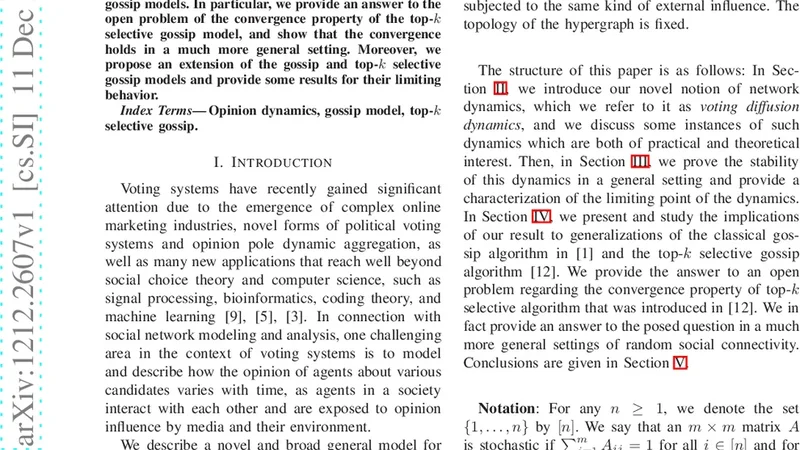
We present a general model for opinion dynamics in a social network together with several possibilities for object selections at times when the agents are communicating. We study the limiting behavior of such a dynamics and show that this dynamics almost surely converges. We consider some special implications of the convergence result for gossip and top-$k$ selective gossip models. In particular, we provide an answer to the open problem of the convergence property of the top-$k$ selective gossip model, and show that the convergence holds in a much more general setting. Moreover, we propose an extension of the gossip and top-$k$ selective gossip models and provide some results for their limiting behavior.
💡 Research Summary
The paper introduces a unified mathematical framework for opinion dynamics in a distributed setting, where a population of agents repeatedly exchanges information over a social network. The authors formalize the act of “object selection” – the rule that determines which piece(s) of opinion are communicated during each interaction – and show that a wide variety of existing models (standard gossip, selective gossip, top‑k gossip, etc.) can be expressed as special cases of this framework. By modeling the evolution of the agents’ opinion vectors as a stochastic process on a graph, they prove an almost‑sure convergence theorem: under mild connectivity conditions on the underlying communication graph and provided the selection mechanism continues to propagate information throughout the network, the state of every agent converges with probability one to a common value. This common limit is the weighted average of the initial opinions, establishing a conserved quantity for the whole system.
A major contribution is the resolution of an open problem concerning the top‑k selective gossip model. In that model each agent, at each communication round, shares only its k most “important” opinions (according to a locally defined ranking) with a neighbor. Prior work had only proved convergence for k = 1; the behavior for larger k remained unknown. By embedding the top‑k rule into their general framework and exploiting spectral properties of the graph Laplacian, the authors demonstrate that the process still converges almost surely for any fixed k, as long as the selection rule preserves sufficient graph connectivity (e.g., the induced subgraph remains k‑regular or strongly connected). Moreover, they provide quantitative bounds on the convergence rate, showing that larger k accelerates the decay of opinion disparities.
Beyond these special cases, the paper proposes two extensions. First, a dynamic‑k model where the value of k may change over time, allowing the system to adapt to varying information‑budget constraints. Second, a heterogeneous‑selection model in which different agents employ different selection rules (some full‑gossip, some top‑k, some random subsets). For both extensions the authors re‑derive sufficient conditions guaranteeing almost‑sure convergence, emphasizing that the key requirement is the preservation of a globally strongly‑connected communication pattern over time.
The theoretical results are complemented by extensive simulations on several canonical network topologies (complete graphs, small‑world networks, scale‑free graphs). The experiments confirm the predicted convergence behavior, illustrate how the convergence speed depends on k and on the degree of heterogeneity, and validate the robustness of the sufficient connectivity conditions in realistic, time‑varying settings.
In summary, the work provides a comprehensive and flexible analytical tool for studying distributed vote aggregation and consensus formation. It not only unifies existing gossip‑type models under a single stochastic framework but also settles the convergence question for top‑k selective gossip and opens the door to more realistic, adaptive, and heterogeneous communication protocols in large‑scale networked systems.
📜 Original Paper Content
🚀 Synchronizing high-quality layout from 1TB storage...