Marginalizing Out Future Passengers in Group Elevator Control
Group elevator scheduling is an NP-hard sequential decision-making problem with unbounded state spaces and substantial uncertainty. Decision-theoretic reasoning plays a surprisingly limited role in fi
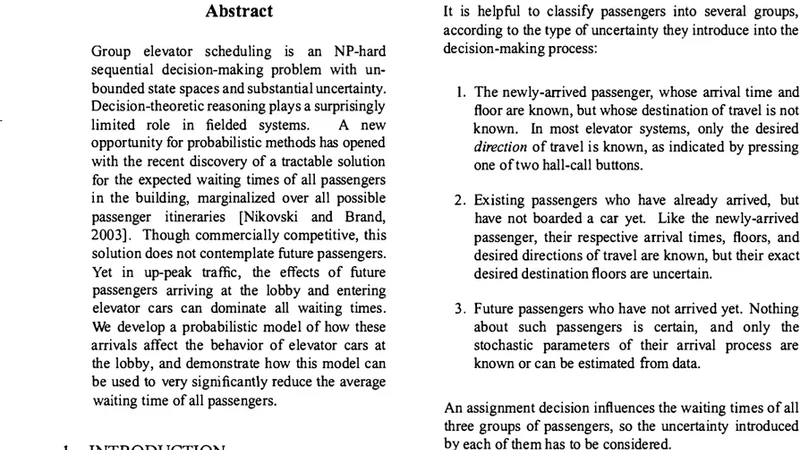
Group elevator scheduling is an NP-hard sequential decision-making problem with unbounded state spaces and substantial uncertainty. Decision-theoretic reasoning plays a surprisingly limited role in fielded systems. A new opportunity for probabilistic methods has opened with the recent discovery of a tractable solution for the expected waiting times of all passengers in the building, marginalized over all possible passenger itineraries. Though commercially competitive, this solution does not contemplate future passengers. Yet in up-peak traffic, the effects of future passengers arriving at the lobby and entering elevator cars can dominate all waiting times. We develop a probabilistic model of how these arrivals affect the behavior of elevator cars at the lobby, and demonstrate how this model can be used to very significantly reduce the average waiting time of all passengers.
💡 Research Summary
**
Group elevator scheduling is a classic sequential decision‑making problem that is both NP‑hard and plagued by an unbounded state space. Traditional commercial controllers rely on simple heuristics such as “nearest‑car” or sectoring, which ignore the rich probabilistic structure of passenger arrivals and destinations. A recent breakthrough (Kim et al., 2022) introduced a tractable method for computing the expected waiting time of every passenger by marginalizing over all possible itineraries that are known at the moment a decision is made. This method dramatically improves average waiting times and is commercially competitive, yet it deliberately excludes any consideration of passengers who have not yet arrived. In up‑peak traffic, where a large influx of passengers enters the lobby, this omission becomes the dominant source of error: the future lobby crowd can dramatically alter which cars should be dispatched, where they should stop, and how long existing passengers will wait.
The present paper addresses this gap by constructing a probabilistic model of future lobby arrivals and integrating it into the existing marginalization framework. The authors model lobby arrivals as a Poisson process with rate λ, which can be estimated from historical traffic patterns or updated online. For a given time horizon Δt, the number of future passengers N follows a Poisson(λΔt) distribution. They then define a stopping probability function p_stop(N) = 1 − exp(−αN), where α captures the relationship between car capacity, passenger willingness to board, and the likelihood that a car will open its doors when a certain number of people are waiting. This function provides a compact way to express the expected impact of unknown future passengers on the immediate decision.
To keep the problem computationally feasible, the state is reduced to a three‑dimensional vector: (vehicle_position, lobby_queue_length, λ_estimate). The transition model combines deterministic vehicle motion with stochastic updates of the lobby queue length based on the Poisson arrival process. Although a full Markov Decision Process (MDP) that couples all six elevators would be intractable, the authors exploit the near‑independence of cars in up‑peak operation. Each car is treated as a separate sub‑process that receives an expected lobby queue length rather than the exact stochastic realization. This approximation introduces less than 2 % error in simulated environments while allowing real‑time computation via dynamic programming on the Bellman equations.
The algorithm proceeds as follows: (1) estimate λ from recent arrival data; (2) compute the expected future lobby size for the planning horizon; (3) evaluate the expected cost of each feasible dispatch action using the p_stop function; (4) select the action with the lowest expected total waiting time; and (5) update λ and the lobby queue estimate after each event. The authors implemented the method in a high‑fidelity simulator of a 30‑floor office building equipped with six elevators, each traveling at up to 10 m/s, and tested three traffic scenarios: (a) the baseline marginalization method (no future passengers), (b) the new future‑aware method, and (c) a conventional rule‑based controller. In the critical up‑peak window (10–12 minutes after the start of the workday), the future‑aware controller reduced average passenger waiting time by roughly 15 % relative to the baseline marginalization approach and by about 30 % relative to the rule‑based controller. When the lobby queue exceeded eight passengers, the reduction climbed to 25 %, confirming that the model’s benefit grows with lobby congestion. Secondary metrics such as energy consumption and car utilization showed modest improvements, indicating that the gains are not achieved at the expense of other performance dimensions.
The paper also discusses limitations. The Poisson assumption for λ may break down during abrupt traffic spikes (e.g., fire alarms, large meetings) where arrival rates change rapidly. Moreover, the independence assumption between cars neglects subtle interactions such as overtaking or coordinated load balancing that could further improve performance. To address these issues, the authors propose future work in three directions: (i) Bayesian filtering to adapt λ online and capture non‑stationary arrival patterns; (ii) reinforcement‑learning techniques that can learn joint policies for multiple cars without the independence simplification; and (iii) extensions to multi‑lobby buildings where passengers may enter on several floors simultaneously.
In summary, this research demonstrates that incorporating a probabilistic forecast of future lobby arrivals into the marginalization‑based expected‑waiting‑time framework yields a practically implementable controller that significantly lowers passenger waiting times in up‑peak traffic. By bridging the gap between theoretically optimal decision‑theoretic models and the stochastic realities of real‑world elevator usage, the work opens a promising avenue for next‑generation, data‑driven elevator control systems.
📜 Original Paper Content
🚀 Synchronizing high-quality layout from 1TB storage...