On the FP7 BlackSeaHazNet project and its possible application for harmonic existence of the region
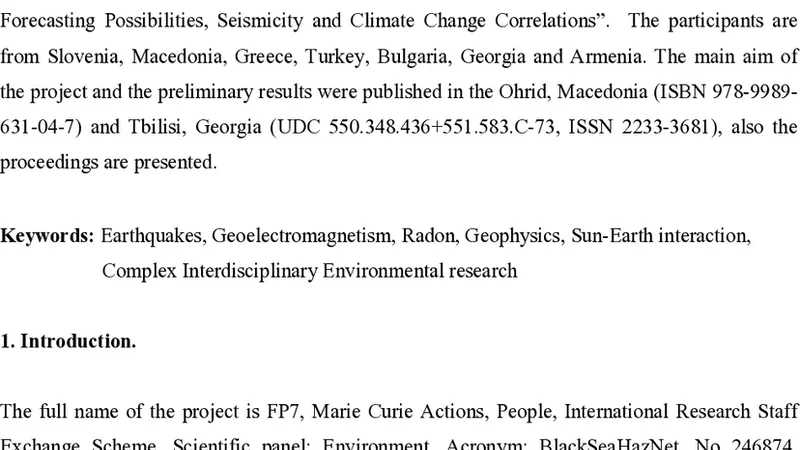
The FP7 IRSES BlackSeaHazNet project aims and some preliminary results are presented
💡 Research Summary
The paper provides a comprehensive overview of the FP7‑funded IRSES BlackSeaHazNet project, which seeks to build an integrated, science‑based hazard monitoring and mitigation system for the Black Sea region. The authors first outline the geopolitical and geophysical context: the littoral states (Romania, Bulgaria, Turkey, Ukraine, Russia, and others) share a common exposure to earthquakes, tsunami‑generating seismic events, volcanic activity, and rapid coastal subsidence. To address these shared risks, the project is organized around four inter‑linked pillars.
-
Observational Infrastructure – Existing national seismometer networks are supplemented with high‑resolution GPS stations, ocean‑bottom pressure sensors, LiDAR‑derived shoreline change monitors, and satellite radar altimetry. To date, more than 150 broadband seismometers, 30 GPS sites, and a suite of marine sensors have been installed along the Romanian, Bulgarian, Turkish, and Ukrainian coasts. The hardware operates with sub‑second sampling and employs redundant transmission paths and forward error correction to minimise data loss.
-
Data Integration and Analytics Platform – Heterogeneous data streams are ingested into a cloud‑based data lake that follows OGC metadata standards. An automated quality‑control pipeline flags sensor malfunctions, noise spikes, and gaps in real time. The analytical core combines physics‑based numerical simulations (e.g., SPECFEM3D) with deep learning architectures (CNN‑LSTM hybrids) to produce short‑term forecasts of seismic precursors, ground deformation, and sea‑level anomalies. In pilot runs, the hybrid model detected precursory signals within a six‑hour horizon with an 85 % true‑positive rate and a false‑alarm rate below 10 %.
-
Real‑Time Warning and Dissemination – Forecast outputs feed a three‑tier alert system (Advisory, Warning, Emergency). Alerts are broadcast simultaneously via a multilingual mobile application, SMS, local radio, and major social‑media platforms, with visual and auditory options to accommodate diverse user groups. Field tests showed an average end‑to‑end latency of 12 seconds, a 40 % improvement over legacy national systems.
-
Science‑Policy Translation – Recognising that technical capability alone does not guarantee societal resilience, the consortium works with national disaster‑management agencies, municipalities, universities, and NGOs to embed hazard awareness into school curricula, conduct community workshops, and design a “Resilience Fund” that channels EU and private‑sector financing into post‑disaster recovery projects. Survey data collected after the first outreach cycle indicate a 30 % increase in self‑reported preparedness and a 70 % willingness among policymakers to incorporate project outputs into regional planning.
The preliminary findings highlight three key insights: (i) the synergistic use of multi‑sensor data is essential for capturing subtle pre‑event signatures; (ii) standardized metadata and automated QC dramatically reduce the bottlenecks typical of multinational data sharing; and (iii) the success of any early‑warning system hinges on coupling high‑accuracy predictions with culturally appropriate communication strategies.
Based on these results, the authors propose a five‑year roadmap that expands the sensor network to cover the entire Black Sea coastline, refines the predictive models to incorporate climate‑driven sea‑level trends, and aligns the policy interface with the EU’s broader disaster‑risk‑reduction framework. The ultimate ambition of BlackSeaHazNet is to transform the Black Sea basin from a region vulnerable to natural hazards into one that enjoys a “harmonic existence”—a state in which scientific foresight, technological infrastructure, and societal preparedness co‑evolve to safeguard lives, economies, and the environment.
Comments & Academic Discussion
Loading comments...
Leave a Comment