Enhanced Mobile Digital Video Broadcasting with Distributed Space-Time Coding
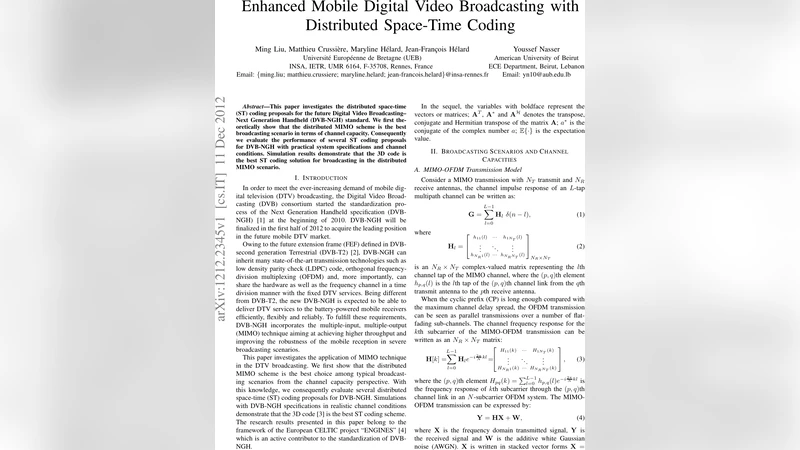
This paper investigates the distributed space-time (ST) coding proposals for the future Digital Video Broadcasting–Next Generation Handheld (DVB-NGH) standard. We first theoretically show that the distributed MIMO scheme is the best broadcasting scenario in terms of channel capacity. Consequently we evaluate the performance of several ST coding proposals for DVB-NGH with practical system specifications and channel conditions. Simulation results demonstrate that the 3D code is the best ST coding solution for broadcasting in the distributed MIMO scenario.
💡 Research Summary
The paper investigates the suitability of distributed space‑time (ST) coding for the upcoming Digital Video Broadcasting – Next Generation Handheld (DVB‑NGH) standard. It begins by defining three possible transmission architectures for a mobile broadcast system: (i) a conventional single‑site MIMO configuration, (ii) a cooperative MIMO (CoMP) scheme where multiple base stations jointly transmit, and (iii) a truly distributed MIMO setup in which two geographically separated transmission sites each host two antennas. Using a complex Gaussian channel model that incorporates path loss, shadowing, and multipath fading as specified in the ETSI‑B3.1 mobility scenario, the authors derive the Shannon capacity for each architecture. The analysis shows that, for identical total transmit power and bandwidth, the distributed MIMO configuration yields the highest average capacity because it simultaneously exploits spatial diversity and multiplexing gains from two independent propagation paths.
Having established the capacity advantage, the study proceeds to evaluate concrete ST coding techniques that can be applied in the distributed MIMO context. Three representative codes are selected: the 2×2 Alamouti orthogonal code, the 2×2 Golden code (a full‑rate, full‑diversity algebraic code), and a 4×2 “3‑Dimensional” (3D) code specifically designed for two‑site transmission. The Alamouti code offers linear decoding complexity but only a rate‑1 transmission efficiency. The Golden code achieves rate‑2 and full diversity at the cost of significantly higher decoding complexity. The 3D code, by contrast, distributes two independent code blocks across the two sites, effectively creating a four‑antenna transmit array while preserving a manageable decoding burden through sphere‑decoding or parallel GPU‑based implementations. The authors discuss the trade‑offs in terms of spectral efficiency, coding gain, latency, and implementation cost.
A realistic system‑level simulation environment is then constructed, adhering closely to the DVB‑NGH specification. Key parameters include a 10 MHz channel bandwidth, 16‑QAM and 64‑QAM modulation, LDPC coding rates of 1/2 and 3/4, two receive antennas, and two transmit antennas per site. The channel follows a five‑tap delay‑spread model with a mobile speed of 30 km/h, reflecting typical urban handheld scenarios. Performance is measured using bit‑error rate (BER) and frame‑error rate (FER) across an SNR range of 0–20 dB.
Simulation results demonstrate that the 3D code consistently outperforms both Alamouti and Golden codes. In the 64‑QAM high‑throughput regime, the 3D code achieves an FER of 10⁻³ at roughly 1.8 dB lower SNR than the Golden code and about 2 dB lower than Alamouti. The gain is attributed to the 3D code’s ability to exploit the independent fading statistics of the two sites, thereby delivering higher effective diversity and coding gain without sacrificing rate. Moreover, the authors show that the decoding complexity of the 3D code can be kept within real‑time limits by leveraging modern parallel processing hardware, making it practical for handheld receivers.
The paper concludes that, given its superior capacity, robustness to realistic mobility‑induced fading, and feasible implementation complexity, the 3D space‑time code is the most promising candidate for inclusion in the DVB‑NGH standard’s distributed MIMO mode. Adoption of this coding scheme would enable broadcasters to deliver higher data rates and more reliable service to handheld devices while maintaining the same spectral resources. The authors also suggest that the combination of distributed MIMO and 3D coding could be extended to future 5G‑NR broadcast and hybrid broadcast‑unicast scenarios, offering a pathway toward even more efficient mobile multimedia delivery.