Bring out your codes! Bring out your codes! (Increasing Software Visibility and Re-use)
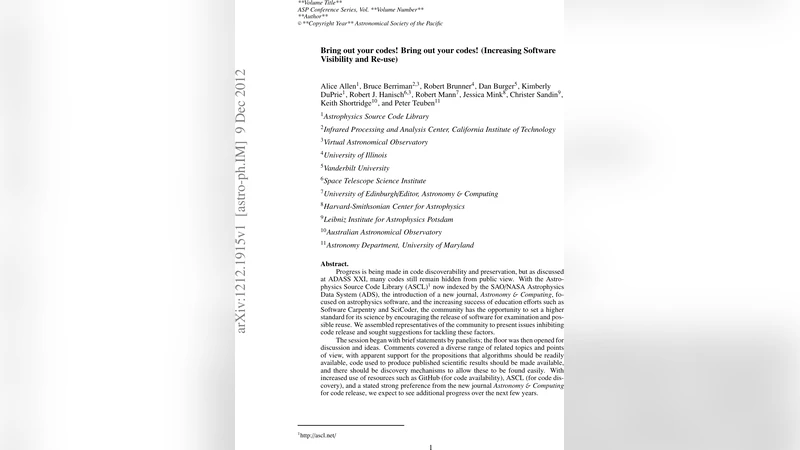
Progress is being made in code discoverability and preservation, but as discussed at ADASS XXI, many codes still remain hidden from public view. With the Astrophysics Source Code Library (ASCL) now indexed by the SAO/NASA Astrophysics Data System (ADS), the introduction of a new journal, Astronomy & Computing, focused on astrophysics software, and the increasing success of education efforts such as Software Carpentry and SciCoder, the community has the opportunity to set a higher standard for its science by encouraging the release of software for examination and possible reuse. We assembled representatives of the community to present issues inhibiting code release and sought suggestions for tackling these factors. The session began with brief statements by panelists; the floor was then opened for discussion and ideas. Comments covered a diverse range of related topics and points of view, with apparent support for the propositions that algorithms should be readily available, code used to produce published scientific results should be made available, and there should be discovery mechanisms to allow these to be found easily. With increased use of resources such as GitHub (for code availability), ASCL (for code discovery), and a stated strong preference from the new journal Astronomy & Computing for code release, we expect to see additional progress over the next few years.
💡 Research Summary
The paper provides a comprehensive overview of the current state and future prospects of software visibility and reuse within the astrophysics community. It begins by highlighting recent infrastructural advances that have improved code discoverability and preservation. The most notable development is the inclusion of the Astrophysics Source Code Library (ASCL) in the SAO/NASA Astrophysics Data System (ADS), which now allows researchers to locate software associated with a given publication through standard bibliographic searches. This integration treats code as a first‑class research output, on par with the paper itself.
A second major milestone is the launch of the journal Astronomy & Computing, dedicated specifically to astrophysics software. The journal’s editorial policy explicitly encourages—or even requires—authors to make the code underlying their results publicly available. By incorporating code availability checks into the peer‑review workflow, the journal creates a strong incentive for authors to share their software and provides a formal venue for citing code.
The paper also discusses the growing impact of education initiatives such as Software Carpentry and SciCoder. These workshops teach astronomers modern development practices—version control with Git, automated testing, documentation standards, and continuous integration—thereby lowering the technical barriers to releasing clean, reusable code. As more early‑career scientists receive this training, a cultural shift toward treating software as a citable scholarly product is expected.
During the ADASS XXI panel, participants identified several persistent obstacles to code release. Uncertainty over copyright and licensing, a lack of confidence in code quality, and the absence of recognition for software contributions in hiring, promotion, and funding decisions were cited as the most significant deterrents. The authors propose concrete remedies: (1) provide standardized license templates and clear institutional guidelines; (2) assign Digital Object Identifiers (DOIs) to software and integrate citation metrics into bibliometric databases; and (3) modify evaluation criteria at journals, funding agencies, and research institutions to explicitly reward software development and sharing.
From a technical standpoint, the paper recommends tighter integration between public code repositories (e.g., GitHub) and discovery services like ASCL. Automated metadata harvesting could ensure that any repository push triggers an update in the ASCL index, dramatically improving discoverability. Including comprehensive README files, usage examples, and test suites would further enhance the reusability of shared code.
In conclusion, while the astrophysics community has made meaningful progress in building the infrastructure needed for open software—through ASCL indexing, a dedicated journal, and targeted training—cultural and incentive‑based challenges remain. The authors argue that sustained effort on both policy and practice fronts will be essential for achieving a higher standard of scientific transparency. Over the next few years, the combined effect of increased GitHub adoption, expanded ASCL coverage, and the strong code‑release stance of Astronomy & Computing is expected to lead to a substantial rise in the availability and reuse of astrophysical software, thereby strengthening reproducibility and accelerating scientific discovery.
Comments & Academic Discussion
Loading comments...
Leave a Comment