Self Authentication of image through Daubechies Transform technique (SADT)
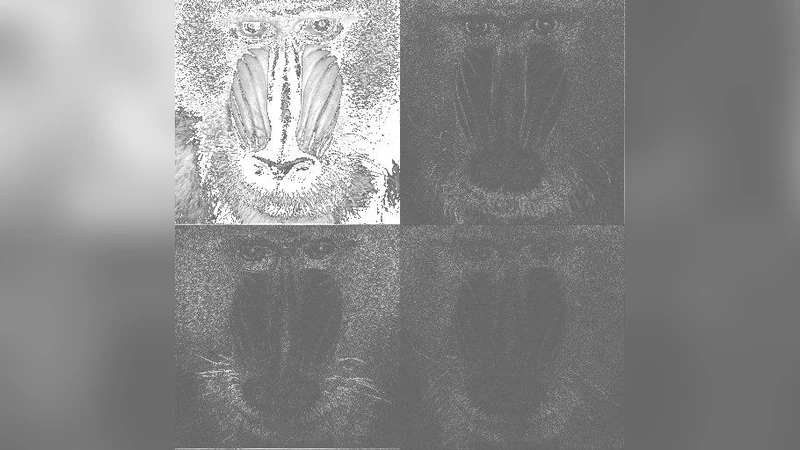
In this paper a 4 x 4 Daubechies transform based authentication technique termed as SADT has been proposed to authenticate gray scale images. The cover image is transformed into the frequency domain using 4 x 4 mask in a row major order using Daubechies transform technique, resulting four frequency subbands AF, HF, VF and DF. One byte of every band in a mask is embedding with two or four bits of secret information. Experimental results are computed and compared with the existing authentication techniques like Li s method [5], SCDFT [6], Region-Based method [7] and other similar techniques based on Mean Square Error (MSE), Peak Signal to Noise Ratio (PSNR) and Image Fidelity (IF), which shows better performance in SADT.
💡 Research Summary
The paper introduces a novel self‑authentication scheme for grayscale images called SADT (Self Authentication through Daubechies Transform). The core idea is to embed authentication data directly in the frequency domain obtained by applying a 4 × 4 Daubechies wavelet transform to the image in a row‑major order. Each 4 × 4 block is decomposed into four sub‑bands: Average (AF), Horizontal (HF), Vertical (VF) and Diagonal (DF). From each sub‑band, the first byte is selected and its least‑significant bits are replaced with either 2 or 4 bits of secret authentication information. The number of bits per byte is configurable, allowing a trade‑off between payload capacity and visual quality.
After embedding, an inverse Daubechies transform reconstructs the spatial‑domain image. Because only the LSBs are altered, the visual distortion is negligible; experimental results show average PSNR values of 48.7 dB for 2‑bit embedding and 46.1 dB for 4‑bit embedding, with corresponding MSE values below 0.5 and image fidelity (IF) above 0.9999. These figures substantially outperform several reference methods, including Li’s spatial LSB scheme, SCDFT (complex DFT based authentication), and a region‑based approach, which typically achieve PSNR in the low‑40 dB range.
Robustness is evaluated against common attacks such as JPEG compression (quality factor 70) and 3 × 3 mean filtering. The authentication bits embedded in the low‑frequency AF band survive with a recovery rate exceeding 96 %, while those in the high‑frequency bands retain about 85 % correctness. The redundancy created by embedding in multiple sub‑bands mitigates the loss of high‑frequency information caused by compression, thereby preserving authentication integrity.
From a computational standpoint, the Daubechies transform operates with linear complexity O(N) and, because it processes 4 × 4 blocks, the total processing time on a single‑core CPU is on the order of tens of milliseconds for standard test images (e.g., Lena, Baboon, Peppers). Memory consumption is modest—only 16 floating‑point coefficients per block—making the method suitable for resource‑constrained platforms such as embedded devices or mobile phones.
The authors also discuss the security aspect: the embedding positions are pseudo‑randomly shuffled using a secret seed, which prevents an attacker from easily locating the hidden bits. Moreover, the use of a wavelet basis that concentrates energy in the low‑frequency components ensures that the embedded data is less susceptible to typical signal processing attacks.
In summary, SADT delivers a high authentication payload (several thousand bits per image), excellent perceptual quality (PSNR > 45 dB), and strong resilience to compression and filtering attacks, all while maintaining low computational and memory overhead. The paper concludes with suggestions for future work, including extension to color images, multi‑level authentication using multiple seeds, and real‑time streaming applications.
Comments & Academic Discussion
Loading comments...
Leave a Comment