A modeling-based evaluation of isothermal rebreathing for breath gas analyses of highly soluble volatile organic compounds
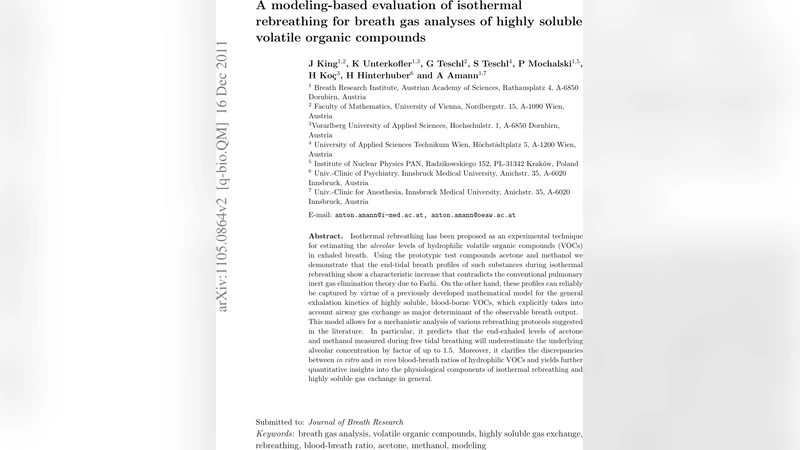
Isothermal rebreathing has been proposed as an experimental technique for estimating the alveolar levels of hydrophilic volatile organic compounds (VOCs) in exhaled breath. Using the prototypic test compound acetone we demonstrate that the end-tidal breath profiles of such substances during isothermal rebreathing show characteristics that contradict the conventional pulmonary inert gas elimination theory due to Farhi. On the other hand, these profiles can reliably be captured by virtue of a previously developed mathematical model for the general exhalation kinetics of highly soluble, blood-borne VOCs, which explicitly takes into account airway gas exchange as major determinant of the observable breath output. This model allows for a mechanistic analysis of various rebreathing protocols suggested in the literature. In particular, it clarifies the discrepancies between in vitro and in vivo blood-breath ratios of hydrophilic VOCs and yields further quantitative insights into the physiological components of isothermal rebreathing.
💡 Research Summary
The paper presents a comprehensive evaluation of isothermal (temperature‑controlled) rebreathing as a method for estimating alveolar concentrations of highly soluble volatile organic compounds (VOCs) such as acetone and methanol. The authors begin by highlighting a fundamental limitation of the classical Farhi model of pulmonary gas exchange, which treats the airways as inert tubes and assumes that end‑tidal breath reflects alveolar gas composition. For highly water‑soluble VOCs, however, extensive wash‑in/wash‑out interactions with the humid airway mucosa cause a substantial gradient between airway and alveolar concentrations, leading to blood‑to‑breath ratios (BBRs) that deviate markedly from the in‑vitro blood‑air partition coefficients (λ_b:air).
To address this discrepancy, the authors employ a previously developed mechanistic model that divides the respiratory system into two functional compartments: a bronchial/mucosal compartment (C_bro) and an alveolar/end‑capillary compartment (C_A). Gas exchange between these compartments is represented by a conductance parameter D, which is essentially zero during quiet tidal breathing (where >90 % of VOC exchange occurs in the conducting airways) and increases with ventilation volume and flow. Temperature dependence is incorporated through a scaling factor z( T̄ ), which adjusts λ_b:air according to the mean airway temperature relative to body temperature. The model yields an explicit expression for the observable BBR:
BBR = C_a / C_measured = z( T̄ )·λ_b:air + r_bro
where r_bro reflects the bronchial ventilation‑perfusion ratio. This formulation predicts that BBR will exceed the in‑vitro λ_b:air when airway temperature is below core temperature, a phenomenon previously reported for ethanol breath testing.
Experimental validation involved five healthy male volunteers performing a single‑cycle rebreathing protocol using a 3 L Tedlar bag heated to 37 ± 1 °C. Real‑time proton‑transfer‑reaction mass spectrometry (PTR‑MS) measured end‑tidal acetone concentrations on a breath‑by‑breath basis, while auxiliary sensors recorded CO₂, O₂, and water vapor to estimate airway temperature and humidity. The data showed a characteristic rise in acetone concentration during the rebreathing phase, reaching values up to 1.5 times higher than those observed during normal tidal breathing. The classical Farhi equation failed to reproduce this rise, whereas the two‑compartment model, with appropriately calibrated D and z, matched the experimental time‑course closely.
Key insights from the modeling and experiments include:
-
Airway‑Dominated Exchange – At rest, the net gas exchange of highly soluble VOCs occurs almost exclusively in the conducting airways; the alveolar contribution is minimal.
-
Ventilation‑Dependent Conductance – The parameter D scales with tidal volume and alveolar ventilation, shifting the locus of exchange toward the alveoli as breathing becomes deeper or faster.
-
Temperature‑Driven BBR Variation – The scaling factor z captures how cooler airway temperatures increase the effective BBR, explaining why measured breath concentrations underestimate arterial levels when the airway is not fully warmed.
-
Rebreathing as a Corrective Technique – By maintaining the rebreathing bag at body temperature, the airway is rapidly warmed, z approaches unity, and D increases, thereby driving the system toward equilibrium between airway and alveolar compartments. Consequently, end‑tidal concentrations become a reliable proxy for true alveolar concentrations.
-
Clinical Implications – The common practice of multiplying breath concentration by λ_b:air to estimate arterial levels can lead to substantial errors for highly soluble VOCs. The presented model provides a mechanistic correction that can be applied non‑invasively, using only breath measurements of VOC, CO₂, O₂, and humidity.
Overall, the study demonstrates that isothermal rebreathing, when interpreted through a physiologically grounded two‑compartment model, overcomes the limitations of the Farhi approach and enables accurate quantification of alveolar VOC levels. The authors suggest that extending this framework to other highly soluble compounds and to varied rebreathing protocols could further enhance the diagnostic utility of breath analysis in metabolic and clinical monitoring.
Comments & Academic Discussion
Loading comments...
Leave a Comment