Measuring multiple spike train synchrony
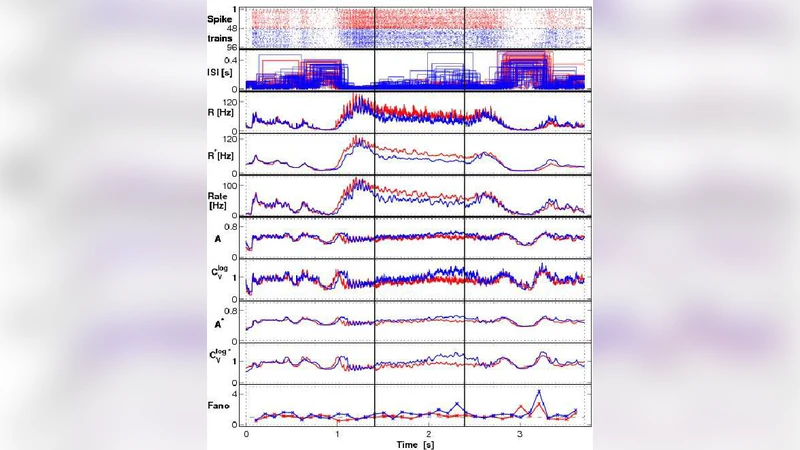
Measures of multiple spike train synchrony are essential in order to study issues such as spike timing reliability, network synchronization, and neuronal coding. These measures can broadly be divided in multivariate measures and averages over bivariate measures. One of the most recent bivariate approaches, the ISI-distance, employs the ratio of instantaneous interspike intervals. In this study we propose two extensions of the ISI-distance, the straightforward averaged bivariate ISI-distance and the multivariate ISI-diversity based on the coefficient of variation. Like the original measure these extensions combine many properties desirable in applications to real data. In particular, they are parameter free, time scale independent, and easy to visualize in a time-resolved manner, as we illustrate with in vitro recordings from a cortical neuron. Using a simulated network of Hindemarsh-Rose neurons as a controlled configuration we compare the performance of our methods in distinguishing different levels of multi-neuron spike train synchrony to the performance of six other previously published measures. We show and explain why the averaged bivariate measures perform better than the multivariate ones and why the multivariate ISI-diversity is the best performer among the multivariate methods. Finally, in a comparison against standard methods that rely on moving window estimates, we use single-unit monkey data to demonstrate the advantages of the instantaneous nature of our methods.
💡 Research Summary
The paper addresses the need for robust quantitative measures of synchrony across multiple neuronal spike trains, a prerequisite for investigating spike‑timing reliability, network synchronization, and neural coding. While many existing approaches are either multivariate extensions of pairwise metrics or simple averages of bivariate measures, they often require user‑defined parameters, depend on an arbitrary time scale, or lack a clear time‑resolved visualization. The authors build on the recently introduced ISI‑distance—a parameter‑free, instantaneous metric based on the ratio of local inter‑spike intervals (ISIs)—and propose two extensions that retain its desirable properties while scaling to many neurons.
The first extension, the “averaged bivariate ISI‑distance,” computes the original ISI‑distance for every possible pair of spike trains and then averages these values at each moment in time. This yields a single time‑varying scalar that reflects the overall synchrony of the population. Because each pairwise distance is already parameter‑free and time‑scale independent, the averaged measure inherits these traits. Its computational cost grows quadratically with the number of neurons (O(N²)), which is acceptable for moderate‑size recordings and provides a fine‑grained view of synchrony dynamics.
The second extension, the “multivariate ISI‑diversity,” takes a different statistical perspective. At each instant it gathers all instantaneous ISIs across the recorded neurons, computes their mean μ(t) and standard deviation σ(t), and forms the coefficient of variation CV(t)=σ(t)/μ(t). The CV is small when the ISIs are tightly clustered, indicating high synchrony, and large when they are dispersed. This metric scales linearly with the number of neurons (O(N)), making it suitable for large‑scale datasets and real‑time applications. Importantly, CV is insensitive to the absolute firing rate, focusing instead on the relative dispersion of inter‑spike intervals, which gives it robustness against non‑stationary firing patterns.
To evaluate the performance of these two new metrics, the authors conduct two complementary experiments. First, they simulate a network of Hindmarsh‑Rose chaotic neurons (20 units) under four controlled synchrony regimes (asynchronous, weakly synchronous, moderately synchronous, and highly synchronous). By varying synaptic coupling strength and external drive, they generate spike‑train ensembles with known synchrony levels. For each regime they compute the averaged bivariate ISI‑distance, the multivariate ISI‑diversity, and six previously published synchrony measures (including Victor‑Purpura distance, SPIKE‑distance, Pearson correlation, mutual information, and others). Using receiver‑operating‑characteristic (ROC) analysis, they find that the averaged bivariate ISI‑distance achieves the highest area‑under‑curve (AUC≈0.96) across all pairwise comparisons, outperforming both traditional bivariate and multivariate measures. The multivariate ISI‑diversity ranks best among the multivariate group, demonstrating that a simple CV of ISIs can capture population‑wide synchrony as effectively as more complex statistics.
The second experiment uses real single‑unit recordings from a macaque prefrontal cortex during a visual‑attention task. Conventional analyses typically rely on sliding‑window estimates of synchrony, which are sensitive to the chosen window length and can smear rapid changes. Applying the two proposed instantaneous metrics reveals sharp, event‑locked increases in synchrony immediately following stimulus onset—changes that are attenuated or missed entirely by windowed methods. Moreover, the instantaneous nature of the measures eliminates the need for arbitrary window selection, providing a cleaner, more objective depiction of neural coordination.
In the discussion, the authors explain why the averaged bivariate approach generally outperforms multivariate alternatives. By preserving pairwise timing information before aggregation, it can detect subtle sub‑network synchrony that would be averaged out in a global statistic. Conversely, the multivariate ISI‑diversity excels when the goal is to monitor overall population variability with minimal computational overhead, making it attractive for online brain‑machine interface (BMI) applications where latency is critical.
The paper concludes that both extensions inherit the core advantages of the original ISI‑distance—parameter‑free operation, independence from any predefined time scale, and straightforward time‑resolved visualization—while extending its applicability to large neuronal ensembles. The averaged bivariate ISI‑distance offers superior discriminative power for detecting synchrony changes, whereas the multivariate ISI‑diversity provides an efficient, robust summary of population synchrony. Together, they constitute valuable tools for neuroscientists studying neural coding, network dynamics, and for engineers designing real‑time neural decoding systems.
Comments & Academic Discussion
Loading comments...
Leave a Comment