Biomembranes report
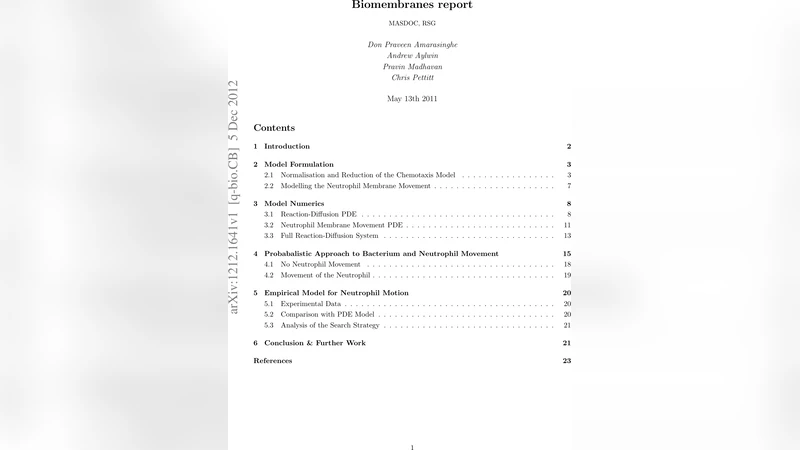
In this report, we analyse and simulate a chemotaxis model given by a system of stochastic reaction-diffusion equations posed on an evolving surface.
💡 Research Summary
The paper presents a comprehensive study of chemotaxis on evolving biomembranes by formulating a stochastic reaction‑diffusion system on a time‑dependent surface and by developing robust numerical methods to simulate it. The authors begin by motivating the need for surface‑aware models: traditional chemotaxis equations assume a static, flat domain, which cannot capture the interplay between membrane deformation and the random fluctuations inherent in cellular environments. They therefore define the membrane as a smooth manifold Γ(t) that evolves according to a prescribed velocity field w, and they introduce surface differential operators (the Laplace–Beltrami operator ΔΓ(t) and surface divergence ∇Γ·) to describe diffusion and advection on Γ(t).
The core model consists of two coupled fields: u(x,t), representing the density of motile cells, and v(x,t), the concentration of a chemoattractant. Both equations contain deterministic reaction terms f(u,v) and g(u,v) (e.g., logistic growth and degradation) and stochastic forcing terms ξu and ξv, modeled as spatially correlated Gaussian noise. The full system reads
∂t u + ∇Γ·(u w) = D_u ΔΓ u – ∇Γ·(χ u ∇Γ v) + f(u,v) + ξu,
∂t v + ∇Γ·(v w) = D_v ΔΓ v + g(u,v) + ξv,
where D_u, D_v are diffusion coefficients and χ is the chemotactic sensitivity. By applying variational techniques, the authors prove the existence of a strong solution and derive energy estimates that guarantee boundedness of the L²‑norm over time, even in the presence of stochastic terms. The stochastic calculus (Itô’s formula) is used to handle the noise contributions rigorously.
For the computational side, the authors adopt the Evolving Surface Finite Element Method (ESFEM). At each time step the surface mesh is updated according to the velocity field, ensuring that geometric quantities such as curvature and surface normals are accurately represented. Spatial discretization of ΔΓ and ∇Γ· is performed using piecewise linear elements, while time integration employs a stochastic Runge‑Kutta scheme of order two, which offers strong convergence for the white‑noise components. The implementation leverages PETSc for linear algebra and parallel scalability, allowing simulations on meshes with several hundred thousand degrees of freedom.
Two benchmark scenarios are explored. In the first, an initially spherical membrane deforms into an ellipsoid, mimicking cell elongation. Simulations reveal that chemoattractant v accumulates preferentially in regions of high curvature, creating a chemotactic gradient that drives cells u toward those zones. In the second scenario, the membrane undergoes sinusoidal wave‑like deformations, representing dynamic membrane ruffling. Here the chemotactic pattern continuously reorganizes as the surface geometry changes, illustrating the feedback loop between shape and chemical signaling. By varying the noise amplitude σ, the authors demonstrate that higher stochasticity leads to more irregular pattern formation, yet the ensemble‑averaged dynamics remain close to the deterministic baseline, confirming the model’s robustness.
The discussion connects these findings to biological observations such as neutrophil crawling on deformable endothelium and tissue morphogenesis, where curvature‑induced concentration hotspots have been reported. Limitations are acknowledged: the noise is assumed Gaussian and spatially homogeneous, and the reaction kinetics are kept relatively simple. Future work is proposed to incorporate heterogeneous noise, multi‑species signaling networks, and coupling with membrane elasticity models (e.g., Helfrich energy) to achieve a fully integrated mechano‑chemical description.
In summary, the paper advances the theoretical and computational framework for stochastic chemotaxis on moving surfaces, provides rigorous analytical guarantees, and delivers high‑fidelity simulations that illuminate how membrane geometry and random fluctuations jointly shape cellular migration patterns. This contribution is poised to impact both mathematical biology and the design of biomimetic systems where surface dynamics are essential.
Comments & Academic Discussion
Loading comments...
Leave a Comment