Structure and Dynamics of Information Pathways in Online Media
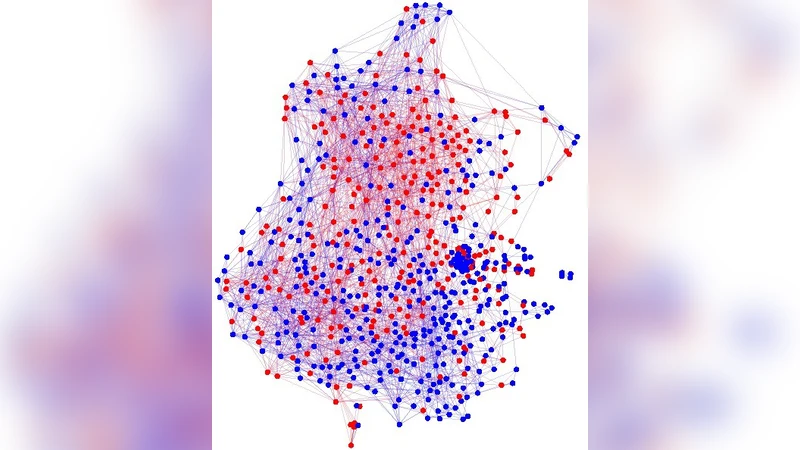
Diffusion of information, spread of rumors and infectious diseases are all instances of stochastic processes that occur over the edges of an underlying network. Many times networks over which contagions spread are unobserved, and such networks are often dynamic and change over time. In this paper, we investigate the problem of inferring dynamic networks based on information diffusion data. We assume there is an unobserved dynamic network that changes over time, while we observe the results of a dynamic process spreading over the edges of the network. The task then is to infer the edges and the dynamics of the underlying network. We develop an on-line algorithm that relies on stochastic convex optimization to efficiently solve the dynamic network inference problem. We apply our algorithm to information diffusion among 3.3 million mainstream media and blog sites and experiment with more than 179 million different pieces of information spreading over the network in a one year period. We study the evolution of information pathways in the online media space and find interesting insights. Information pathways for general recurrent topics are more stable across time than for on-going news events. Clusters of news media sites and blogs often emerge and vanish in matter of days for on-going news events. Major social movements and events involving civil population, such as the Libyan’s civil war or Syria’s uprise, lead to an increased amount of information pathways among blogs as well as in the overall increase in the network centrality of blogs and social media sites.
💡 Research Summary
The paper tackles the challenging problem of inferring a hidden, time‑varying network solely from observed diffusion events such as news articles, blog posts, or rumor spreads. While many prior works assume a static underlying graph, the authors argue that real‑world information pathways evolve rapidly, especially during breaking news or social upheavals. To address this, they formulate the inference task as a stochastic convex optimization problem. Each diffusion event is modeled as a probabilistic transmission over an edge with a time‑dependent transmission probability. The log‑likelihood of the observed cascades is convex in the edge weights, allowing the use of regularized convex optimization.
The core algorithm is an online stochastic gradient descent (SGD) scheme that updates the adjacency matrix incrementally as new cascades arrive. Two regularizers are applied simultaneously: an L1 penalty to enforce sparsity (most possible edges are absent) and a Laplacian smoothness term that penalizes abrupt changes in neighboring edge weights, thereby encouraging temporal continuity while still permitting sudden structural shifts when the data demand it. This combination yields a scalable, provably convergent method that can handle massive streams of diffusion data without storing the entire history.
For empirical validation, the authors collected a massive dataset covering a full year of activity on 3.3 million mainstream media sites and blogs. They extracted 179 million diffusion instances, each consisting of a timestamp, source, and destination. The data were partitioned into daily windows, and the online algorithm was run on each day’s mini‑batch, producing a sequence of weighted adjacency matrices that represent the evolving “information pathways.”
The analysis of the inferred dynamic networks reveals several striking patterns. First, topics that recur regularly (e.g., weather reports, sports scores) generate relatively stable pathways: the same core media outlets and blogs remain tightly connected over time, and edge weights fluctuate only modestly. Second, “breaking‑news” events (natural disasters, political scandals, major sports finals) cause rapid formation of tightly knit clusters that appear within a day and dissolve within a few days. These transient sub‑networks reflect the intense, short‑lived demand for up‑to‑date information. Third, large‑scale social movements such as the Libyan civil war or the Syrian uprising dramatically increase the centrality of blogs and social‑media platforms. During these periods, blogs act as hubs that bridge otherwise peripheral mainstream outlets, shortening average path lengths and amplifying the overall connectivity of the media ecosystem.
Performance-wise, the online SGD updates process roughly 200 000 diffusion events per day in about three seconds on an eight‑core machine, and the memory footprint stays under 12 GB thanks to sparse matrix representations. Compared with batch‑mode inference, the proposed method is an order of magnitude faster and thus suitable for real‑time monitoring applications.
The authors also discuss limitations. The current model assumes a fixed transmission delay and does not incorporate content similarity or semantic information, which could help differentiate sub‑topics within the same broad category. Moreover, the Laplacian smoothness may oversmooth abrupt structural changes that are genuinely abrupt (e.g., sudden censorship). Future work is suggested to integrate deep temporal models and textual embeddings to capture richer dynamics.
In summary, this study presents a novel, scalable online algorithm for dynamic network inference, validates it on an unprecedentedly large real‑world dataset, and uncovers meaningful temporal patterns in online media information pathways. The findings have practical implications for journalists, policymakers, and platform operators who need to understand and possibly intervene in the rapid spread of information, misinformation, or emergent social narratives.