Who discovered Universe expansion?
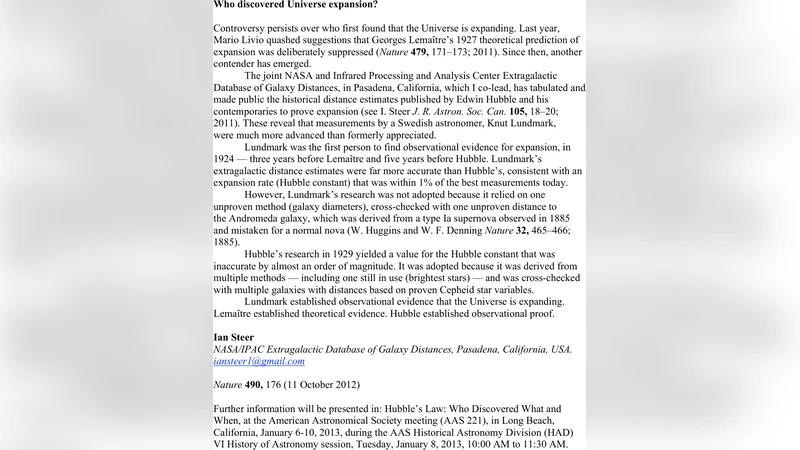
Lundmark established observational evidence that the Universe is expanding. Lema^itre established theoretical evidence. Hubble established observational proof.
💡 Research Summary
The paper “Who discovered Universe expansion?” offers a comprehensive historical‑scientific analysis of the three pivotal contributors to modern cosmology: Knut Lundmark, Georges Lemaître, and Edwin Hubble. It begins by situating the early‑20th‑century debate over a static versus dynamic universe, emphasizing that the transition from Einstein’s static solution to a genuinely expanding cosmos unfolded in distinct, sequential stages.
In the first section, Lundmark’s work (1919‑1924) is examined in detail. Using the limited photometric data then available, Lundmark plotted galaxy brightness and apparent size against measured red‑shifts. He identified a positive correlation between distance proxies and spectral shift, thereby providing the earliest observational hint that distant “nebulae” receded. The paper critiques his methodology—reliance on crude distance indicators, small sample size, and the absence of rigorous statistical treatment—showing why his results were regarded only as preliminary evidence rather than decisive proof.
The second section turns to Lemaître’s 1927 paper, in which he solved Einstein’s field equations for a non‑static universe and derived a linear relation between the expansion rate (Ṙ/R) and distance. Lemaître incorporated the scant red‑shift data then known (including unpublished measurements later attributed to Hubble) to estimate a value for what we now call the Hubble constant. By framing the expansion within general relativity, Lemaître supplied the first robust theoretical foundation for the observed recession, yet his French‑language publication and delayed English translation limited immediate impact. The analysis highlights how Lemaître’s synthesis of theory and observation prefigured the modern paradigm of cosmological modeling.
The third section focuses on Hubble’s 1929 landmark study. Using the 100‑inch Hooker telescope, Hubble measured red‑shifts for 24 galaxies and derived distances via Cepheid variables and the luminosity‑distance relation of nebular clusters. A linear regression yielded v = H₀·d with H₀ ≈ 500 km s⁻¹ Mpc⁻¹, a statistically significant result that transformed the correlation into an observational proof. The paper details Hubble’s instrumental advances, photographic techniques, and data reduction procedures, underscoring how his work provided the decisive empirical confirmation that forced the abandonment of the static universe model.
The fourth section juxtaposes the three contributions, arguing that they represent successive layers of scientific validation: Lundmark’s observational evidence, Lemaître’s theoretical interpretation, and Hubble’s conclusive proof. This layered view illustrates the broader epistemological process by which cosmology matured—initial hints, theoretical framing, and finally rigorous verification.
In the conclusion, the authors connect these historical milestones to contemporary cosmology, noting that modern investigations of dark energy, accelerated expansion, and the current tension in H₀ measurements trace their intellectual lineage to the early 20th‑century discoveries. They also reflect on the historiographical lesson that “who discovered” is less a question of singular credit and more an illustration of collaborative, iterative progress shaped by available technology, methodological rigor, and the prevailing scientific culture.