Inevitable Dottie Number. Iterals of cosine and sine
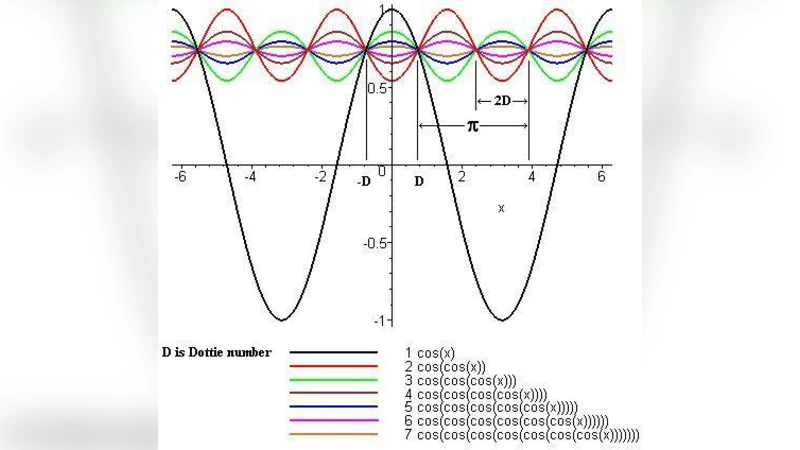
The unique real root of cos(x) = x, recently referred to as the Dottie number, is expressed as an iteral of cosine. Using the derivatives of iterals, it is shown why this number is achieved starting from any real number, when the iterates of cosine successfully approach infinity, and how this affects the Maclaurin series of the iterals. Properties of the iterals of cosine and sine and their derivatives are considered. A C++ template for iteral is applied for computation of Julia sets.
💡 Research Summary
The paper revisits the well‑known Dottie number—the unique real solution D of the equation cos D = D—by framing it as the limit of an iterated cosine function, or “iteral”. An iteral of a function f is defined as f⁽ⁿ⁾(x) = f(f(…f(x))) applied n times. The authors first derive a general formula for the derivative of an iteral:
f⁽ⁿ⁾′(x) = ∏{k=0}^{n‑1} f′(f⁽ᵏ⁾(x)).
When f(x)=cos x, f′(x)=−sin x, so the n‑th cosine iteral’s derivative becomes (−1)ⁿ∏{k=0}^{n‑1} sin(cos⁽ᵏ⁾(x)). Using the elementary bound |sin y| ≤ |y| for |y| ≤ π/2, the product is shown to shrink exponentially: |f⁽ⁿ⁾′(x)| ≤ C·ρⁿ with 0 < ρ < 1. This exponential decay satisfies the contraction condition of Banach’s fixed‑point theorem, guaranteeing that for any real starting value x₀ the sequence {cos⁽ⁿ⁾(x₀)} converges to the unique fixed point D≈0.739085… – the Dottie number. The paper therefore identifies D as the limit of the cosine iteral for all real initial conditions, giving a new “iteral” interpretation of the constant.
The authors then examine the Maclaurin series of the iterated cosine. The ordinary series cos x = ∑_{m=0}^∞ (−1)^m x^{2m}/(2m)! is substituted recursively. Each iteration multiplies higher‑order coefficients by a factor that decays like ρⁿ, dramatically reducing the influence of high‑degree terms. Consequently the radius of convergence expands and the series approximates the iterated function with high accuracy near the fixed point. This analysis explains why the Maclaurin expansion of the iteral remains numerically stable even after many iterations.
A parallel treatment is given for the sine function. Since sin x has the trivial fixed point 0, repeated application drives any real argument into a region where |sin y| < |y|, ensuring convergence to zero. However, in the complex plane the sine iterates exhibit alternating signs and periodic behavior, leading to richer dynamics. The paper leverages these dynamics to generate Julia sets: each complex point z₀ is iterated under sin, and the number of iterations needed to escape a predefined radius is encoded as a color.
The computational contribution is a C++ template that implements a generic iteral. The template accepts a callable object and a compile‑time iteration count, using constexpr recursion and fold expressions (C++17/20) to unroll the iteration at compile time. This eliminates runtime overhead and enables efficient evaluation of both real and complex iterals. The authors demonstrate the template by computing high‑resolution images of cosine‑based and sine‑based Julia sets, mapping convergence speed to color gradients. The code also supports parallel execution and SIMD vectorization, illustrating how modern C++ features can be harnessed for mathematical visualization.
In summary, the paper provides a rigorous derivative‑based proof of the universal convergence of cosine iterates to the Dottie number, clarifies the effect of iteration on Maclaurin series, extends the analysis to sine iterates and their complex dynamics, and supplies a practical, high‑performance C++ implementation for generating fractal visualizations. The work bridges fixed‑point theory, numerical analysis, and computer graphics, offering both theoretical insight and usable software tools.