Unifying exact completions
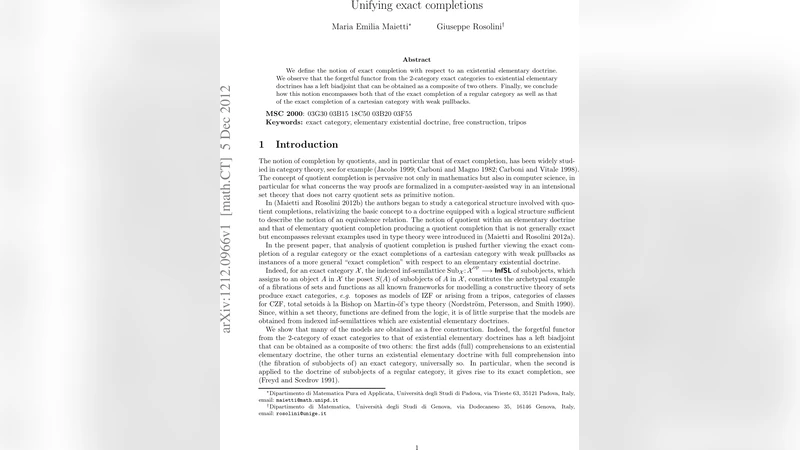
We define the notion of exact completion with respect to an existential elementary doctrine. We observe that the forgetful functor from the 2-category exact categories to existential elementary doctrines has a left biadjoint that can be obtained as a composite of two others. Finally, we conclude how this notion encompasses both that of the exact completion of a regular category as well as that of the exact completion of a cartesian category with weak pullbacks.
💡 Research Summary
The paper introduces a unifying framework for exact completions by basing the construction on the notion of an existential elementary doctrine. An elementary doctrine is a 2‑categorical device that assigns to each object a poset of logical predicates together with pullback functors for morphisms; the existential version additionally provides left adjoints (existential quantifiers) to these pullback functors, satisfying the Beck‑Chevalley condition and Frobenius reciprocity. This structure simultaneously generalises the subobject classifier of a regular category and the weak pullback structure of a cartesian category, thereby serving as a common logical substrate.
The authors define a forgetful 2‑functor
(U : \mathbf{ExactCat} \to \mathbf{ExistentialDoctrine})
which sends an exact category to its associated existential elementary doctrine by interpreting equivalence relations, regular images and exact quotients as logical operations in the doctrine. The central result is that (U) admits a left biadjoint (L). For any existential elementary doctrine (P), the biadjoint produces an exact category (L(P)) together with a universal morphism of doctrines (P \to U(L(P))).
Crucially, the construction of (L) is shown to decompose into two well‑known left biadjoints. The first stage takes an arbitrary existential elementary doctrine (P) and freely adds regular images, yielding a regular doctrine (R(P)). This step is precisely the regular completion familiar from the theory of regular categories. The second stage then freely adds exact quotients to the regular doctrine, producing an exact doctrine (E(R(P))). This second step coincides with the classical exact completion of a cartesian category that possesses weak pullbacks. The composite (L = E \circ R) therefore realises the desired left biadjoint to (U).
To demonstrate the unifying power of the framework, the paper verifies that the construction recovers the traditional exact completion of a regular category. In that case the existential elementary doctrine is given by the subobject posets, and the composite (E\circ R) yields exactly the exact category obtained by taking regular images and then forming exact quotients. Likewise, when the starting point is a cartesian category with weak pullbacks, the associated doctrine already possesses the necessary pullback structure; the first stage is essentially trivial, and the second stage reproduces the known exact completion for such categories.
Beyond these two canonical examples, the authors argue that many other logical and categorical settings fit into the same pattern. For instance, first‑order logical theories, internal type theories, and even certain topos‑like structures can be encoded as existential elementary doctrines. Their exact completions are then obtained uniformly by applying the biadjoint (L). This suggests a broad, conceptually clean perspective: exact completions are not isolated constructions tied to specific categorical properties, but instances of a single biadjoint arising from the universal property of the forgetful functor from exact categories to existential elementary doctrines. The paper thus provides both a technical tool for constructing exact categories and a philosophical insight into the deep relationship between categorical logic and exactness.
Comments & Academic Discussion
Loading comments...
Leave a Comment