The Residual Method for Regularizing Ill-Posed Problems
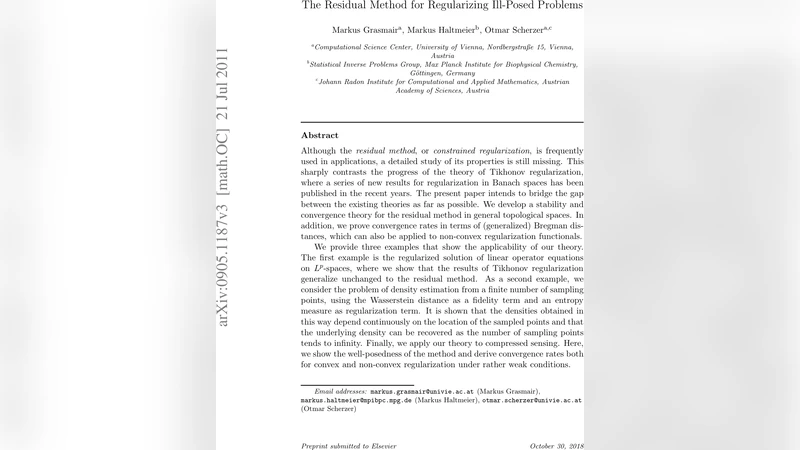
Although the \emph{residual method}, or \emph{constrained regularization}, is frequently used in applications, a detailed study of its properties is still missing. This sharply contrasts the progress of the theory of Tikhonov regularization, where a series of new results for regularization in Banach spaces has been published in the recent years. The present paper intends to bridge the gap between the existing theories as far as possible. We develop a stability and convergence theory for the residual method in general topological spaces. In addition, we prove convergence rates in terms of (generalized) Bregman distances, which can also be applied to non-convex regularization functionals. We provide three examples that show the applicability of our theory. The first example is the regularized solution of linear operator equations on $L^p$-spaces, where we show that the results of Tikhonov regularization generalize unchanged to the residual method. As a second example, we consider the problem of density estimation from a finite number of sampling points, using the Wasserstein distance as a fidelity term and an entropy measure as regularization term. It is shown that the densities obtained in this way depend continuously on the location of the sampled points and that the underlying density can be recovered as the number of sampling points tends to infinity. Finally, we apply our theory to compressed sensing. Here, we show the well-posedness of the method and derive convergence rates both for convex and non-convex regularization under rather weak conditions.
💡 Research Summary
The paper develops a comprehensive theoretical framework for the residual method, also known as constrained regularization, which has been widely used in practice but lacks a systematic mathematical treatment comparable to that of Tikhonov regularization. The authors work in a very general setting: a topological space (X) for the unknown, a topological space (Y) for the data, a (possibly nonlinear) forward operator (F:X\to Y), a data‑fidelity functional (\mathcal{S}:Y\times Y\to
Comments & Academic Discussion
Loading comments...
Leave a Comment