Greedy is good: An experimental study on minimum clique cover and maximum independent set problems for randomly generated rectangles
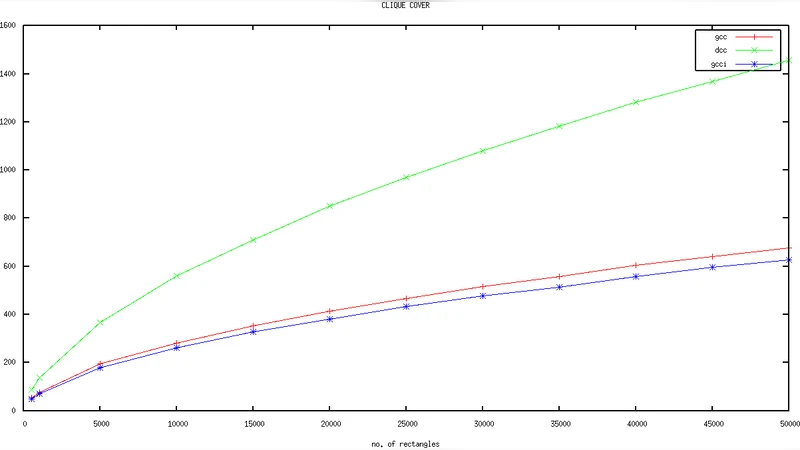
Given a set ${\cal R}={R_1,R_2,…, R_n}$ of $n$ randomly positioned axis parallel rectangles in 2D, the problem of computing the minimum clique cover (MCC) and maximum independent set (MIS) for the intersection graph $G({\cal R})$ of the members in $\cal R$ are both computationally hard \cite{CC05}. For the MCC problem, it is proved that polynomial time constant factor approximation is impossible to obtain \cite{PT11}. Though such a result is not proved yet for the MIS problem, no polynomial time constant factor approximation algorithm exists in the literature. We study the performance of greedy algorithms for computing these two parameters of $G({\cal R})$. Experimental results shows that for each of the MCC and MIS problems, the corresponding greedy algorithm produces a solution that is very close to its optimum solution. Scheinerman \cite{Scheinerman80} showed that the size of MIS is tightly bounded by $\sqrt{n}$ for a random instance of the 1D version of the problem, (i.e., for the interval graph). Our experiment shows that the size of independent set and the clique cover produced by the greedy algorithm is at least $2\sqrt{n}$ and at most $3\sqrt{n}$, respectively. Thus the experimentally obtained approximation ratio of the greedy algorithm for MIS problem is at most 3/2 and the same for the MCC problem is at least 2/3. Finally we will provide refined greedy algorithms based on a concept of {\it simplicial rectangle}. The characteristics of this algorithm may be of interest in getting a provably constant factor approximation algorithm for random instance of both the problems. We believe that the result also holds true for any finite dimension.
💡 Research Summary
The paper investigates two classic NP‑hard problems—Minimum Clique Cover (MCC) and Maximum Independent Set (MIS)—on the intersection graph G(R) induced by a collection R = {R₁,…,Rₙ} of axis‑parallel rectangles placed uniformly at random in the plane. While it is known that MCC admits no polynomial‑time constant‑factor approximation (Papadimitriou & Yannakakis, 2011) and no such approximation is known for MIS, the authors focus on average‑case behavior for random instances and evaluate the practical performance of very simple greedy heuristics.
Instance generation and graph model
Each rectangle is generated by picking its lower‑left corner and its width and height independently from a uniform distribution over a fixed bounding box. Two rectangles intersect iff their projections on both axes overlap; consequently an undirected edge is placed between the corresponding vertices in G(R). In this geometric setting, a clique corresponds to a set of mutually intersecting rectangles, while an independent set corresponds to a family of pairwise disjoint rectangles.
Greedy algorithms
For MCC the algorithm repeatedly selects a vertex of maximum degree (i.e., a rectangle intersecting the most others), forms a clique consisting of that vertex together with all its neighbors, removes the entire clique from the graph, and repeats until no vertices remain. For MIS the algorithm repeatedly selects a vertex of minimum degree, adds it to the independent set, deletes it together with all its neighbors, and continues. Both procedures are implemented using an O(n²) adjacency matrix; the experiments cover n = 100, 400, 900, 1 600 and larger, with each size averaged over at least 30 random trials.
Empirical findings
The key empirical observation is that both the size of the greedy MIS and the number of cliques produced by the greedy MCC lie in the interval