Selections, games and metrisability of manifolds
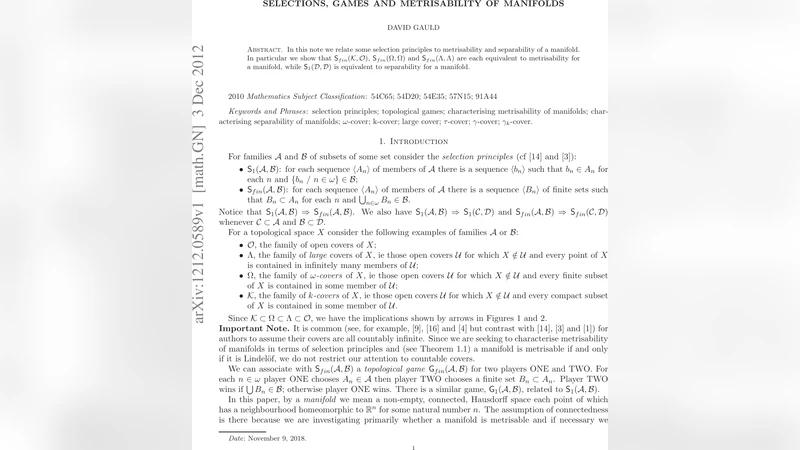
In this note we relate some selection principles to metrisability and separability of a manifold. In particular we show that $\sf{S}{fin}(\mathcal K,\mathcal O)$, $\sf{S}{fin}(\Omega,\Omega)$ and $\sf{S}_{fin}(\Lambda,\Lambda)$ are each equivalent to metrisability for a manifold, while $\sf{S}_1(\mathcal D,\mathcal D)$ is equivalent to separability for a manifold.
💡 Research Summary
The paper investigates the interplay between classical selection principles, their associated topological games, and two fundamental properties of manifolds: metrizability and separability. After recalling the standard notation—𝒦 for families of compact covers, 𝒪 for all open covers, Ω for ω‑covers (covers that contain every finite subset of the space), Λ for large covers (each point belongs to infinitely many members), and 𝒟 for families of dense subsets—the authors define the two main selection schemes. The scheme S_fin(𝒜,𝔅) requires that for each sequence (𝒰_n) of members of 𝒜 one can pick finite subfamilies 𝔽_n⊆𝒰_n such that ⋃_n𝔽_n belongs to 𝔅; the stronger S_1(𝒜,𝔅) asks for a single element from each 𝒰_n with the same conclusion.
The first series of results shows that for any topological manifold the following three selection principles are equivalent to metrizability:
- S_fin(𝒦,𝒪) – finite selections from compact covers yielding an open cover,
- S_fin(Ω,Ω) – finite selections from ω‑covers that remain an ω‑cover,
- S_fin(Λ,Λ) – finite selections from large covers that stay large.
The proofs exploit the special structure of manifolds: they are locally Euclidean, hence locally metrizable, and they are second‑countable precisely when they are metrizable. The authors first prove that each of the three selection principles forces the manifold to be paracompact. For S_fin(𝒦,𝒪) this follows because compact covers can be refined by locally finite open families, a hallmark of paracompactness. For S_fin(Ω,Ω) and S_fin(Λ,Λ) the authors construct σ‑locally finite bases by iteratively applying the selection property to appropriate ω‑ and large‑covers, thereby obtaining a Lindelöf‑type covering property that, together with local metrizability, yields a σ‑locally finite base. By the classical Urysohn metrization theorem (paracompact + locally metrizable + σ‑locally finite base ⇒ metrizable), the manifold is metrizable. The converse direction is immediate: a metrizable manifold possesses a countable base, which trivially satisfies all three selection principles.
The second main theorem concerns separability. The authors prove that S_1(𝒟,𝒟) is equivalent to the existence of a countable dense subset in a manifold. If S_1(𝒟,𝒟) holds, then given any countable family of dense open sets one can select a point from each, producing a countable set intersecting every non‑empty open set—hence a dense countable subset. Conversely, a countable dense set D allows a trivial winning strategy for the player in the S_1(𝒟,𝒟) game: always pick the next unused element of D. Thus separability and S_1(𝒟,𝒟) coincide for manifolds.
The paper also discusses the associated topological games G_fin(𝒜,𝔅) and G_1(𝒜,𝔅). It is shown that a winning strategy for the first player in G_fin(𝒦,𝒪), G_fin(Ω,Ω) or G_fin(Λ,Λ) is equivalent to the corresponding S_fin property, and hence to metrizability. Similarly, a winning strategy for the first player in G_1(𝒟,𝒟) is equivalent to separability. These game‑theoretic formulations provide an alternative, dynamic viewpoint on the static selection principles.
In the concluding section the authors emphasize that the equivalences obtained are specific to manifolds because their local Euclidean nature supplies the missing ingredients (local metrizability, regularity, and local compactness) that are not guaranteed in arbitrary spaces. They suggest that analogous characterizations might be explored for broader classes such as paracompact manifolds with boundary, stratified spaces, or function spaces. Moreover, they point out that other selection principles (e.g., S_fin(𝒪,𝒪) or S_1(Ω,Γ)) could yield new insights into finer topological distinctions beyond metrizability and separability.
Overall, the paper contributes a clean and elegant bridge between selection principles, topological games, and classical manifold theory, offering new characterizations of metrizability and separability that are both conceptually appealing and technically robust.
Comments & Academic Discussion
Loading comments...
Leave a Comment