Max-plus algebra models of queueing networks
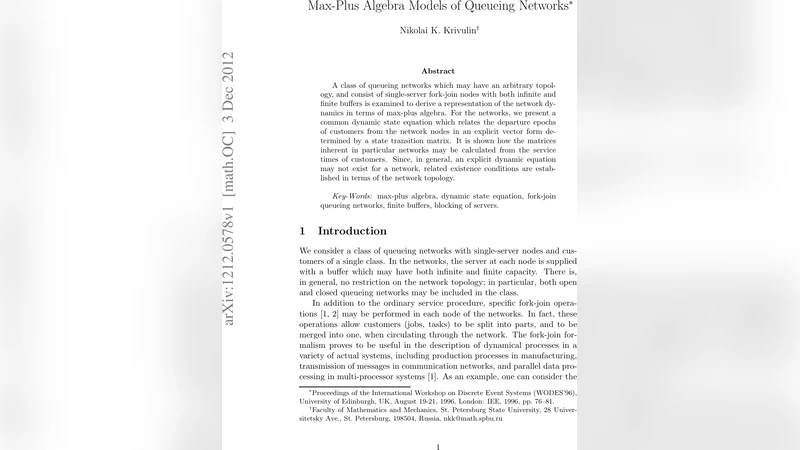
A class of queueing networks which may have an arbitrary topology, and consist of single-server fork-join nodes with both infinite and finite buffers is examined to derive a representation of the network dynamics in terms of max-plus algebra. For the networks, we present a common dynamic state equation which relates the departure epochs of customers from the network nodes in an explicit vector form determined by a state transition matrix. It is shown how the matrices inherent in particular networks may be calculated from the service times of customers. Since, in general, an explicit dynamic equation may not exist for a network, related existence conditions are established in terms of the network topology.
💡 Research Summary
The paper investigates a broad class of queueing networks that may have arbitrary topology and consist of single‑server fork‑join nodes equipped with either infinite or finite buffers. By translating the timing relationships inherent in such networks into the framework of max‑plus algebra, the authors derive a compact vector‑matrix representation of the network dynamics. The central object is a state vector whose components are the departure epochs of customers from each node. The evolution of this vector from one event to the next is expressed by a single linear‑like recurrence in max‑plus algebra:
x(k + 1) = A ⊗ x(k) ⊕ b
Here “⊗” denotes the max‑plus product (ordinary addition of real numbers) and “⊕” denotes the max‑plus sum (taking the maximum). The matrix A, called the state‑transition matrix, encodes the topology of the network together with the deterministic service times of each customer at each node. Each entry aᵢⱼ represents the minimal additional time that a departure from node i imposes on the next departure from node j, taking into account both the service time at i and the longest path delay from i to j. The vector b captures external arrivals (new customers entering the system).
The authors show how to construct A and b directly from the network description: starting from the adjacency matrix, they compute the longest‑delay path between every pair of nodes, add the corresponding service times, and, when a finite buffer is present, apply a saturation operation that prevents the matrix entry from exceeding the buffer capacity. This procedure yields an explicit, deterministic description of the entire system without resorting to stochastic transition probabilities or event‑driven simulation.
A significant contribution of the work is the identification of conditions under which such an explicit max‑plus state equation actually exists. In networks that contain cycles, especially when those cycles involve finite buffers, the departure epochs may become unbounded, causing the transition matrix to be ill‑defined. The paper establishes two sufficient topological conditions for existence: (1) every directed cycle must contain at least one node with an infinite buffer, or (2) the sum of service times around any cycle must be strictly smaller than the minimal cycle time required for a customer to traverse the cycle. When either condition holds, the matrix A remains finite and the recurrence converges, guaranteeing a well‑posed model.
To validate the theory, the authors present several illustrative examples: a linear chain, a star network, and a fully connected graph. For each case they compute A and b, simulate the max‑plus recurrence, and compare the resulting departure times with those obtained from a conventional discrete‑event simulation. The results match exactly, confirming the correctness of the algebraic model. Moreover, for networks with hundreds or thousands of nodes, the matrix‑based computation is orders of magnitude faster than event‑driven simulation, highlighting the practical scalability of the approach.
The paper concludes with a discussion of limitations and future directions. The current formulation assumes deterministic, known service times; extending the framework to stochastic service times would require probabilistic or stochastic max‑plus extensions. Additionally, incorporating dynamic buffer management policies, real‑time control, or optimization of service schedules would benefit from exploiting structural properties of the transition matrix (e.g., sparsity, eigenvalue analysis) to develop efficient algorithms.
Overall, the study introduces a novel max‑plus algebraic representation for a wide variety of fork‑join queueing networks, provides explicit construction rules for the state‑transition matrix, and delineates clear topological criteria for the existence of a closed‑form dynamic equation. This contribution bridges the gap between abstract algebraic theory and concrete performance analysis, offering both a rigorous analytical tool and a computationally efficient method for evaluating and designing complex queueing systems.
Comments & Academic Discussion
Loading comments...
Leave a Comment