H*-algebras and nonunital Frobenius algebras: first steps in infinite-dimensional categorical quantum mechanics
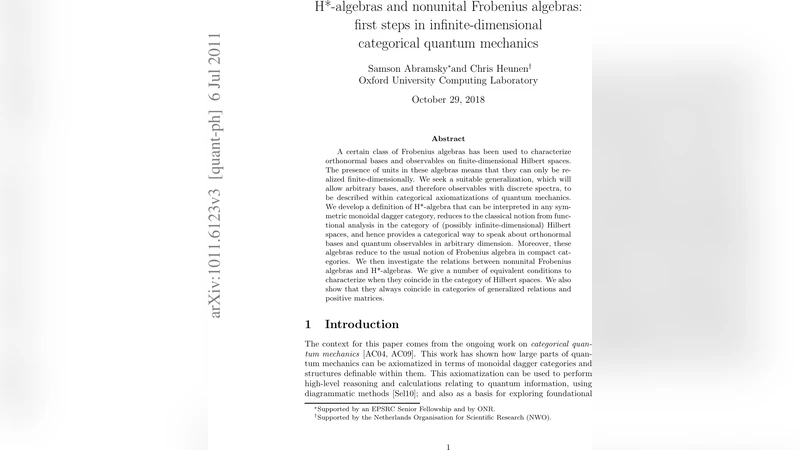
A certain class of Frobenius algebras has been used to characterize orthonormal bases and observables on finite-dimensional Hilbert spaces. The presence of units in these algebras means that they can only be realized finite-dimensionally. We seek a suitable generalization, which will allow arbitrary bases and observables to be described within categorical axiomatizations of quantum mechanics. We develop a definition of H*-algebra that can be interpreted in any symmetric monoidal dagger category, reduces to the classical notion from functional analysis in the category of (possibly infinite-dimensional) Hilbert spaces, and hence provides a categorical way to speak about orthonormal bases and quantum observables in arbitrary dimension. Moreover, these algebras reduce to the usual notion of Frobenius algebra in compact categories. We then investigate the relations between nonunital Frobenius algebras and H*-algebras. We give a number of equivalent conditions to characterize when they coincide in the category of Hilbert spaces. We also show that they always coincide in categories of generalized relations and positive matrices.
💡 Research Summary
The paper addresses a fundamental limitation in the categorical treatment of quantum mechanics: the standard use of (unital) Frobenius algebras to model orthonormal bases and observables works only in finite‑dimensional Hilbert spaces because the existence of a unit forces the underlying category to be compact. To overcome this restriction, the authors introduce H*-algebras, a structure that can be defined in any symmetric monoidal dagger category and that reduces to the classical notion of an H*-algebra from functional analysis when the ambient category is the (possibly infinite‑dimensional) Hilbert space category Hilb.
Core Definition
An H*-algebra on an object (A) consists of a multiplication (\mu: A\otimes A\to A) and a comultiplication (\delta: A\to A\otimes A) satisfying:
- Adjointness: (\delta = \mu^{\dagger}) and (\mu = \delta^{\dagger}) (the dagger is the categorical analogue of the Hilbert‑space adjoint).
- Frobenius law: ((\mu\otimes \mathrm{id})\circ(\mathrm{id}\otimes\delta) = \delta\circ\mu = (\mathrm{id}\otimes\mu)\circ(\delta\otimes \mathrm{id})).
No explicit unit or counit is required. In Hilb, this definition coincides with the traditional H*-algebra: a (possibly unbounded) closed *‑subalgebra of bounded operators that is closed under the Hilbert‑space inner product. Consequently, H*-algebras provide a categorical way to speak about orthonormal bases and quantum observables without assuming finite dimensionality.
Relation to Compact Frobenius Algebras
When the ambient category is compact (i.e., every object has a dual), the adjointness condition forces the existence of a unit and counit, and an H*-algebra automatically becomes a unital Frobenius algebra. Thus H*-algebras genuinely generalise the familiar finite‑dimensional picture while collapsing to it in the compact case.
Non‑unital Frobenius Algebras vs. H*-algebras
The authors study non‑unital Frobenius algebras (structures that satisfy the Frobenius law but lack a unit). In Hilb, they prove that the following four statements are equivalent:
- (\mu) is complete (i.e., the associated linear map is a Hilbert‑space isometry onto a closed subspace) and (\delta = \mu^{\dagger}).
- (\mu) and (\delta) are mutual daggers.
- (\mu) is a partial isometry (preserves inner products on its image).
- (\mu) preserves the inner product in the sense (\langle \mu(x\otimes y), z\rangle = \langle x\otimes y, \delta(z)\rangle).
These equivalences show that, under mild analytic conditions, a non‑unital Frobenius algebra in Hilb is automatically an H*-algebra. Hence the two notions coincide for the infinite‑dimensional quantum systems of interest.
Other Categories
Beyond Hilb, the paper examines two additional concrete dagger categories:
- Rel (sets and relations): Here multiplication is relational composition, comultiplication is relational converse. The adjointness condition holds trivially, so every non‑unital Frobenius algebra is an H*-algebra.
- PosMat (positive real matrices): Multiplication is matrix multiplication, comultiplication is matrix transpose scaled by a positive factor. Again, the dagger (transpose) makes the two structures identical.
Thus the coincidence of H*-algebras and non‑unital Frobenius algebras is not an artifact of Hilbert spaces alone but a robust phenomenon across several important categorical models of quantum‑like processes.
Implications for Categorical Quantum Mechanics
By providing a unit‑free algebraic primitive that still captures the essential features of bases and observables, H*-algebras enable a dimension‑agnostic formulation of categorical quantum mechanics. This opens the door to:
- Modeling continuous‑variable systems (position, momentum, quantum optics) within the same diagrammatic language that has been successful for qubits.
- Defining quantum channels and process theories that act on infinite‑dimensional state spaces without resorting to ad‑hoc analytic machinery.
- Extending quantum circuit and ZX‑calculus‑style graphical calculi to settings where the underlying Hilbert spaces are not compact.
The paper concludes by suggesting future work on categorical constructions of infinite‑dimensional quantum protocols, error‑correction schemes, and a deeper exploration of the interplay between H*-algebras and other categorical structures such as †‑compact closed categories, traced monoidal categories, and enriched dagger categories.
In summary, the authors successfully generalise the Frobenius‑algebraic characterisation of orthonormal bases to the infinite‑dimensional realm by introducing H*-algebras, establishing precise conditions under which non‑unital Frobenius algebras and H*-algebras coincide, and demonstrating the robustness of this coincidence across several key categorical settings. This work provides a solid theoretical foundation for extending categorical quantum mechanics beyond the finite‑dimensional frontier.
Comments & Academic Discussion
Loading comments...
Leave a Comment