Simplification and integration in computing and cognition: the SP theory and the multiple alignment concept
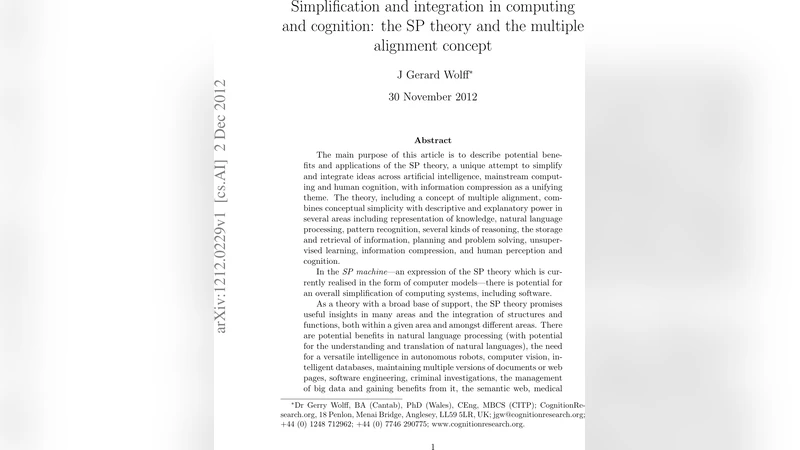
The main purpose of this article is to describe potential benefits and applications of the SP theory, a unique attempt to simplify and integrate ideas across artificial intelligence, mainstream computing and human cognition, with information compression as a unifying theme. The theory, including a concept of multiple alignment, combines conceptual simplicity with descriptive and explanatory power in several areas including representation of knowledge, natural language processing, pattern recognition, several kinds of reasoning, the storage and retrieval of information, planning and problem solving, unsupervised learning, information compression, and human perception and cognition. In the SP machine – an expression of the SP theory which is currently realised in the form of computer models – there is potential for an overall simplification of computing systems, including software. As a theory with a broad base of support, the SP theory promises useful insights in many areas and the integration of structures and functions, both within a given area and amongst different areas. There are potential benefits in natural language processing (with potential for the understanding and translation of natural languages), the need for a versatile intelligence in autonomous robots, computer vision, intelligent databases, maintaining multiple versions of documents or web pages, software engineering, criminal investigations, the management of big data and gaining benefits from it, the semantic web, medical diagnosis, the detection of computer viruses, the economical transmission of data, and data fusion. Further development of these ideas would be facilitated by the creation of a high-parallel, web-based, open-source version of the SP machine, with a good user interface. This would provide a means for researchers to explore what can be done with the system and to refine it.
💡 Research Summary
The paper presents the SP theory—a unifying framework that seeks to simplify and integrate concepts across artificial intelligence, mainstream computing, and human cognition—using information compression as its central principle. At the heart of the theory lies the concept of multiple alignment, adapted from biological sequence alignment, which aligns several patterns simultaneously to achieve maximal compression. In the SP model, all knowledge is represented as atomic or hierarchical patterns; the multiple‑alignment process identifies a “core” pattern (the “spine”) that can be reused across many contexts and “leaf” patterns that capture specific details. By repeatedly aligning new inputs with existing patterns, the system automatically discovers regularities, forms clusters, and builds generalized structures without supervision.
The authors argue that contemporary AI research suffers from a proliferation of specialized algorithms, data structures, and programming paradigms, leading to excessive system complexity and high maintenance costs. In contrast, the SP machine—a concrete software embodiment of the theory—offers a single, universal mechanism for representation, learning, inference, planning, and retrieval. This uniformity promises a reduction in software redundancy, smoother integration of disparate modules, and easier scaling to large‑scale or real‑time applications.
Key technical contributions include:
- A detailed description of how multiple alignment can perform a wide range of cognitive tasks, from natural‑language parsing and generation to pattern recognition in vision and speech. By treating grammatical rules, visual features, or sensor readings as patterns, the same alignment engine can parse sentences, recognize objects, or interpret sensor streams.
- An unsupervised learning procedure that incrementally builds a repository of patterns by aligning incoming data with the existing pattern set, thereby discovering new regularities and refining existing abstractions. This mirrors human inductive learning and supports continual adaptation in dynamic environments.
- A unified reasoning mechanism that subsumes deductive, inductive, abductive, and analogical reasoning within the alignment process. The system can draw conclusions, generate hypotheses, and solve problems by finding the most compressive alignment that links premises to conclusions.
- A proposal for a high‑parallel, web‑based, open‑source implementation of the SP machine. Such a platform would enable researchers worldwide to experiment with the theory across domains—autonomous robotics, computer vision, intelligent databases, semantic web technologies, medical diagnosis, cyber‑security, big‑data analytics, and more.
The paper also discusses cognitive parallels: human memory appears to rely on compressing experiences into reusable schemas, and the SP theory formalizes this intuition mathematically. By modeling perception, learning, and reasoning as compression‑driven alignment, the theory offers a plausible computational account of human cognition.
Potential applications highlighted include natural‑language understanding and translation, versatile intelligence for autonomous robots, efficient data transmission, version control for documents and web pages, software engineering tools that automatically generate and refactor code, crime‑scene analysis, virus detection, and data fusion across heterogeneous sources. In each case, the SP system’s ability to represent heterogeneous information uniformly and to retrieve or infer relevant knowledge through alignment promises performance gains and simplification of system architecture.
In conclusion, the SP theory and its multiple‑alignment mechanism constitute a bold attempt to provide a single, parsimonious substrate for diverse intelligent behaviours. By grounding all processing in information compression, the theory claims to achieve both conceptual elegance and practical power. The authors advocate further development of a scalable, open‑source SP machine as the next critical step toward validating the theory’s promises and fostering a collaborative research ecosystem.