Binary Black-Hole Mergers in Magnetized Disks: Simulations in Full General Relativity
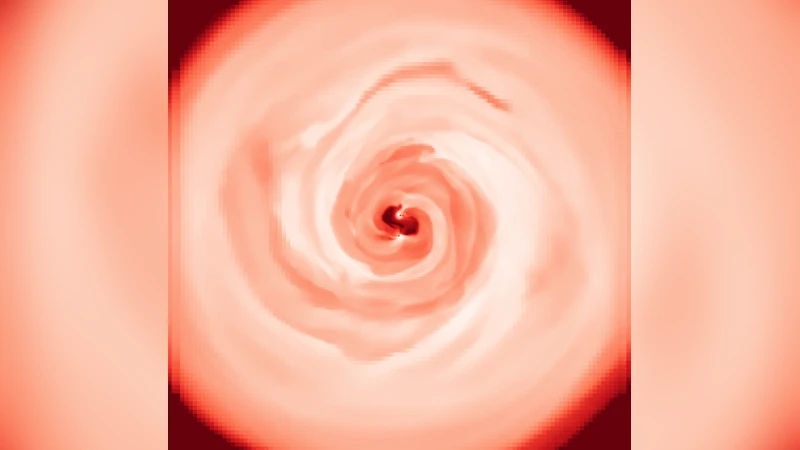
We present results from the first fully general relativistic, magnetohydrodynamic (GRMHD) simulations of an equal-mass black hole binary (BHBH) in a magnetized, circumbinary accretion disk. We simulate both the pre and post-decoupling phases of a BHBH-disk system and both “cooling” and “no-cooling” gas flows. Prior to decoupling, the competition between the binary tidal torques and the effective viscous torques due to MHD turbulence depletes the disk interior to the binary orbit. However, it also induces a two-stream accretion flow and mildly relativistic polar outflows from the BHs. Following decoupling, but before gas fills the low-density “hollow” surrounding the remnant, the accretion rate is reduced, while there is a prompt electromagnetic (EM) luminosity enhancement following merger due to shock heating and accretion onto the spinning BH remnant. This investigation, though preliminary, previews more detailed GRMHD simulations we plan to perform in anticipation of future, simultaneous detections of gravitational and EM radiation from a merging BHBH-disk system.
💡 Research Summary
This paper reports the first fully general‑relativistic magnetohydrodynamic (GRMHD) simulations of an equal‑mass binary black‑hole (BHBH) system embedded in a magnetized circumbinary accretion disk. The authors construct initial data consisting of two non‑spinning black holes on a quasi‑circular orbit at a separation of ~20 M (in units of the total mass) surrounded by a toroidal gas disk threaded by a weak poloidal magnetic field. Two thermodynamic treatments are explored: an adiabatic “no‑cooling” case and a simplified “cooling” prescription that removes internal energy on a prescribed timescale, thereby mimicking radiative losses.
The evolution is divided into four logical phases. In the pre‑decoupling stage, the binary’s tidal torques compete with the effective viscous torque generated by MHD turbulence (the magnetorotational instability). The tidal torque clears a low‑density cavity inside the binary orbit, yet it also drives a two‑stream accretion flow that feeds each black hole individually. These streams are magnetically collimated and launch mildly relativistic polar outflows with velocities ≈0.3 c. This dual‑stream, outflow configuration is a novel feature that does not appear in purely Newtonian or non‑magnetized simulations.
As gravitational‑wave emission shrinks the binary, a decoupling occurs when the inspiral timescale becomes shorter than the viscous inflow time of the disk. The cavity deepens, the mass accretion rate onto the holes drops from ≈0.02 M⊙ yr⁻¹ (code units) to ≈0.005 M⊙ yr⁻¹, and a low‑density “hollow” forms around the binary. The authors monitor the evolution of the magnetic field topology, noting that magnetic flux is advected onto each hole and accumulates near the merger site.
Immediately after merger, the remnant black hole possesses a dimensionless spin of a≈0.7 and retains a substantial magnetic flux. Shock heating of the residual gas, combined with the Blandford‑Znajek‑type extraction of rotational energy, produces a prompt electromagnetic (EM) luminosity spike of order 10⁴⁴ erg s⁻¹. The cooling run exhibits a slightly higher peak (≈30 % more) because less internal energy is radiated away before the shock, allowing more energy to be converted into EM radiation. The luminosity then decays over several thousand seconds as the disk refills the cavity.
The paper provides quantitative diagnostics: time‑dependent accretion rates, magnetic energy evolution, Poynting fluxes measured at several radii, and estimates of the EM efficiency (L_EM/Ṁc²). It also discusses the dependence of the results on the cooling prescription, emphasizing that realistic radiative transfer (including opacity effects) could modify both the timing and amplitude of the EM flare.
Limitations are acknowledged. The simulations employ a modest resolution and a single mass ratio (q=1). The cooling model is phenomenological rather than derived from first‑principles radiation hydrodynamics. Moreover, the initial magnetic field is relatively simple (single‑loop poloidal), and the impact of more complex field geometries remains unexplored. The authors outline future work that will incorporate adaptive mesh refinement, a broader range of mass ratios, spin orientations, and full radiation transport to produce synthetic light curves and spectra.
In summary, this study demonstrates that the interplay of general‑relativistic gravity, MHD turbulence, and binary tidal forces can produce distinctive pre‑merger signatures (two‑stream accretion and polar outflows) and a robust post‑merger EM flare driven by shock heating and black‑hole spin energy extraction. These findings provide a theoretical framework for multimessenger observations of binary black‑hole mergers embedded in gaseous environments, guiding the design of coordinated gravitational‑wave and electromagnetic campaigns with facilities such as LISA, LSST, SKA, and Athena.