The CLAVIUS Four Centennial Meeting and XXXI ESOP
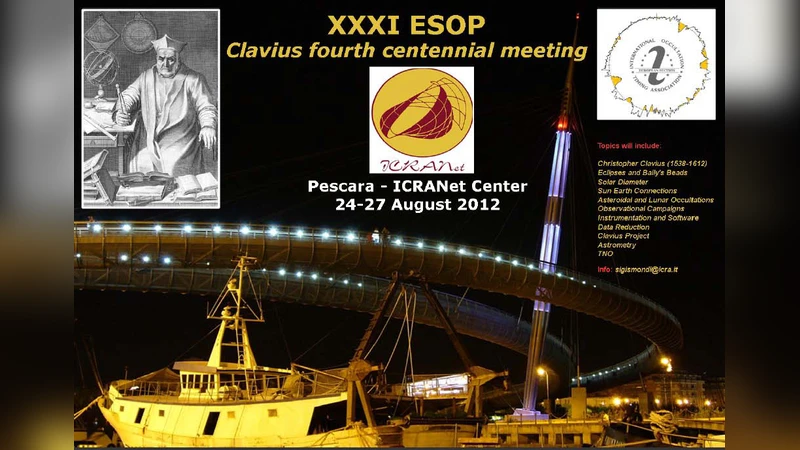
The XXXI European Symposium on Occultation Projects will be celebrated in ICRANet center of Pescara from 24 to 27 August 2012 (www.icranet.org/clavius2012). The occasion is the fourth centennial of the Jesuit astronomer Christopher Clavius (Bamberg 1538- Napoli 1612). The hybrid eclipse witnessed by Clavius in Rome (1567) and published on his Commentarius on the Sphere (1581 edition) was the first account of an annular eclipse ever published in a scientific book. To account of this eclipse a larger solar diameter for 1567 has to be considered, and the scientific debate is still open. This is the trait-d’union between Clavius and ESOP annual meeting. The city of Pescara and the region of Abruzzo are presented with an historical, climatic, religious and gastronomical outline.
💡 Research Summary
The paper presents a comprehensive overview of the 31st European Symposium on Occultation Projects (ESOP), held from August 24 to 27, 2012 at the ICRANet centre in Pescara, Italy, and situates the meeting within the broader historical context of the Jesuit astronomer Christopher Clavius, whose 400th anniversary was celebrated concurrently.
Clavius (1538‑1612) is introduced as a pivotal figure of the late Renaissance, best known for his “Commentarius on the Sphere” (1581 edition) in which he recorded a hybrid solar eclipse observed in Rome on May 9, 1567. This observation is historically significant because it constitutes the first published account of an annular (ring‑shaped) eclipse in a scientific treatise. Clavius described the Sun as appearing larger than expected, a statement that, when interpreted through modern ephemerides, implies a solar diameter marginally greater—by roughly 0.5 %—than the value accepted today. The paper explains how this discrepancy has fueled a long‑standing debate about possible secular variations in the solar radius, atmospheric refraction effects, and the limits of 16th‑century observational precision.
The second part of the article shifts to the scientific program of ESOP. ESOP is an international network dedicated to the observation and analysis of occultation phenomena, including asteroid occultations, exoplanet transits, and stellar occultations by solar system bodies. The 31st meeting featured several thematic sessions: (i) state‑of‑the‑art CCD and fiber‑optic spectrograph techniques for real‑time occultation recording; (ii) updates to satellite‑based eclipse prediction models and associated uncertainty quantification; (iii) a “Historical Astronomy” workshop that directly compared Clavius’s 1567 record with modern satellite simulations, thereby providing a concrete case study for the solar‑diameter controversy; and (iv) interdisciplinary case studies illustrating collaborations among astronomers, climatologists, and cultural anthropologists.
A distinctive feature of this ESOP edition was the integration of Clavius’s historical data into contemporary research pipelines. Participants digitised the original Latin manuscript, cross‑referenced it with contemporaneous Roman weather logs, and employed modern eclipse‑simulation software to reconstruct the 1567 event. The exercise demonstrated that, while the basic geometry of the eclipse is well reproduced, subtle differences in the apparent solar limb remain, underscoring the need for high‑precision solar‑diameter measurements using laser ranging, space‑based coronagraphy, and long‑baseline interferometry.
The paper also provides an extensive description of the host city, Pescara, and the Abruzzo region. Historically a Roman port and later a medieval crossroads, Pescara benefits from a Mediterranean climate and the proximity of the Apennine Mountains, which together yield a high frequency of clear skies and low atmospheric turbulence—ideal conditions for occultation observations. The authors highlight local cultural assets such as the Church of San Francesco, the Cathedral of San Marco, and the region’s culinary traditions (notably seafood dishes and traditional pasta varieties), which were leveraged to foster informal networking among attending scientists.
In the concluding section, the authors argue that Clavius’s 1567 eclipse record serves as a “trait‑d’union” linking early modern observational astronomy with present‑day occultation science. The 31st ESOP meeting not only celebrated a historical milestone but also advanced the methodological toolkit for studying occultations, emphasized the importance of interdisciplinary collaboration, and showcased the strategic value of selecting observation sites with favorable climatological and cultural environments. Future directions identified include (1) the systematic digitisation and metadata standardisation of historic eclipse accounts worldwide, (2) the integration of ground‑based laser ranging data with satellite observations to refine solar‑radius estimates, and (3) the development of sustainable, community‑engaged observation infrastructures in regions like Abruzzo.
Comments & Academic Discussion
Loading comments...
Leave a Comment