Computing links and accessing arcs
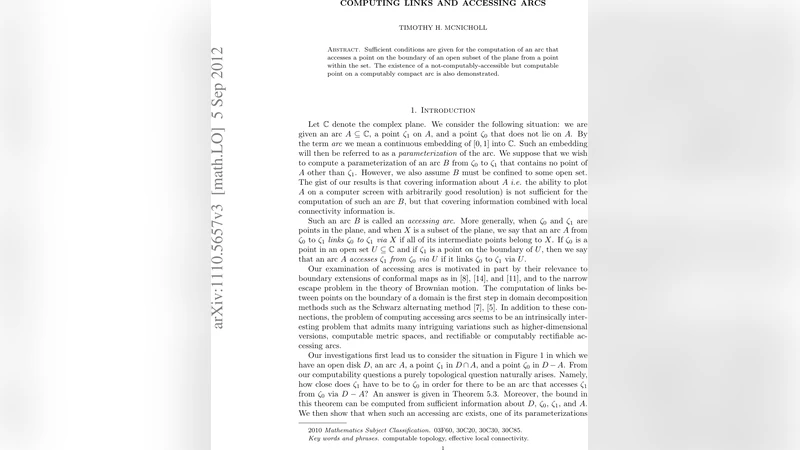
Sufficient conditions are given for the computation of accessing arcs and arcs that links boundary components of multiply connected domains. The existence of a not-computably-accessible but computable point on a computably compact arc is also demonstrated.
💡 Research Summary
The paper investigates the algorithmic construction of accessing arcs—continuous injective curves that connect an interior point ζ₀ of an open subset U⊂ℂ to a boundary point ζ₁∈∂U while staying entirely inside U except at ζ₁. This problem is motivated by applications such as boundary extensions of conformal maps, the narrow‑escape problem for Brownian motion, and domain‑decomposition methods like the Schwarz alternating method.
The authors first formalize the topological setting: an arc is a compact, connected set with exactly two non‑cut points, and an accessing arc must avoid a given obstacle arc A⊂ℂ except at its endpoint ζ₁. They recall basic facts about polygonal arcs, Jordan curves, and connectivity, establishing that removing an arc from a disk leaves the complement arcwise connected under suitable conditions.
The computational framework is based on Type‑2 Effectivity. Objects are represented by names: points by rational rectangles, continuous functions by strongly Cauchy sequences of rational polygonal curves, and compact sets by enumerations of finite rational rectangle covers (κ‑mc‑names). Two kinds of auxiliary information are considered:
- Plot‑ability – a κ‑mc‑name for the obstacle arc A, i.e., the ability to draw A at any resolution.
- Local connectivity – effective versions of “connected in the small” (CIK) and “uniformly locally arcwise connected” (ULAC) functions, which guarantee that any two sufficiently close points in a set can be joined by a short arc lying inside the set.
The first major result (Theorem 4.1) shows that plot‑ability alone is insufficient. Using a diagonalization construction, the authors build a computable compact arc A such that any computable curve C from –i to 0 that avoids A must intersect A at the origin. Consequently, even though A has a computable compact name, there is no computable accessing arc from –i to 0 that avoids A. This demonstrates that a mere visual representation of A does not provide enough information to compute an accessing arc.
The second major contribution (Theorem 5.3) establishes a positive result: if a ULAC function g for A is known, then one can effectively compute an accessing arc whenever the interior point ζ₀ and the boundary point ζ₁ satisfy a quantitative proximity condition. Specifically, if |ζ₀–ζ₁| < 2^{–g(k)} for some k such that 2^{–g(k)} + 2^{–k} does not exceed the minimum distance of ζ₀ and ζ₁ to the boundary of the ambient disk, then ζ₀ lies on the boundary of the connected component of ζ₁ in D \ A. The algorithm proceeds by (i) using the ULAC function to find a short polygonal bridge between ζ₀ and ζ₁, (ii) refining this bridge into a rational polygonal arc that stays inside the open set, and (iii) outputting a strongly Cauchy sequence of such polygonal arcs, which yields a computable parametrization of the accessing arc.
Supporting propositions (5.1 and 5.2) prove that removing an arc from a disk leaves the complement connected and that any sub‑arc of A intersecting a component of the complement must meet the disk’s boundary. These topological lemmas are essential for the constructive argument.
The paper also highlights the subtle distinction between computable points and computably accessible points. The constructed arc A contains a point (the origin) that is computable as a member of a compact set but cannot be reached by any computable accessing arc, illustrating that computability of a set does not guarantee computable accessibility of its points.
In summary, the authors demonstrate that effective local connectivity information (ULAC/CIK) is necessary and sufficient for the algorithmic construction of accessing arcs, whereas mere plot‑ability is inadequate. The results deepen our understanding of computable topology, provide concrete criteria for algorithm designers working with conformal maps or stochastic processes, and open avenues for higher‑dimensional and metric‑space generalizations.
Comments & Academic Discussion
Loading comments...
Leave a Comment