Persistence and periodicity in a dynamic proximity network
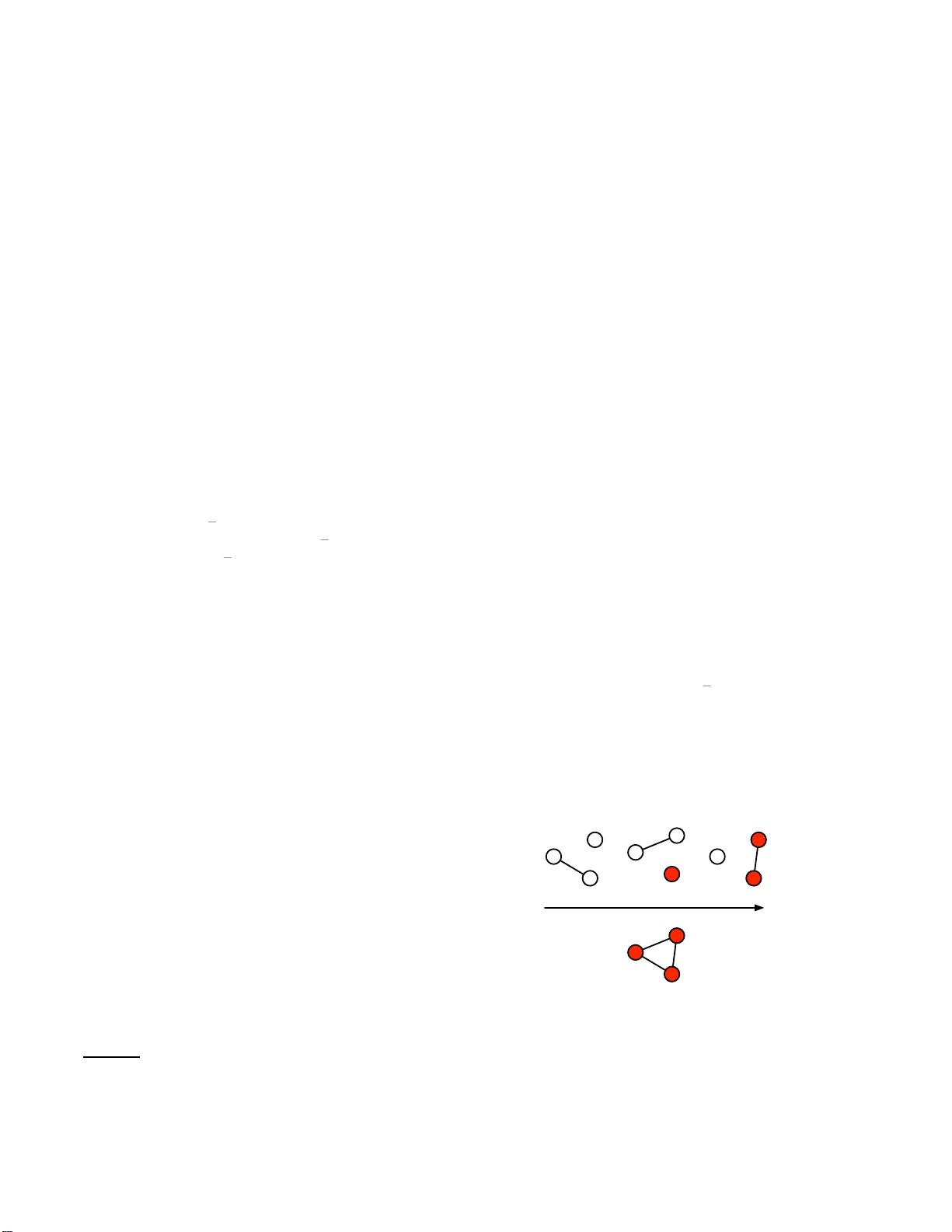
The topology of social networks can be understood as being inherently dynamic, with edges having a distinct position in time. Most characterizations of dynamic networks discretize time by converting temporal information into a sequence of network “snapshots” for further analysis. Here we study a highly resolved data set of a dynamic proximity network of 66 individuals. We show that the topology of this network evolves over a very broad distribution of time scales, that its behavior is characterized by strong periodicities driven by external calendar cycles, and that the conversion of inherently continuous-time data into a sequence of snapshots can produce highly biased estimates of network structure. We suggest that dynamic social networks exhibit a natural time scale \Delta_{nat}, and that the best conversion of such dynamic data to a discrete sequence of networks is done at this natural rate.
💡 Research Summary
The paper investigates the temporal dynamics of a high‑resolution proximity network composed of 66 individuals equipped with RFID badges that record face‑to‑face contacts at a granularity of seconds. Unlike the common practice of discretizing continuous interaction streams into a sequence of static “snapshots” using an arbitrarily chosen time window Δ, the authors retain the continuous‑time nature of the data and ask how the network’s topology evolves across different time scales, what periodic patterns are present, and how snapshot‑based analyses may bias structural measurements.
First, the authors examine the distribution of inter‑event intervals (the time between successive contacts). The empirical distribution follows a heavy‑tailed, power‑law‑like form that spans from a few seconds up to several days, indicating that the network operates simultaneously on a broad spectrum of temporal scales. This finding undermines any single, fixed Δ as a faithful representation of the underlying dynamics.
Second, they compute standard network metrics—average clustering coefficient, size of the giant component, average shortest‑path length, node centralities—within a sliding window that moves across the continuous timeline. By applying Fourier analysis and power‑spectral density estimation to these time series, they uncover strong periodicities aligned with external calendar cycles: a 24‑hour diurnal rhythm, a 7‑day weekly cycle, and longer term modulations associated with academic semesters and holidays. The metrics clearly differentiate between work‑hours, evenings, and weekend periods, demonstrating that human daily routines imprint themselves on the structure of the contact network.
Third, the paper systematically evaluates the bias introduced by conventional snapshot methods. Using a range of Δ values (1 minute, 5 minutes, 15 minutes, 1 hour), they reconstruct discrete networks and compare them to the original continuous‑time network. Short windows produce overly sparse graphs, fragmenting the giant component and depressing clustering; long windows artificially fuse independent contacts, yielding unrealistically dense graphs with spurious clusters. These distortions propagate to downstream analyses such as community detection, centrality ranking, and epidemic spreading simulations, leading to potentially erroneous conclusions about network resilience or contagion speed.
To address this problem, the authors propose a “natural time scale” Δₙₐₜ. Δₙₐₜ is defined as the smallest window that simultaneously (i) captures the average inter‑event interval of the data and (ii) includes at least one dominant periodic component identified in the spectral analysis. Empirically, Δₙₐₜ is around 5 minutes for the studied dataset. When the continuous data are discretized at Δₙₐₜ, the resulting snapshot networks reproduce the continuous‑time structural statistics with less than 2 % deviation, and epidemic simulations on these snapshots yield the same infection curves as those run on the raw data. Thus, Δₙₐₜ provides a principled, data‑driven guideline for converting continuous interaction streams into discrete graphs without sacrificing fidelity.
In the discussion, the authors argue that the choice of temporal resolution is not a mere methodological convenience but a critical factor that determines the validity of any dynamic network analysis. They suggest that the Δₙₐₜ framework can be generalized to other high‑frequency human‑behavior datasets, such as mobile phone call logs, GPS traces, or online interaction timestamps. By aligning the discretization window with the intrinsic temporal heterogeneity and external periodic drivers of the system, researchers can obtain more accurate representations of social structure, improve the reliability of predictive models (e.g., for disease spread or information diffusion), and avoid systematic biases that have plagued many prior studies. The paper thus makes a strong methodological contribution, urging the community to treat time as an integral, measurable dimension of network topology rather than an afterthought.
Comments & Academic Discussion
Loading comments...
Leave a Comment