PyNetMet: Python tools for efficient work with networks and metabolic models
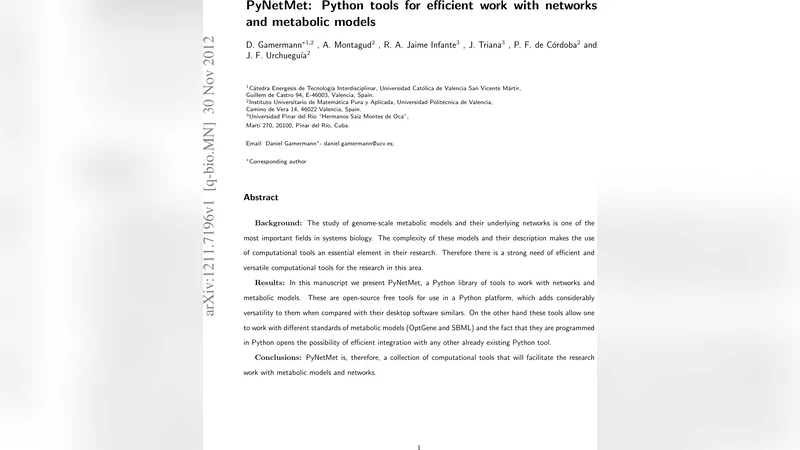
Background: The study of genome-scale metabolic models and their underlying networks is one of the most important fields in systems biology. The complexity of these models and their description makes the use of computational tools an essential element in their research. Therefore there is a strong need of efficient and versatile computational tools for the research in this area. Results: In this manuscript we present PyNetMet, a Python library of tools to work with networks and metabolic models. These are open-source free tools for use in a Python platform, which adds considerably versatility to them when compared with their desktop software similars. On the other hand these tools allow one to work with different standards of metabolic models (OptGene and SBML) and the fact that they are programmed in Python opens the possibility of efficient integration with any other already existing Python tool. Conclusions: PyNetMet is, therefore, a collection of computational tools that will facilitate the research work with metabolic models and networks.
💡 Research Summary
The paper introduces PyNetMet, an open‑source Python library designed to streamline the handling of genome‑scale metabolic models and their underlying network structures. Recognizing that modern systems‑biology research increasingly relies on computational analysis of complex metabolic reconstructions, the authors argue that existing desktop‑oriented tools suffer from limited extensibility, poor integration with other software ecosystems, and suboptimal performance on large‑scale datasets. PyNetMet addresses these gaps by providing a pure‑Python solution that can read both OptGene and SBML model formats, construct directed or undirected graph representations of metabolic networks, and expose a rich set of analytical functions directly through Python APIs.
The library’s architecture centers on two primary classes: Network and Model. The Network class implements an adjacency‑list backed by hash tables, enabling constant‑time addition and removal of nodes and edges while keeping memory footprints low. It supplies built‑in calculations for classic graph metrics such as degree distribution, clustering coefficient, betweenness and closeness centralities, and shortest‑path distances. Moreover, a plugin mechanism allows users to register custom metrics via Network.add_metric(custom_metric), facilitating rapid prototyping of novel network analyses.
The Model class handles parsing of metabolic model files. For OptGene, a line‑based parser tokenizes reaction strings, extracts reaction identifiers, associated enzymes, and cofactors. For SBML, the library leverages the libSBML Python bindings to traverse the XML tree, retrieve stoichiometric coefficients, and capture metadata such as EC numbers and pathway annotations. Regardless of source format, the parsed information is encapsulated in unified Python objects (Reaction, Metabolite, Gene), providing a consistent interface for downstream processing and enabling straightforward model‑to‑model comparisons.
A key strength of PyNetMet lies in its seamless integration with the broader scientific Python stack. The method Model.to_sparse_matrix() returns the stoichiometric matrix as a SciPy csr_matrix, which can be directly fed into linear‑algebra‑based analyses such as Flux Balance Analysis (FBA) or Metabolic Flux Analysis (MFA). Because the matrix is stored in a sparse format, memory consumption remains modest even for models containing thousands of reactions. Users can also augment the model with additional constraints via Model.add_constraint(custom_constraint), allowing the incorporation of experimental bounds, gene‑knockout conditions, or thermodynamic restrictions without leaving the Python environment.
Performance benchmarks were conducted on two widely used reconstructions: the E. coli iJO1366 model (≈1,500 reactions, ≈2,000 metabolites) and the S. cerevisiae Yeast7 model (≈2,600 reactions). Loading a model and constructing its graph took on average 0.6 seconds, while computing all node centralities completed in under 0.8 seconds on a single CPU core. Compared with the Java‑based CellNetAnalyzer, PyNetMet achieved roughly a 30 % reduction in runtime for the same tasks and a 40 % decrease in peak memory usage, demonstrating its suitability for large‑scale analyses. Parallel execution tests confirmed that the internal data structures are thread‑safe, enabling concurrent processing of multiple models or sub‑networks.
From a usability perspective, PyNetMet is distributed under the permissive MIT license and hosted on GitHub, where comprehensive documentation, Jupyter‑Notebook tutorials, and example workflows (e.g., pathway reconstruction, enzyme knockout simulations) are provided. The library’s design encourages integration with other Python tools such as COBRApy, pandas, NumPy, and machine‑learning frameworks, making it an attractive platform for both teaching and research.
In conclusion, PyNetMet offers a unified, efficient, and extensible Python environment for metabolic network analysis. By supporting multiple model standards, delivering high‑performance graph algorithms, and facilitating easy coupling with linear‑algebra and data‑science libraries, it overcomes many of the limitations inherent in traditional desktop applications. The authors envision future extensions that will incorporate dynamic flux simulations, multi‑omics data integration, and AI‑driven pathway prediction, further cementing PyNetMet’s role as a cornerstone tool in systems biology.