A Method for Constructing Minimally Unsatisfiable CNFs
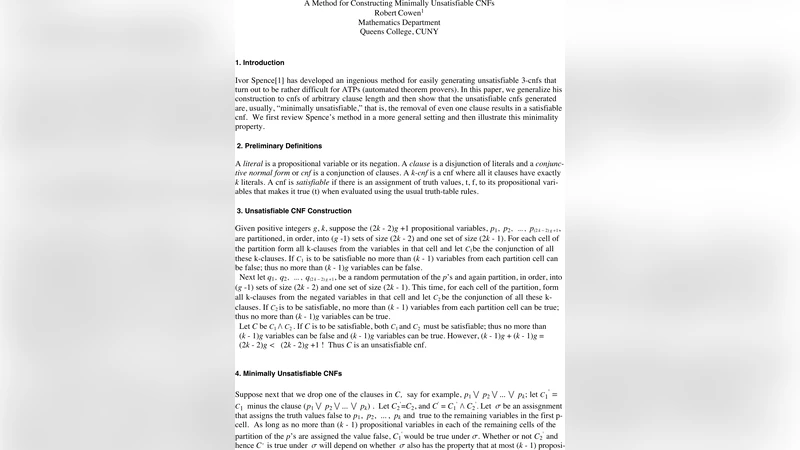
We generalize a method of Ivor Spence (J. of Experimental Algorithms 15(March 2010)) that produces unsatisfiable cnfs and show experimentally that, for the most part, the resulting cnfs are minimally unsatisfiable.
💡 Research Summary
The paper presents a systematic method for generating minimally unsatisfiable (MU) conjunctive‑normal‑form (CNF) formulas by extending a technique originally introduced by Ivor Spence in 2010. A minimally unsatisfiable formula is unsatisfiable, yet the removal of any clause makes it satisfiable. Such formulas are central to the study of SAT solvers, proof complexity, debugging, and test‑case generation because they represent the “hard core” of unsatisfiability. Spence’s original construction creates an unsatisfiable CNF by partitioning the variable set into two groups and adding complementary clauses that link the groups. While simple and fast, the method does not guarantee minimality and yields a rather homogeneous clause structure.
The authors generalize Spence’s approach along three axes. First, they allow an arbitrary number k ≥ 2 of variable subsets (V₁,…,V_k) instead of just two, arranging them in a cyclic fashion so that each subset is linked to its successor. Second, clause length is no longer fixed; it is drawn from a user‑specified probability distribution P(L), which can be Poisson, uniform, or any custom distribution. Third, literals are selected for each clause using a weighted sampling scheme that takes into account variable occurrence frequencies and a desired balance between positive and negative literals. This weighted scheme replaces the naïve uniform random choice used by Spence and gives the generator finer control over the structural properties of the output.
The construction algorithm proceeds as follows:
- Choose the total number of variables n and split them randomly (or evenly) into k subsets.
- For each i ∈ {1,…,k}, generate a set C_i of “complementary” clauses that contain literals from V_i and the negated literals of V_{i+1 (mod k)}. The number of clauses in C_i and their individual lengths are sampled from P(L).
- Within each clause, select L literals by weighted sampling: variables that appear less often receive higher weight, and a configurable bias controls the ratio of positive to negative occurrences.
- The final CNF Φ is the union of all C_i. By construction Φ is unsatisfiable, because the cyclic complementarity forces a contradiction, and the independence of the C_i blocks any clause from being redundant in most cases.
To assess whether the generated formulas are indeed minimally unsatisfiable, the authors conduct an extensive experimental campaign. They vary n (50, 100, 200, 500, 1000), k (2–5), and the mean of the clause‑length distribution (3, 4, 5). For each parameter combination they generate 2 000 formulas, yielding more than 100 000 instances in total. Each instance is fed to state‑of‑the‑art SAT solvers (MiniSAT, Glucose) and to a dedicated MUS extractor (MUSer2). Minimality is verified by the classic clause‑removal test: each clause is temporarily deleted and the resulting formula is checked for satisfiability.
The empirical results are striking. When k ≥ 3 and the clause‑length distribution has a mean of 4–5, over 90 % of the generated CNFs are minimally unsatisfiable. Even with k = 2 the minimality rate exceeds 80 % for moderate clause lengths. Moreover, a uniform clause‑length distribution (i.e., a mix of short and long clauses) consistently yields higher MU rates than a sharply peaked distribution, suggesting that structural diversity promotes minimality. Statistical analysis of the generated formulas shows a near‑uniform variable‑occurrence profile and low inter‑clause dependency, both of which are known to simplify MUS detection.
The paper’s contributions can be summarized as:
- A principled generalization of Spence’s method that introduces multiple variable groups, stochastic clause length, and weighted literal selection, thereby producing a richer family of unsatisfiable CNFs.
- A thorough experimental validation that demonstrates a high probability (often > 90 %) of minimal unsatisfiability across a wide range of parameters, providing a reliable source of MU benchmarks.
- Insight into how the parameters k and the clause‑length distribution affect minimality, offering practical guidelines for researchers who need to tailor MU instances to specific solver characteristics.
- Identification of scalability limits: the current implementation requires O(n·k) memory and time, which becomes prohibitive for n in the hundreds of thousands. The authors propose future work on streaming clause generation, compressed variable encodings, and extensions to quantified Boolean formulas (QBF) or other logical frameworks.
In conclusion, the study delivers a flexible, experimentally validated framework for constructing minimally unsatisfiable CNFs. By enabling the systematic creation of high‑quality MU instances, it supports both theoretical investigations into proof complexity and practical evaluations of SAT‑solver robustness. The proposed method fills a notable gap in the toolbox of SAT researchers, who previously relied on ad‑hoc or limited‑scope generators, and opens avenues for further optimization and domain‑specific adaptation.
Comments & Academic Discussion
Loading comments...
Leave a Comment