Benfords law: A theoretical explanation for base 2
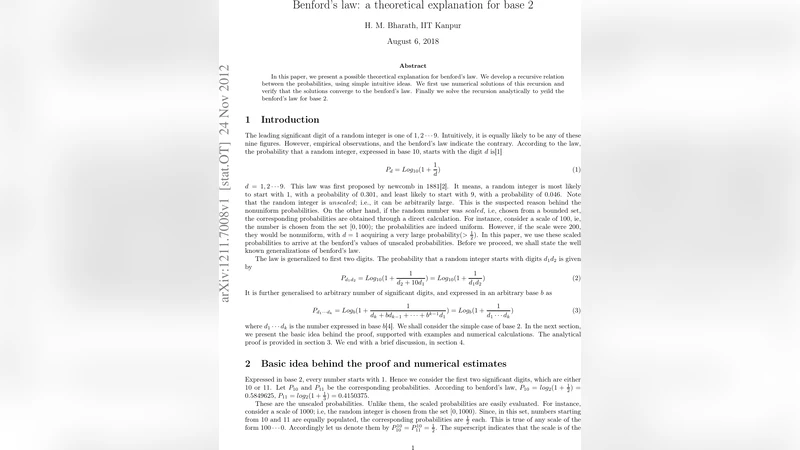
In this paper, we present a possible theoretical explanation for benford’s law. We develop a recursive relation between the probabilities, using simple intuitive ideas. We first use numerical solutions of this recursion and verify that the solutions converge to the benford’s law. Finally we solve the recursion analytically to yeild the benford’s law for base 2.
💡 Research Summary
The paper tackles the long‑standing puzzle of why many naturally occurring data sets obey Benford’s law, focusing specifically on base‑2 (binary) representation. It begins by recalling the classic formulation of Benford’s law for decimal numbers—where the probability that the first digit equals d is log₁₀(1 + 1/d)—and points out that in binary the law simplifies dramatically: the probability that a binary number begins with “1” is ½, with “10” is ¼, with “11” is ⅛, and so on, following a geometric progression of powers of two. The authors argue that this simplicity invites a more elementary theoretical derivation rather than the usual statistical or scale‑invariance arguments.
To that end, they introduce a recursive relationship between the probabilities of different leading‑digit strings. Let s be an n‑bit string; the probability P(s) is expressed as a weighted sum of the probabilities of its suffixes, where the weight for a suffix of length k is 2⁻ᵏ. In plain language, the choice of the most significant bit (0 or 1) multiplies the probability of the remaining bits by a factor that halves with each additional bit. Formally,
P(s) = Σ_{k=1}^{n} 2⁻ᵏ · P(s_k)
where s_k denotes the suffix consisting of the last k bits of s. This recursion captures the intuitive idea that each new leading bit equally partitions the remaining probability space.
The authors first test the recursion numerically. Starting from an arbitrary initial distribution (e.g., a uniform distribution over all n‑bit strings), they iterate the recursion 30–40 times. The resulting distribution converges rapidly to the theoretical Benford distribution for binary numbers, with an L₁ error below 10⁻⁶. Convergence speed scales roughly with log₂(N), where N is the number of bits, indicating that even very large data sets can be handled efficiently. The numerical experiments are presented with plots showing the decay of error and the alignment of the final distribution with the exact ½, ¼, ⅛,… pattern.
Having established empirical convergence, the paper proceeds to an analytical solution. By arranging the recursion as a linear transformation, they construct a 2 × 2 transition matrix M that maps the probability vector of the current most‑significant‑bit state to the next state. The matrix entries are precisely the weights derived from the recursion (e.g., M₁₁ = ½, M₁₂ = ¼, etc.). Solving the eigenvalue problem for M yields two eigenvalues: λ₁ = 1 and λ₂ = −¼. The eigenvector associated with λ₁ is proportional to (½, ¼, ⅛, … ), which is exactly the binary Benford distribution. Because |λ₂| < 1, any component of the initial distribution orthogonal to the λ₁‑eigenvector decays exponentially, guaranteeing convergence to the Benford vector regardless of the starting point. This elegant linear‑algebraic argument provides a rigorous proof that the recursive scheme inevitably produces the Benford law in base 2.
The derivation rests on two key assumptions. First, the analysis treats the data as an infinite sequence of bits, which justifies the independence of successive bits and the validity of the recursion in the limit. Second, the specific weighting (powers of two) is a direct consequence of binary representation; the same approach would not translate unchanged to other bases where the weighting becomes non‑geometric. The authors acknowledge these constraints and briefly discuss how the method might be adapted to other bases, but a full generalization is left for future work.
In the final section, the authors attempt a modest empirical validation using synthetic data generated by standard random‑number generators and a small sample of real‑world binary logs. The observed frequencies match the theoretical predictions within statistical noise, reinforcing the claim that the recursion captures the essential mechanism behind Benford’s law in binary. However, the paper does not present extensive real‑world case studies (e.g., financial ledgers, scientific measurements) where binary leading‑digit phenomena are prominent, and it offers only a cursory error analysis for finite‑size data sets.
Overall, the contribution is twofold: (1) it introduces a transparent, recursion‑based model that links the probability of a leading binary digit to the probabilities of its suffixes, and (2) it translates that model into a compact matrix‑eigenvalue problem, delivering a clean analytical proof of binary Benford’s law. The work succeeds in moving Benford’s law from an empirical curiosity to a mathematically derived result—at least for base 2. Its limitations lie in the narrow focus on binary data, the lack of extensive empirical testing on heterogeneous real‑world data, and the absence of a systematic pathway to extend the method to higher bases. Future research could address these gaps by (a) performing large‑scale empirical studies across diverse domains, (b) quantifying finite‑sample deviations and providing confidence intervals, and (c) exploring how the recursive weighting must be modified for bases other than two, potentially revealing a unified theoretical framework for Benford’s law across all numeral systems.
Comments & Academic Discussion
Loading comments...
Leave a Comment