On the Concrete Categories of Graphs
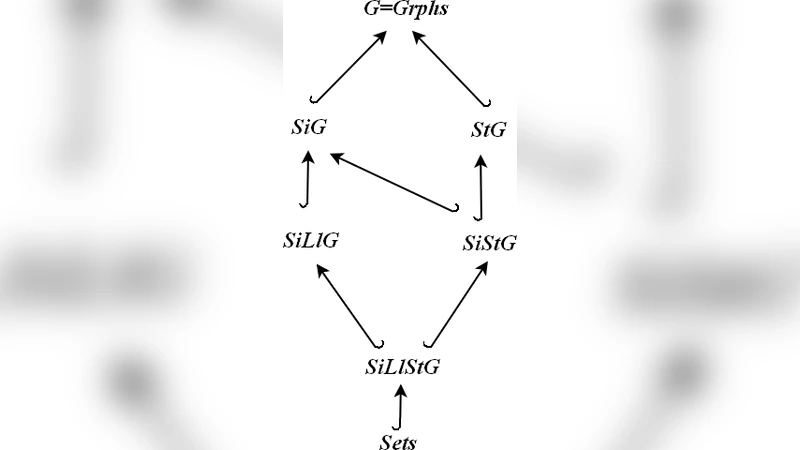
In the standard Category of Graphs, the graphs allow only one edge to be incident to any two vertices, not necessarily distinct, and the graph morphisms must map edges to edges and vertices to vertices while preserving incidence. We refer to these graph morphisms as Strict Morphisms. We relax the condition on the graphs allowing any number of edges to be incident to any two vertices, as well as relaxing the condition on graph morphisms by allowing edges to be mapped to vertices, provided that incidence is still preserved. We call this broader graph category The Category of Conceptual Graphs, and define four other graph categories created by combinations of restrictions of the graph morphisms as well as restrictions on the allowed graphs. We investigate which Lawvere axioms for the category of Sets and Functions apply to each of these Categories of Graphs, as well as the other categorial constructions of free objects, projective objects, generators, and their categorial duals.
💡 Research Summary
This paper revisits the categorical foundations of graph theory by contrasting the traditional “strict” graph category—where each pair of vertices may be joined by at most one edge and morphisms preserve vertices and edges separately—with a newly introduced “conceptual” graph category that relaxes both constraints. In the strict setting, objects are simple graphs (no multiple edges or loops) and morphisms are strict: they map vertices to vertices and edges to edges while preserving incidence. The authors broaden the framework in two orthogonal ways. First, they allow multi‑edge graphs, permitting any number of edges between a pair of vertices (including loops). Second, they introduce loose morphisms that may send an edge to a vertex (or a vertex to an edge) provided the incidence relation is respected. By crossing the two axes—graph simplicity vs. multiplicity and morphism strictness vs. looseness—they obtain four hybrid categories, which together with the original strict‑simple category yield six concrete graph categories in total.
For each of these categories the paper asks whether the classic Lawvere axioms that characterize the category Set hold. The axioms considered are: (L1) existence of all finite limits, (L2) existence of all finite colimits, (L3) existence of exponentials (internal hom‑objects), (L4) existence of a subobject classifier, and (L5) the axiom of choice. The analysis shows that all six categories possess finite limits, because products and equalizers can be built component‑wise from the underlying vertex sets. Finite colimits, however, depend on the morphism flexibility: the three categories with strict morphisms (strict‑simple, strict‑multi, and loose‑multi) admit coproducts and pushouts defined by disjoint unions of vertices and edges, while the loose‑simple and conceptual‑multi categories fail to have general pushouts because edges may be collapsed to vertices, breaking the usual universal property.
Exponentials are the most discriminating axiom. In the strict‑simple category no internal hom exists, as the single‑edge restriction prevents the representation of arbitrary function spaces as graphs. The strict‑multi and loose‑multi categories admit partial exponentials for certain hom‑sets but not a full exponential object for every pair of graphs. Only the most permissive conceptual‑multi category, which allows both multi‑edges and loose morphisms, supports a genuine internal hom: the set of all incidence‑preserving maps between two graphs can itself be equipped with a graph structure, yielding a true exponential object.
The existence of a subobject classifier mirrors the exponential situation. Traditional strict categories lack a classifier because there is no graph that can uniformly encode “characteristic” subgraphs. In contrast, the conceptual‑multi category admits a two‑valued Ω‑graph (vertices and edges labelled true/false) that classifies subobjects via characteristic morphisms, thereby satisfying (L4).
All categories satisfy the axiom of choice (L5) because each object has an underlying set of vertices, and a global choice function can be defined on that set independent of edge structure.
The paper then studies free and projective objects. The free graph on a set X is simply the discrete graph with vertex set X and no edges; this construction works uniformly across all categories. Projective objects differ: in the strict‑simple setting the complete graph Kₙ (one edge between every pair of distinct vertices) is projective, while in the multi‑edge settings the corresponding complete multi‑graph (all possible parallel edges) plays that role. In the conceptual‑multi category the projective objects are even richer, encompassing graphs that are “maximally connected” both at the vertex and edge level.
Generators and cogenerators are also identified. The singleton vertex graph and the singleton edge graph serve as generators in most categories; however, only the conceptual‑multi category possesses a cogenerator—a graph consisting of a single vertex with an infinite family of parallel loops—because every morphism can be detected by its action on this object.
A comparative table summarises which of the Lawvere axioms each category satisfies, together with the nature of its free, projective, generating, and cogenerating objects. The authors conclude that the conceptual‑multi category is the most expressive: it satisfies all Lawvere axioms except for a subtle failure of certain colimits involving edge‑to‑vertex collapses. This expressiveness comes at a cost: the increased flexibility of morphisms makes isomorphism testing computationally harder and complicates categorical reasoning.
Finally, the paper outlines future directions. The rich internal logic of the conceptual‑multi category suggests applications to graph‑based type theory, categorical semantics for network transformations, and the development of a “graph internal language” analogous to the internal language of a topos. Moreover, the systematic classification of graph categories may guide the design of graph databases and query languages that need to balance structural rigidity against expressive power.
Comments & Academic Discussion
Loading comments...
Leave a Comment