A Brief History of the Energy-Momentum Tensor; 1900-1912
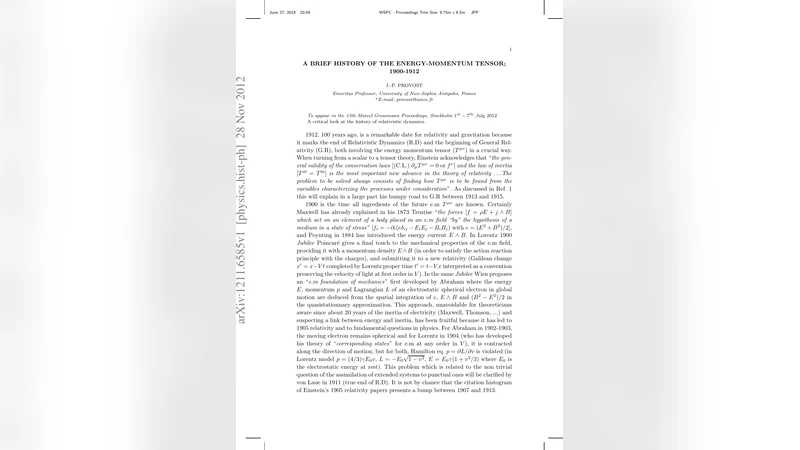
A critical look at the history of relativistic dynamics.
💡 Research Summary
The paper “A Brief History of the Energy‑Momentum Tensor; 1900‑1912” offers a comprehensive historiographical analysis of how the concept of the energy‑momentum (or stress‑energy) tensor emerged, evolved, and became a cornerstone of relativistic physics during the first dozen years of the twentieth century. It is organized chronologically, focusing on the intellectual contributions of key figures—Helmholtz, Larmor, Lorentz, Poincaré, Einstein, Minkowski, Hilbert, and Noether—and on the shifting theoretical contexts that drove the tensor’s development.
The narrative begins with the late‑19th‑century attempts to describe electromagnetic fields in terms of energy density and stress. Helmholtz (1868) introduced an energy density for the electromagnetic field, while Larmor (1900) went further by packaging the field’s energy density, momentum density, and stress components into a second‑rank tensor now known as the electromagnetic stress‑energy tensor. Larmor’s formulation, however, was not symmetric; the antisymmetric part reflected the fact that the electromagnetic field alone does not carry intrinsic angular momentum in the way later formulations would require.
The paper then moves to the pre‑Einsteinian relativistic ideas of Lorentz and Poincaré. Their work on the Lorentz transformation and the principle of relativity set the stage for a four‑dimensional description of physical quantities. When Einstein published his 1905 special‑relativity paper, he introduced the four‑vector of energy and momentum, (P^\mu = (E/c, \mathbf{p})), and showed that its norm is invariant. Although Einstein recognized the need for a tensorial description of the field’s influence on matter, his 1905 paper did not yet present a fully fledged stress‑energy tensor; instead, he used the concept of “energy‑momentum flux” in a more heuristic way.
A decisive breakthrough came with Hermann Minkowski’s 1908 “Space‑and‑Time” lecture. Minkowski recast the Lorentz transformations as rotations in a four‑dimensional pseudo‑Euclidean space and introduced the notion that the electromagnetic field could be described by a symmetric second‑rank tensor (T^{\mu\nu}). He argued that the total stress‑energy tensor of a system—electromagnetic plus material contributions—should be symmetric, because symmetry guarantees the conservation of angular momentum in addition to linear momentum and energy. This insight linked the mathematical property of symmetry to a fundamental physical conservation law and paved the way for a unified treatment of forces in relativistic physics.
The paper devotes a substantial section to the 1911‑1912 parallel developments by David Hilbert and Albert Einstein in the context of the nascent general theory of relativity. Both scholars employed the variational principle: they started from an action integral (S = \int \mathcal{L}, d^4x) and derived field equations by demanding (\delta S = 0). Hilbert’s approach emphasized the invariance of the Lagrangian density under arbitrary coordinate transformations, which, via Noether’s theorem (published in 1918 but anticipated in Hilbert’s notes), implied that the associated conserved quantity is precisely the symmetric energy‑momentum tensor. Einstein, working independently, arrived at the same conclusion: the gravitational field equations (G_{\mu\nu} = \kappa T_{\mu\nu}) require a symmetric source term (T_{\mu\nu}) that encapsulates both matter and non‑gravitational fields. The paper highlights how Hilbert’s formalism made the symmetry of (T_{\mu\nu}) a logical necessity, whereas Einstein’s physical reasoning emphasized the equivalence principle and the need for a universal source of gravitation.
Beyond the historical narrative, the author extracts three overarching themes that characterize the early development of the tensor concept:
- From Force‑Based to Field‑Based Descriptions – The transition from Newtonian point‑force language to a field‑centric view where energy and momentum are distributed continuously in space‑time.
- Symmetry as a Physical Guideline – The realization that a symmetric stress‑energy tensor guarantees the conservation of both linear and angular momentum, thereby aligning mathematical elegance with physical necessity.
- Variational Principles and Noetherian Symmetries – The adoption of action‑based methods that automatically generate conserved currents, making the stress‑energy tensor an inevitable by‑product of the underlying symmetry of the action.
The paper concludes by arguing that the 1900‑1912 period laid the conceptual groundwork for modern theoretical physics. The symmetric stress‑energy tensor now appears in quantum field theory as the operator that generates space‑time translations, in gauge theories as the source of gravitation, and in cosmology as the fluid that drives the dynamics of the universe. The early debates over symmetry, the role of electromagnetic versus material contributions, and the interplay between variational calculus and physical intuition continue to echo in contemporary research on quantum gravity and emergent space‑time.
In sum, the article demonstrates that the energy‑momentum tensor’s history is not a linear accumulation of facts but a rich tapestry of mathematical innovation, physical insight, and philosophical reflection that transformed the way physicists understand the distribution and conservation of energy and momentum in the relativistic world.