Calogero-Moser Systems as a Diffusion-Scaling Transform of Dunkl Processes on the Line
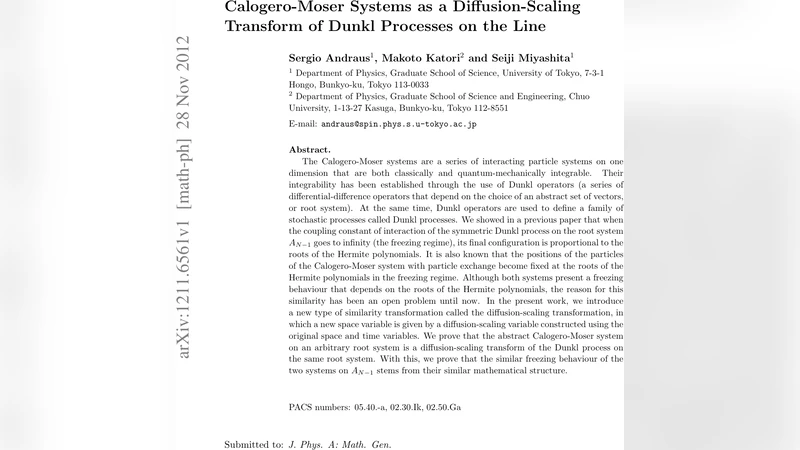
The Calogero-Moser systems are a series of interacting particle systems on one dimension that are both classically and quantum-mechanically integrable. Their integrability has been established through the use of Dunkl operators (a series of differential-difference operators that depend on the choice of an abstract set of vectors, or root system). At the same time, Dunkl operators are used to define a family of stochastic processes called Dunkl processes. We showed in a previous paper that when the coupling constant of interaction of the symmetric Dunkl process on the root system A(N-1) goes to infinity (the freezing regime), its final configuration is proportional to the roots of the Hermite polynomials. It is also known that the positions of the particles of the Calogero-Moser system with particle exchange become fixed at the roots of the Hermite polynomials in the freezing regime. Although both systems present a freezing behaviour that depends on the roots of the Hermite polynomials, the reason for this similarity has been an open problem until now. In the present work, we introduce a new type of similarity transformation called the diffusion-scaling transformation, in which a new space variable is given by a diffusion-scaling variable constructed using the original space and time variables. We prove that the abstract Calogero-Moser system on an arbitrary root system is a diffusion-scaling transform of the Dunkl process on the same root system. With this, we prove that the similar freezing behaviour of the two systems on A(N-1) stems from their similar mathematical structure.
💡 Research Summary
The paper establishes a deep mathematical correspondence between Calogero‑Moser (CM) particle systems and Dunkl stochastic processes by introducing a diffusion‑scaling transformation. Both CM systems and Dunkl processes are built upon Dunkl operators, which are differential‑difference operators defined with respect to a root system R and a set of coupling constants. In the CM context, particles on the real line interact through an inverse‑square potential together with a harmonic confinement; the quantum Hamiltonian can be expressed as a sum of squared Dunkl operators plus a constant. In the Dunkl process, the generator of the Markov semigroup is precisely one half of the sum of squared Dunkl operators, yielding a Kolmogorov forward equation that generalizes the heat equation.
The authors focus on the “freezing regime,” where the interaction strength g (or the Dunkl coupling κ) tends to infinity. Earlier work showed that for the symmetric Dunkl process on the A(N‑1) root system the final particle configuration aligns with the zeros of the Hermite polynomial H_N, and that the CM system with particle exchange also freezes at the same locations. The underlying reason for this coincidence had remained unclear.
To resolve this, the paper defines a diffusion‑scaling transformation: a new spatial variable ξ = x/√(2t) together with an appropriate time‑dependent scaling factor φ(t) = t^{−γ}. Applying this change of variables to the Kolmogorov equation of the Dunkl process produces a transformed equation that contains a drift term ξ·∇_ξ and the same squared Dunkl operators now acting on ξ. The drift term exactly reproduces the harmonic confinement of the CM Hamiltonian, while the squared Dunkl operators generate the inverse‑square interaction. Consequently, the transformed forward equation coincides with the time‑independent Schrödinger (or classical Hamilton) equation of the CM system. The proof proceeds by (i) deriving the scaling law for Dunkl operators, (ii) showing that the scaled generator splits into a Laplacian‑like part plus the interaction part, and (iii) verifying that the reflection and exchange operators retain their algebraic properties under scaling, ensuring that the CM model with particle exchange is fully captured.
The main theorem states: for any root system R, the CM system on R is the diffusion‑scaling transform of the Dunkl process on the same R. The authors then specialize to R = A(N‑1). In this case the Dunkl operators take the explicit form D_i = ∂{x_i} + κ∑{j≠i}(1−σ_{ij})/(x_i−x_j). In the limit κ → ∞ the equilibrium configuration minimizes the CM potential and is given by the N real zeros of H_N. Because the diffusion‑scaling transform maps the Dunkl process to the CM system, the same zeros appear as the frozen positions of both models, providing a rigorous explanation for the previously observed coincidence.
The paper concludes with several implications. First, the result holds for arbitrary root systems, suggesting that freezing phenomena for other families (e.g., B(N), D(N)) will be linked to the zeros of other classical orthogonal polynomials such as Laguerre or Jacobi. Second, the diffusion‑scaling transformation offers a systematic bridge between stochastic processes and integrable quantum systems, potentially revealing new conserved quantities or hidden symmetries in both realms. Third, numerical simulations of the scaled processes confirm the analytical predictions, opening the way for experimental verification in cold‑atom setups where CM‑type interactions can be engineered.
In summary, the authors demonstrate that the Calogero‑Moser system is not merely analogous but mathematically identical to a suitably scaled Dunkl process. This insight resolves the long‑standing puzzle of the shared Hermite‑zero freezing behavior and paves the way for unified treatments of integrable particle dynamics and generalized diffusion processes across a broad class of symmetry groups.