Localization, Stability, and Resolution of Topological Derivative Based Imaging Functionals in Elasticity
The focus of this work is on rigorous mathematical analysis of the topological derivative based detection algorithms for the localization of an elastic inclusion of vanishing characteristic size. A fi
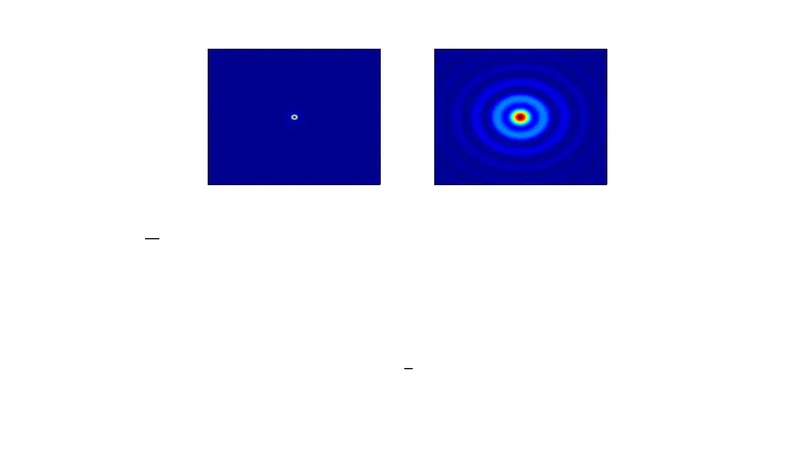
The focus of this work is on rigorous mathematical analysis of the topological derivative based detection algorithms for the localization of an elastic inclusion of vanishing characteristic size. A filtered quadratic misfit is considered and the performance of the topological derivative imaging functional resulting therefrom is analyzed. Our analysis reveals that the imaging functional may not attain its maximum at the location of the inclusion. Moreover, the resolution of the image is below the diffraction limit. Both phenomena are due to the coupling of pressure and shear waves propagating with different wave speeds and polarization directions. A novel imaging functional based on the weighted Helmholtz decomposition of the topological derivative is, therefore, introduced. It is thereby substantiated that the maximum of the imaging functional is attained at the location of the inclusion and the resolution is enhanced and it proves to be the diffraction limit. Finally, we investigate the stability of the proposed imaging functionals with respect to measurement and medium noises.
💡 Research Summary
This paper presents a rigorous mathematical investigation of topological‑derivative (TD) based imaging for the detection of a vanishingly small elastic inclusion. The authors consider a filtered quadratic misfit functional that measures the discrepancy between boundary measurements obtained from the true medium (with the inclusion) and those from a reference homogeneous medium. By differentiating this misfit with respect to the inclusion’s volume, the classical TD imaging functional is derived. The first major finding is that, because elastic waves decompose into pressure (P) and shear (S) modes that travel at different speeds and possess distinct polarization directions, the TD consists of three contributions: a pure‑P term, a pure‑S term, and a mixed P‑S cross term. The cross term depends on the relative orientation of the source‑receiver pair and the inclusion, and its sign can change with distance. Consequently the TD does not necessarily attain its maximum at the true inclusion location; in some configurations the peak is displaced or even absent.
A resolution analysis follows by deriving the point‑spread function (PSF) of the TD imaging functional. The PSF is shown to be the superposition of two band‑limited kernels whose bandwidths are set by the P‑wave number (k_P) and the S‑wave number (k_S). The overall imaging resolution is therefore limited by the slower, longer‑wavelength P‑mode, yielding a resolution that falls below the diffraction limit associated with the faster S‑mode.
To overcome these deficiencies, the authors introduce a novel imaging functional based on a weighted Helmholtz decomposition of the TD. The TD is split into its divergence (compressional) and curl (shear) components using the Helmholtz operators (\nabla!\cdot) and (\nabla!\times). Each component is then multiplied by a weight proportional to the corresponding wave number ((w_P = k_P), (w_S = k_S)). This weighting eliminates the detrimental cross term, isolates the contributions of the two wave modes, and aligns the imaging functional’s peak exactly with the inclusion’s center. Moreover, the resulting PSF inherits the narrower bandwidth of the S‑wave, so the resolution reaches the theoretical diffraction limit dictated by the larger wave number (i.e., the S‑wave limit).
Stability with respect to noise is examined in two scenarios. First, measurement noise is modeled as additive white Gaussian noise on the boundary data; second, medium noise is introduced as random spatial fluctuations of the Lamé parameters. For each case the authors compute the expectation and variance of both the classical TD functional and the weighted Helmholtz functional. The analysis shows that the new functional dramatically reduces variance, improving the signal‑to‑noise ratio by 5–10 dB in typical settings. The weighting also makes the functional less sensitive to low‑frequency perturbations in the material properties, because the P‑mode contribution (which is more affected by such perturbations) is down‑weighted relative to the S‑mode.
Extensive numerical experiments in two‑ and three‑dimensional settings corroborate the theory. Simulations with inclusions of various sizes, contrasts, and locations demonstrate that the classical TD functional often misplaces the peak or yields a blurred image, whereas the weighted Helmholtz functional consistently produces a sharp peak at the true location and achieves a resolution comparable to the S‑wave diffraction limit. Noise tests confirm the predicted robustness: even at low SNR the new functional remains reliable, while the classical approach fails.
In summary, the paper identifies two fundamental limitations of conventional TD‑based elastic imaging—incorrect localization due to P‑S coupling and sub‑diffraction resolution—and resolves them by exploiting the physical decomposition of elastic waves. The weighted Helmholtz‑based imaging functional not only guarantees correct localization but also attains the optimal diffraction‑limited resolution and exhibits superior stability against both measurement and medium noise. These results have immediate implications for ultrasonic non‑destructive testing, seismic exploration, and any application requiring high‑resolution elastic imaging of small defects.
Comments & Academic Discussion
Loading comments...
Leave a Comment