Decaying turbulence: what happens when the correlation length varies spatially in two adjacent zones
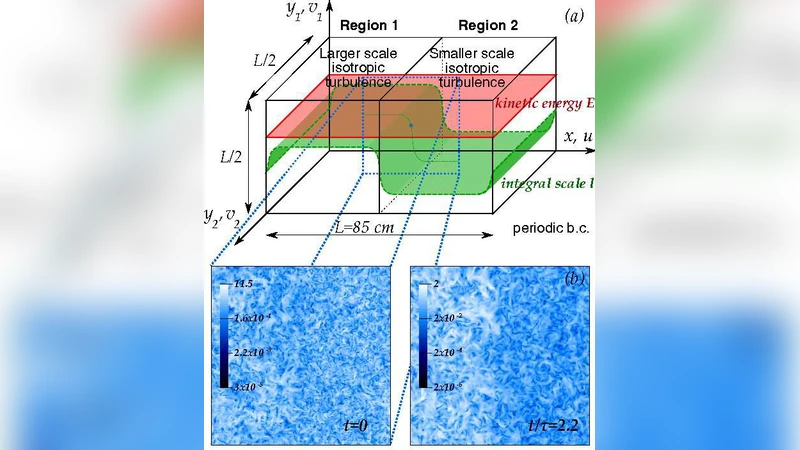
We have imagined a numerical experiment to explore the onset of turbulent intermittency associated with a spatial perturbation of the correlation length. We place two isotropic regions, with different integral scales, inside a volume where the turbulent kinetic energy is initially uniform and leave them to interact and evolve in time. The different length scales produce different decay rates in the two regions. Since the smaller-scale region decays faster, a transient turbulent energy gradient is generated at the interface between the two regions. The transient is characterized by three phases in which the kinetic energy gradient across the interface grows, peaks and then slowly decays. The transient lifetime is almost proportional to the initial ratio of the correlation lengths. The direct numerical simulations also show that the interface width grows in time. The velocity moments inside this interaction zone are seen to depart from their initial isotropic values and, with a certain lag, the anisotropy is seen to spread to small scales. The longitudinal derivative moments also become anisotropic after a few eddy turnover times. This anisotropic behaviour is different from that observed in sheared homogeneous turbulent flows, where high transverse derivative moments are generated, but longitudinal moments almost maintain the isotropic turbulence values. Apart from the behaviour of the energy gradient transients, the results also show the timescaling of the interface diffusion width, and data on the anisotropy of the large and small scales, observed through one-point statistics determined inside the intermittency sublayer, which is associated with the interaction zone.
💡 Research Summary
The paper investigates how a spatial variation of the turbulence integral scale (correlation length) influences the decay and intermittency of homogeneous isotropic turbulence. The authors construct a numerical experiment in which a cubic domain is filled with two adjacent isotropic turbulent fields that have different integral scales ℓ₁ and ℓ₂ but identical initial turbulent kinetic energy (TKE). The fields are blended across a thin transition layer using a smooth hyperbolic‑tangent weighting function and a small random correction to guarantee a uniform energy distribution. Periodic boundary conditions are applied in all three directions, and the incompressible Navier–Stokes equations are solved with a pseudo‑spectral Fourier‑Galerkin method (fourth‑order explicit time integration). Three cases are simulated with ℓ₁/ℓ₂ = 1.5, 2.1 and 2.8; the corresponding Taylor‑microscale Reynolds numbers range from about 70 to 150.
Because the decay rate of turbulent kinetic energy depends on the low‑wavenumber part of the spectrum, the region with the smaller integral scale (steeper low‑k slope, close to k⁴) decays faster than the larger‑scale region (k² slope). Consequently a transient TKE gradient ∂E/∂x develops at the interface. The gradient evolves through three distinct phases: an initial growth phase, a peak‑value phase, and a slow decay phase. The lifetime of the whole transient, defined as the time when the nondimensional gradient falls below 0.05, scales almost linearly with the initial scale ratio ℓ₁/ℓ₂. For the three cases the lifetimes are roughly 2, 4 and 6 large‑eddy turnover times, respectively.
The width of the mixing layer, defined as the distance between the points where the normalized energy profile reaches 0.25 and 0.75, expands roughly linearly with time, indicating a diffusion‑like spreading of the interface. This widening is consistent with earlier wind‑tunnel measurements and two‑dimensional simulations of scalar mixing layers.
Statistical analysis inside the interaction zone reveals a clear departure from isotropy. The longitudinal velocity derivative ∂u/∂x exhibits a rapid increase in skewness (S) and kurtosis (K), while the transverse derivative ∂v/∂y remains close to its homogeneous‑isotropic values. The relationship K ≈ 3 + a S² holds with a ≈ 2.5 for all three cases, showing that the growth of higher‑order moments is governed by a simple quadratic law. This behaviour contrasts with homogeneous shear turbulence, where transverse derivative moments dominate and longitudinal moments stay near isotropic values.
The authors also quantify the scaling of the energy‑gradient peak, the delay time to reach that peak, and the overall transient duration as functions of ℓ₁/ℓ₂. The peak gradient scales proportionally to the scale ratio, while the delay time scales with a factor of about 0.5 large‑eddy turnover times per unit increase in ℓ₁/ℓ₂. The decay exponents of the two regions are measured: the large‑scale region (k² spectrum) decays with an exponent ≈ ‑1.15, close to Saffman’s prediction, whereas the small‑scale region shows increasingly negative exponents (‑1.30, ‑1.46, ‑1.65) as the scale ratio grows, reflecting the approach to a k⁴ low‑k spectrum.
Overall, the study demonstrates that a mere spatial perturbation of the correlation length—without any imposed mean shear or external forcing—can generate a transient energy gradient, cause the interface to diffuse, and induce anisotropy that propagates from large to small scales. The findings provide a new “scale‑imbalance” mechanism for turbulence intermittency and anisotropy, complementary to the classic shear‑induced mechanisms. This insight is relevant for high‑Reynolds‑number turbulence modelling, atmospheric and oceanic boundary‑layer studies, and engineering applications involving mixing of flows with different integral scales.
Comments & Academic Discussion
Loading comments...
Leave a Comment