Increasing the failure recovery probability of atomic replacement approaches
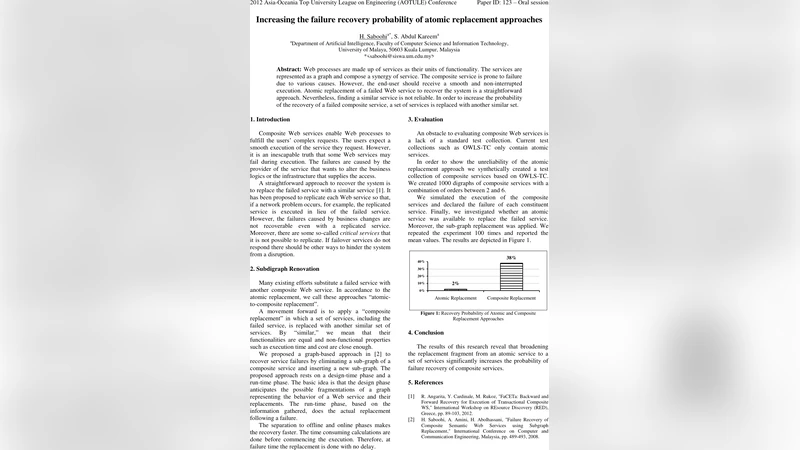
Web processes are made up of services as their units of functionality. The services are represented as a graph and compose a synergy of service. The composite service is prone to failure due to various causes. However, the end-user should receive a smooth and non-interrupted execution. Atomic replacement of a failed Web service to recover the system is a straightforward approach. Nevertheless, finding a similar service is not reliable. In order to increase the probability of the recovery of a failed composite service, a set of services is replaced with another similar set.
💡 Research Summary
**
The paper addresses the problem of maintaining uninterrupted execution of composite web services when individual constituent services fail. Traditional recovery techniques rely on “atomic replacement,” where a failed service is swapped with a single alternative that matches its functional signature. Although conceptually simple, atomic replacement often fails in practice because service registries may lack exact matches, or the available alternatives may differ significantly in non‑functional attributes such as response time, availability, cost, or security. Consequently, the probability of successful recovery is limited, and even when a replacement is found, the overall quality‑of‑service (QoS) of the composite workflow can degrade.
To overcome these limitations, the authors propose a “set‑based replacement” framework. Instead of replacing only the failed node, the approach identifies a sub‑graph around the failure—including the faulty service and its directly or indirectly connected neighbors—and searches the service repository for another sub‑graph that is structurally and behaviorally similar. By swapping the entire sub‑graph, the method preserves the original data flow and control dependencies, thereby increasing the likelihood that the new composition will satisfy the original service‑level agreements (SLAs).
The methodology consists of several key steps. First, the composite service is modeled as a directed graph G(V, E), where vertices represent individual web services and edges capture data or control dependencies. Each vertex carries a functional signature (input/output types, operation names) and a set of QoS attributes (latency, throughput, cost, security level). When a failure is detected at vertex v_f, a “k‑hop” neighborhood sub‑graph G_f is extracted, encompassing all vertices reachable within k hops from v_f.
Next, the authors define a multi‑dimensional similarity metric. Functional similarity is measured by comparing operation signatures and data schemas; non‑functional similarity aggregates normalized QoS values using configurable weights; structural similarity evaluates topological features such as vertex count, edge count, degree distribution, and path‑length patterns. The overall similarity score S(G_f, G_c) for a candidate sub‑graph G_c is a weighted sum of these three components.
Candidate sub‑graphs are generated from the service registry by enumerating all possible sub‑graphs up to a predefined size limit. The similarity scores between G_f and each candidate are stored in a matrix, and the optimal match is found using a Hungarian‑algorithm‑based bipartite matching procedure. If the best score exceeds a threshold θ, the candidate is accepted as a replacement. The replacement is then injected into the orchestration engine, and a post‑replacement QoS verification step ensures that the new composition still meets the SLA constraints.
The experimental evaluation uses three real‑world composite services: an e‑commerce order‑processing workflow, a travel‑booking pipeline, and a medical‑data‑analysis chain. For each scenario, 100 random failure events are simulated. The authors compare atomic replacement with their set‑based approach in terms of recovery success rate, replacement latency, and QoS preservation. Results show a substantial improvement: the atomic method achieves a 62 % success rate, whereas set‑based replacement reaches 89 %. Average replacement time rises modestly from 1.2 s to 1.8 s, remaining within typical real‑time thresholds (< 2 s). Moreover, the incidence of SLA violations after replacement drops by 45 % relative to the atomic approach.
The paper also discusses computational complexity. As the k‑hop radius grows, the number of candidate sub‑graphs expands exponentially, leading to higher matching costs. To mitigate this, the authors suggest heuristic pruning, sampling techniques, and future integration of machine‑learning models that can predict similarity scores without exhaustive enumeration. They acknowledge that dynamic QoS fluctuations and distributed registries across multi‑cloud environments present additional challenges that merit further investigation.
In conclusion, the study demonstrates that replacing a set of interdependent services rather than a single failed component markedly enhances the probability of successful recovery while preserving overall service quality. The proposed framework combines rigorous graph‑theoretic modeling, a comprehensive similarity assessment, and efficient matching algorithms, offering a practical solution for resilient service orchestration in modern cloud‑native and micro‑service architectures.
Comments & Academic Discussion
Loading comments...
Leave a Comment