Restriction categories as enriched categories
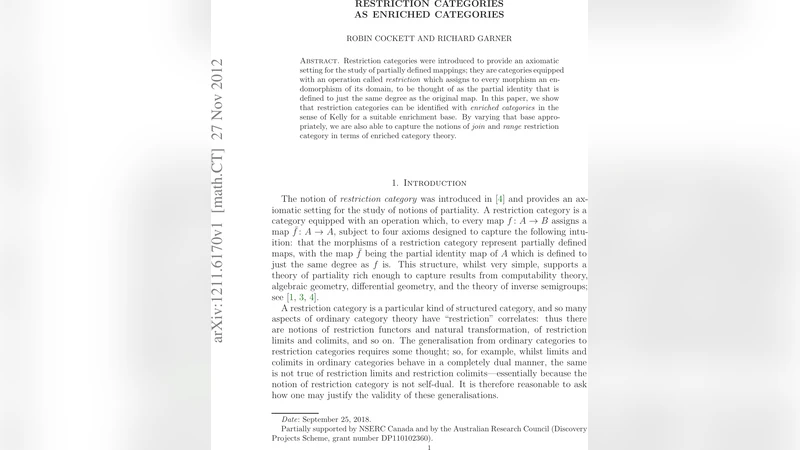
Restriction categories were introduced to provide an axiomatic setting for the study of partially defined mappings; they are categories equipped with an operation called restriction which assigns to every morphism an endomorphism of its domain, to be thought of as the partial identity that is defined to just the same degree as the original map. In this paper, we show that restriction categories can be identified with \emph{enriched categories} in the sense of Kelly for a suitable enrichment base. By varying that base appropriately, we are also able to capture the notions of join and range restriction category in terms of enriched category theory.
💡 Research Summary
This paper establishes a precise equivalence between restriction categories and enriched categories in the sense of Kelly, thereby embedding the theory of partially defined maps into the well‑developed framework of enriched category theory. A restriction category is a category equipped with a unary operation (\bar{(\ )}) assigning to each morphism (f\colon A\to B) an idempotent endomorphism (\bar f\colon A\to A) that captures the domain of definition of (f). The operation satisfies a small set of axioms (e.g., (\bar f\circ f = f), (\bar g\circ\bar f = \bar f\circ\bar g), and (\bar f\circ\bar g\circ f = \bar f\circ g)). These axioms model partiality in a categorical setting and have been used to study partial functions, partial programs, and database schema mappings.
The authors construct a suitable enrichment base (\mathcal V) – a symmetric monoidal closed category whose objects are “restriction algebras”, i.e., lattices of partial identities equipped with a natural order and a tensor product that models composition of partial maps. In this setting, hom‑objects of a (\mathcal V)-enriched category are not mere sets but elements of (\mathcal V) that encode the degree of definition of morphisms. The main theorem shows that any restriction category (\mathcal C) gives rise to a (\mathcal V)-enriched category (\mathcal C_{\mathcal V}) by interpreting (\bar f) as the enrichment hom‑object, and conversely, any (\mathcal V)-enriched category yields a restriction category by extracting the underlying idempotent endomorphisms. The proof builds explicit isomorphisms on objects and morphisms and verifies that the enrichment structure respects the restriction axioms.
By varying the enrichment base, the authors also capture two important extensions. When (\mathcal V) is enriched with join operations (making its underlying lattice a join‑semilattice), the resulting enriched categories correspond exactly to join restriction categories, where compatible families of partial maps admit a least upper bound. When (\mathcal V) is equipped with a “range” operation that assigns to each morphism a canonical image object, the enriched categories model range restriction categories, which support a well‑behaved notion of image. In both cases the same enrichment‑theoretic machinery yields a clean categorical characterisation.
The significance of this work lies in unifying the algebraic study of partiality with the powerful tools of enriched category theory. It opens the door to applying monoidal closed techniques, weighted limits, and enriched Yoneda lemmas to restriction categories, and suggests new avenues for modelling partial computation, database theory, and related areas within a single, elegant categorical framework.
Comments & Academic Discussion
Loading comments...
Leave a Comment