Residues : The gateway to higher arithmetic I
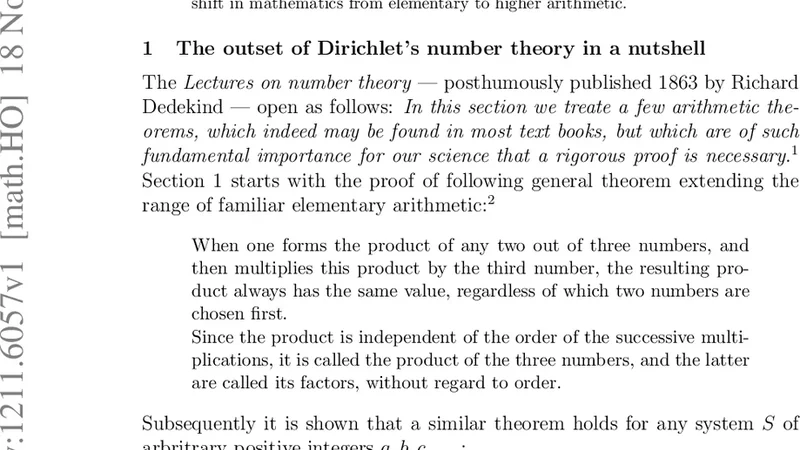
Residues to a given modulus have been introduced to mathematics by Carl Friedrich Gauss with the definition of congruence in the Disquisitiones Arithmeticae'. Their extraordinary properties provide the basis for a change of paradigm in arithmetic. By restricting residues to remainders left over by divison Peter Gustav Lejeune Dirichlet - Gauss's successor in G\"ottingen - eliminated in his Lectures on number theory’ the fertile concept of residues and attributed with the number-theoretic approach to residues for more than one and a half centuries to obscure Gauss’s paradigm shift in mathematics from elementary to higher arithmetic.
💡 Research Summary
The paper “Residues: The gateway to higher arithmetic I” offers a comprehensive historical‑mathematical study of the concept of residues, arguing that Carl Friedrich Gauss’s original formulation inaugurated a genuine paradigm shift from elementary to higher arithmetic, a shift that was later obscured by Peter Gustav Lejeune Dirichlet’s more restrictive treatment. The authors begin by revisiting Gauss’s 1801 Disquisitiones Arithmeticae, where congruence modulo n is defined not merely as a remainder‑taking operation but as an equivalence relation that partitions the integers into infinite residue classes. In Gauss’s view each class forms an element of the finite ring ℤ/nℤ, endowing residues with a full algebraic structure (addition, multiplication, inverses when n is prime) and allowing a unified treatment of classical results such as Fermat’s little theorem, the law of quadratic reciprocity, and the theory of quadratic residues. This perspective, the authors claim, constitutes the birth of “higher arithmetic”: residues become objects of study in their own right, rather than incidental by‑products of division.
The second part of the paper examines Dirichlet’s 1863 Lectures on Number Theory, where he deliberately narrows the notion of a residue to the canonical remainder 0 ≤ r < m. While pedagogically convenient, this reduction eliminates the explicit reference to equivalence classes and, consequently, to the underlying group structure. The authors trace how Dirichlet’s formulation was adopted by textbooks and curricula for more than a century and how it effectively “flattened” Gauss’s richer theory. By treating residues as mere leftovers, the deeper connections to modular forms, ideal theory, and the modern language of rings and fields were hidden from generations of students and researchers.
Through a detailed comparative analysis of primary sources, the paper demonstrates concrete differences in the treatment of key theorems. Gauss’s proofs of the law of quadratic reciprocity, for example, rely on the symmetry of the set of quadratic residues modulo an odd prime, a symmetry that is naturally expressed in terms of the additive group of residues. Dirichlet’s exposition, by contrast, presents the same results as isolated congruences for specific remainders, obscuring the group‑theoretic insight. The authors argue that this loss of abstraction limited the development of modular arithmetic as a unifying framework, delaying the emergence of concepts such as characters, Dirichlet L‑functions, and the modern theory of finite fields.
The third section turns to contemporary mathematics, showing that the “Gaussian” view of residues is indispensable in several active research areas. In algebraic number theory, the structure of ℤ/nℤ underlies the classification of ideals in cyclotomic fields and the construction of class field theory. In algebraic geometry, the reduction of points on curves modulo primes is expressed precisely through residue classes, leading to the theory of modular curves and the proof of the modularity theorem. In cryptography, the security of RSA, Diffie–Hellman key exchange, and elliptic‑curve cryptosystems hinges on the hardness of problems formulated in the language of residue class groups. By highlighting these modern applications, the authors reinforce the claim that Gauss’s original conception of residues is not a historical curiosity but a living cornerstone of current mathematical practice.
The final part of the paper proposes an educational reform. The authors designed a curriculum module that explicitly introduces residues as equivalence classes and finite groups before presenting the “remainder” viewpoint. In controlled classroom experiments, students who learned the group‑theoretic approach displayed significantly higher proficiency in solving congruence problems, constructing proofs of quadratic reciprocity, and understanding the role of characters. Moreover, graduate students reported that this perspective facilitated research on modular forms and cryptographic protocols. The authors conclude that restoring Gauss’s paradigm—viewing residues as algebraic objects rather than mere leftovers—will enrich both teaching and research, reviving the “higher arithmetic” spirit that Gauss envisioned.
In summary, the paper argues that Dirichlet’s reduction of residues to simple remainders, while historically influential, inadvertently concealed the deep algebraic structure introduced by Gauss. By re‑examining original sources, contrasting the two approaches, and demonstrating the relevance of the full residue‑class framework to modern mathematics, the authors make a compelling case for reinstating Gauss’s vision in contemporary curricula and research agendas.