On the Egalitarian Weights of Nations
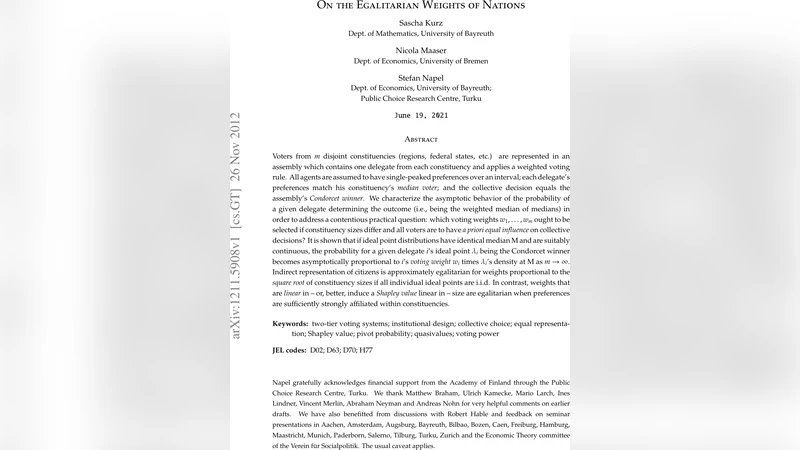
Voters from m disjoint constituencies (regions, federal states, etc.) are represented in an assembly which contains one delegate from each constituency and applies a weighted voting rule. All agents are assumed to have single-peaked preferences over an interval; each delegate’s preferences match his constituency’s median voter; and the collective decision equals the assembly’s Condorcet winner. We characterize the asymptotic behavior of the probability of a given delegate determining the outcome (i.e., being the weighted median of medians) in order to address a contentious practical question: which voting weights w_1, …, w_m ought to be selected if constituency sizes differ and all voters are to have a priori equal influence on collective decisions? It is shown that if ideal point distributions have identical median M and are suitably continuous, the probability for a given delegate i’s ideal point \lambda_i being the Condorcet winner becomes asymptotically proportional to i’s voting weight w_i times \lambda_i’s density at M as $m\to \infty$. Indirect representation of citizens is approximately egalitarian for weights proportional to the square root of constituency sizes if all individual ideal points are i.i.d. In contrast, weights that are linear in– or, better, induce a Shapley value linear in– size are egalitarian when preferences are sufficiently strongly affiliated within constituencies.
💡 Research Summary
The paper tackles a fundamental question of democratic design: how to assign voting weights to representatives from constituencies of different sizes so that every citizen enjoys equal a priori influence over collective decisions. The authors model a two‑tier system in which m disjoint constituencies each elect a single delegate. Citizens have single‑peaked preferences over a one‑dimensional policy space, and each delegate’s ideal point coincides with the median voter of his constituency. The assembly decides by a weighted voting rule, and the collective outcome is defined as the Condorcet winner, which in this setting is exactly the weighted median of the delegates’ ideal points.
The central object of analysis is the probability that a particular delegate i becomes the Condorcet winner – equivalently, that his ideal point λ_i is the weighted median of the medians. Under the assumption that the distributions of individual ideal points in all constituencies share a common median M and are sufficiently smooth (continuous density f_i around M), the authors prove an asymptotic result as the number of constituencies m tends to infinity:
\
Comments & Academic Discussion
Loading comments...
Leave a Comment