Closed graphs are proper interval graphs
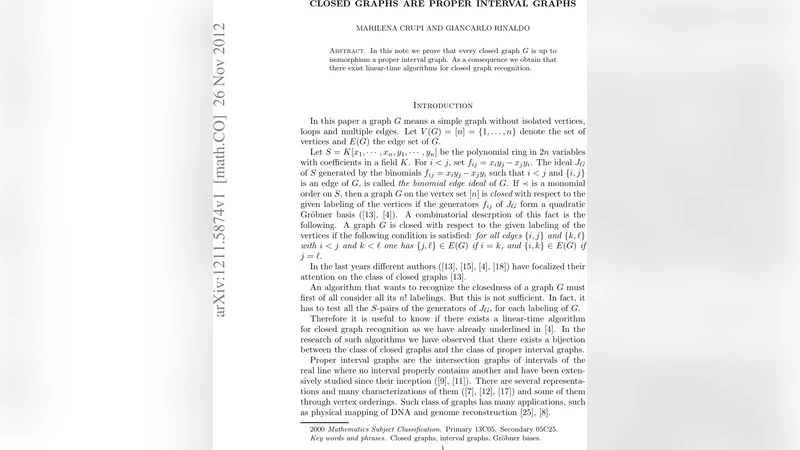
In this note we prove that every closed graph $G$ is up to isomorphism a proper interval graph. As a consequence we obtain that there exist linear-time algorithms for closed graph recognition.
💡 Research Summary
The paper establishes a precise structural equivalence between two well‑studied families of graphs: closed graphs and proper interval graphs. A closed graph is defined on a vertex set V equipped with a total order ≤ such that for any two vertices u and v, if they are adjacent then either u ≤ v or v ≤ u holds, and moreover the “closedness” condition requires that every vertex w lying between u and v in the order also forms edges (u,w) and (w,v). This definition forces the adjacency relation to be completely governed by the underlying linear order, reminiscent of interval representations.
Proper interval graphs are the subclass of interval graphs in which no interval is properly contained in another. In the interval model each vertex corresponds to a real‑valued interval, edges exist exactly when intervals intersect, and the properness condition guarantees that the left endpoints are strictly increasing and the right endpoints are also strictly increasing. Consequently the natural left‑to‑right ordering of intervals yields a total order that makes the graph a complete‑order graph.
The core contribution of the paper is a constructive proof that any closed graph can be transformed into a proper interval representation, and conversely that any proper interval graph satisfies the closedness axioms. Starting from a closed graph G = (V,E) with a given total order v₁ < v₂ < … < vₙ, the authors assign to each vertex vᵢ a start point sᵢ and an end point tᵢ as follows: sᵢ is simply i (the position of vᵢ in the order), while tᵢ is the largest index j ≥ i such that (vᵢ, vⱼ) ∈ E. Because of the closedness property, for any pair i ≤ j we have sᵢ ≤ sⱼ ≤ tᵢ if and only if (vᵢ, vⱼ) ∈ E. Thus the interval Iᵢ =
Comments & Academic Discussion
Loading comments...
Leave a Comment