Jets and gamma-ray emission from isolated accreting black holes
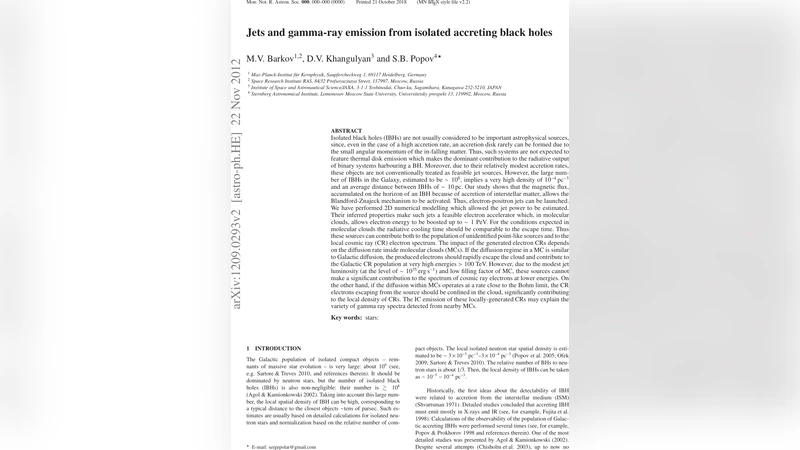
The large number of isolated black holes (IBHs) in the Galaxy, estimated to be 10^8, implies a very high density of 10^-4 pc^-3 and an average distance between IBHs of 10 pc. Our study shows that the magnetic flux, accumulated on the horizon of an IBH because of accretion of interstellar matter, allows the Blandford-Znajeck mechanism to be activated. Thus, electron-positron jets can be launched. We have performed 2D numerical modelling which allowed the jet power to be estimated. Their inferred properties make such jets a feasible electron accelerator which, in molecular clouds, allows electron energy to be boosted up to 1 PeV. For the conditions expected in molecular clouds the radiative cooling time should be comparable to the escape time. Thus these sources can contribute both to the population of unidentified point-like sources and to the local cosmic ray (CR) electron spectrum. The impact of the generated electron CRs depends on the diffusion rate inside molecular clouds (MCs). If the diffusion regime in a MC is similar to Galactic diffusion, the produced electrons should rapidly escape the cloud and contribute to the Galactic CR population at very high energies >100 TeV. However, due to the modest jet luminosity (at the level of 10^35 erg s^-1) and low filling factor of MC, these sources cannot make a significant contribution to the spectrum of cosmic ray electrons at lower energies. On the other hand, if the diffusion within MCs operates at a rate close to the Bohm limit, the CR electrons escaping from the source should be confined in the cloud, significantly contributing to the local density of CRs. The IC emission of these locally-generated CRs may explain the variety of gamma ray spectra detected from nearby MCs.
💡 Research Summary
The paper investigates a previously under‑explored population of isolated black holes (IBHs) in the Milky Way and proposes that they can act as modest but numerous accelerators of electrons and producers of high‑energy γ‑rays. Using population estimates of ∼10⁸ IBHs, the authors infer a mean space density of 10⁻⁴ pc⁻³, corresponding to an average separation of roughly 10 pc. Even though each IBH resides in a low‑density interstellar medium (n≈1 cm⁻³, T≈10⁴ K), continuous Bondi‑type accretion supplies a modest mass‑inflow rate (∼10¹⁰ g s⁻¹). The inflowing gas drags magnetic field lines onto the event horizon, building up a magnetic flux that can reach the threshold required for the Blandford‑Znajek (BZ) mechanism to operate. When the black hole spin is non‑zero, the BZ process extracts rotational energy and launches a relativistic electron‑positron jet.
To quantify the jet power and structure, the authors perform two‑dimensional axisymmetric magnetohydrodynamic (MHD) simulations. The simulations start from a quasi‑steady accretion flow with a prescribed magnetic field topology and follow the development of a collimated outflow. The resulting jet power is of order 10³⁵ erg s⁻¹, substantially lower than that of typical supernova remnants or pulsar wind nebulae, but the sheer number of IBHs makes the collective contribution potentially significant. Within the jet, strong electric fields and shock fronts accelerate electrons to a power‑law distribution extending up to PeV energies, especially when the jet penetrates a dense molecular cloud (MC). In such environments (n≈10³–10⁴ cm⁻³, B≈10–100 µG) the cooling time due to synchrotron and inverse‑Compton (IC) losses becomes comparable to the escape time from the cloud, allowing electrons to retain PeV energies long enough to escape.
A central theme of the paper is the role of particle diffusion inside MCs. If diffusion proceeds at the Galactic average rate (D≈10²⁸ (E/1 GeV)^0.3 cm² s⁻¹), high‑energy electrons (>100 TeV) leave the cloud on timescales of a few hundred years, quickly joining the Galactic cosmic‑ray (CR) electron pool. Consequently, IBH jets could supply a steady, hard component to the CR electron spectrum at the highest energies, although their modest individual luminosities and the low filling factor of MCs prevent them from dominating the spectrum below ∼10 TeV. Conversely, if diffusion is strongly suppressed, approaching the Bohm limit (D_Bohm≈r_L c/3), electrons become trapped for Myr‑scale periods. In this regime the locally generated CR electrons build up a high density inside the cloud, and their IC scattering of the cosmic microwave background and ambient starlight produces γ‑ray emission with a wide variety of spectral shapes. The authors argue that such trapped‑electron scenarios can naturally explain many of the unidentified point‑like γ‑ray sources detected by Fermi‑LAT and ground‑based Cherenkov telescopes, especially those spatially coincident with MCs.
The paper also discusses observational implications. The predicted jet power (∼10³⁵ erg s⁻¹) yields a γ‑ray luminosity of order 10³³–10³⁴ erg s⁻¹ for typical MC parameters, compatible with the fluxes of several unidentified TeV sources. Moreover, the hard electron spectrum injected by IBH jets could account for the observed steepening of the local CR electron spectrum above ∼10 TeV, a feature that is difficult to reconcile with supernova‑remnant‑only models. The authors suggest that future high‑resolution γ‑ray observations (e.g., CTA) combined with radio and infrared surveys of MCs could test the diffusion‑suppression hypothesis and potentially identify individual IBH jet candidates.
Finally, the authors acknowledge limitations and outline future work. The current study relies on 2‑D simulations; full 3‑D relativistic MHD calculations are needed to capture jet stability, magnetic reconnection, and possible precession effects. Direct measurements of IBH spin and magnetic field strength remain challenging, so population synthesis models with a range of spin parameters are required. Crucially, constraining the diffusion coefficient inside MCs—perhaps via multi‑wavelength studies of CR secondary products—will determine whether IBH‑generated electrons escape rapidly or remain confined. The paper concludes that isolated black holes, though individually faint, constitute a previously unrecognized class of Galactic particle accelerators that can contribute to both the high‑energy γ‑ray sky and the ultra‑high‑energy tail of the cosmic‑ray electron spectrum.