On Computing the Shadows and Slices of Polytopes
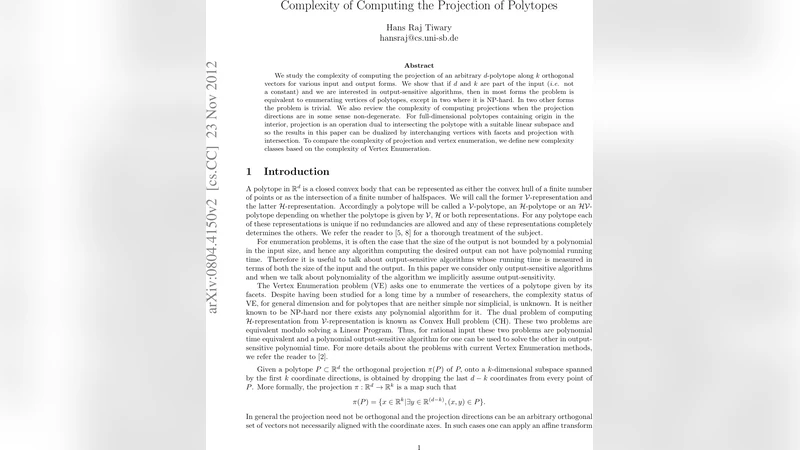
We study the complexity of computing the projection of an arbitrary $d$-polytope along $k$ orthogonal vectors for various input and output forms. We show that if $d$ and $k$ are part of the input (i.e. not a constant) and we are interested in output-sensitive algorithms, then in most forms the problem is equivalent to enumerating vertices of polytopes, except in two where it is NP-hard. In two other forms the problem is trivial. We also review the complexity of computing projections when the projection directions are in some sense non-degenerate. For full-dimensional polytopes containing origin in the interior, projection is an operation dual to intersecting the polytope with a suitable linear subspace and so the results in this paper can be dualized by interchanging vertices with facets and projection with intersection. To compare the complexity of projection and vertex enumeration, we define new complexity classes based on the complexity of Vertex Enumeration.
💡 Research Summary
The paper investigates the computational complexity of projecting (or “shadowing”) an arbitrary d‑dimensional polytope onto a k‑dimensional subspace spanned by k orthogonal vectors. The authors consider all combinations of input and output representations: V‑representation (vertices), H‑representation (facets/inequalities), and the mixed HV‑representation. For each of the nine possible input‑output pairs they ask whether an output‑sensitive polynomial‑time algorithm exists, and they classify the problems into three categories: (i) VE‑complete (equivalent to the classic Vertex Enumeration problem), (ii) NP‑hard, and (iii) trivially polynomial.
Key technical contributions:
-
Trivial cases – When the polytope is given by its vertices (V‑ or HV‑input) and the desired output is also a V‑representation, the projection can be performed by projecting each vertex and then discarding redundancies via a linear program per vertex. This yields a polynomial‑time algorithm.
-
Equivalence to Vertex Enumeration – The authors prove that computing the H‑ or HV‑representation of the projection of a polytope given in V‑ or HV‑form is VE‑complete. The reduction works both ways: any VE algorithm can be used to compute the projection, and any algorithm that computes the projection can be used to enumerate vertices of an arbitrary polytope. This establishes a new complexity class “VE‑complete” that captures problems of the same difficulty as Vertex Enumeration.
-
NP‑hardness for H‑input – When the input is an H‑polytope and the output is either a V‑representation (vertices of the projection) or an H‑representation (facets of the projection), the problem becomes NP‑hard. The proof reduces the known NP‑complete problem of testing containment of an H‑polytope inside a V‑polytope to the decision version “does a given H‑polytope Q equal the projection π(P) of a higher‑dimensional H‑polytope P?”. By constructing P in the form { (x,y) | Ax + By ≤ 1 } and Q = { x | A′x ≤ 1 }, the authors show that deciding Q = π(P) is equivalent to the containment test, thus inheriting NP‑completeness.
-
Balas’ cone construction – To handle the case where the input is H‑represented and the output is the mixed HV‑form, the paper revisits Balas’ construction of a polynomial‑size polyhedral cone W whose extreme rays correspond one‑to‑one with the facets of π(P). By taking the polar dual of W and intersecting with a suitable half‑space, the authors obtain a bounded polytope P′ whose projection’s vertices correspond to the facets of the original projection. This yields a VE‑complete reduction for the H‑to‑HV case.
-
Non‑degenerate projection directions – The authors also study the situation where the projection directions satisfy a generic (non‑degenerate) condition. In this regime, known algorithms based on Fourier‑Motzkin elimination, or on the methods of Amenta‑Ziegler and Jones‑Kerrigan‑Maciejowski, can compute the projection in output‑sensitive polynomial time. The paper classifies these cases as “VE‑easy”: an oracle for Vertex Enumeration suffices to obtain a polynomial‑time solution.
-
Complexity tables – Table 1 summarizes the nine input‑output combinations for arbitrary projection directions, indicating which are VE‑complete, NP‑hard, or trivial. Table 2 does the same for non‑degenerate directions, showing that many previously hard cases become VE‑easy.
-
Duality perspective – For full‑dimensional polytopes containing the origin in their interior, projection is dual to intersecting the polytope with a complementary linear subspace. Consequently, all results can be dualized: vertices ↔ facets and projection ↔ intersection.
The paper’s broader impact is highlighted by the observation that many applied fields—control theory, constraint logic programming, constraint query languages—frequently require polytope projections. Hence, any breakthrough in output‑sensitive vertex enumeration would immediately translate into efficient algorithms for these applications. Conversely, the NP‑hardness results explain why no output‑sensitive polynomial algorithm is known for the general H‑to‑V or H‑to‑H projection problems unless P = NP.
In summary, the authors provide a comprehensive complexity classification of polytope projection problems, introduce new complexity classes anchored on Vertex Enumeration, prove NP‑hardness for several natural cases, and connect these findings to existing algorithms for non‑degenerate projections. The work clarifies the theoretical limits of projection computation and sets a clear agenda for future research on output‑sensitive vertex enumeration.
Comments & Academic Discussion
Loading comments...
Leave a Comment