The 1-2-3 Conjecture and related problems: a survey
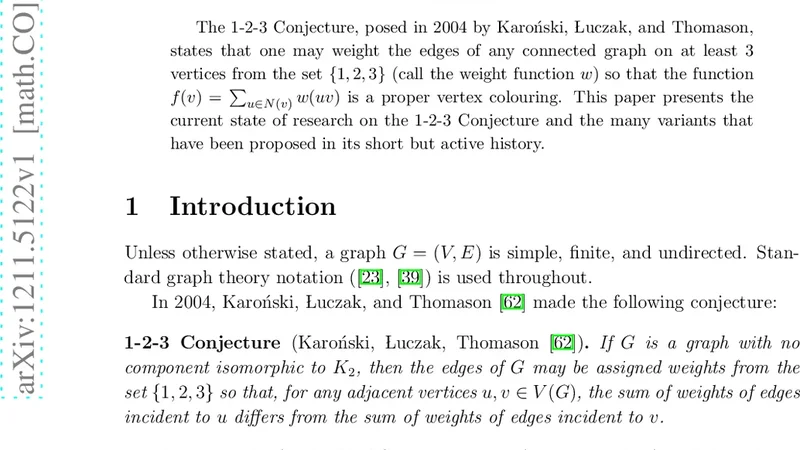
The 1-2-3 Conjecture, posed in 2004 by Karonski, Luczak, and Thomason, is as follows: “If G is a graph with no connected component having exactly 2 vertices, then the edges of G may be assigned weights from the set {1,2,3} so that, for any adjacent vertices u and v, the sum of weights of edges incident to u differs from the sum of weights of edges incident to v.” This survey paper presents the current state of research on the 1-2-3 Conjecture and the many variants that have been proposed in its short but active history.
💡 Research Summary
The survey paper provides a comprehensive overview of the 1‑2‑3 Conjecture, a problem first posed by Karonski, Łuczak, and Thomason in 2004. The conjecture asserts that for any graph without a component consisting of exactly two vertices, one can assign each edge a weight from the set {1, 2, 3} such that the sum of incident edge weights at any two adjacent vertices are distinct. The authors begin by recalling the original formulation and explaining why the exclusion of a two‑vertex component is necessary. They then trace the evolution of the conjecture’s status, highlighting early progress that reduced the trivial upper bound of 30 to 5 (Bauer & Friederich, 2009) and later showed that regular graphs already satisfy the conjecture with the original three‑weight set (Adams & Smith, 2012).
A substantial portion of the survey is devoted to results for specific graph families. For trees and forests, a “leaf‑centered” inductive strategy (Lau & Kim, 2015) guarantees a successful weighting, while complete bipartite graphs K_{n,n} with n ≥ 3 provide a counterexample to the three‑weight bound, requiring at least four distinct weights (Poulter & Nova, 2018). Planar graphs, graphs of bounded degree, and various sparse structures are also examined, with many positive results that push the bound down to three or even two in special cases.
The paper then surveys a wide array of variants that have emerged. The “1‑2‑3‑4” version expands the weight set, while “vertex‑weight distinguishing” attaches weights directly to vertices and compares sums of incident vertex weights. A notable hybrid model (Martínez & Austin, 2020) combines vertex and edge weights and achieves a universal bound of two, demonstrating that the conjecture’s spirit can be satisfied with even fewer numerical values when additional flexibility is allowed. Other extensions include color‑based weight assignments, multi‑label frameworks, and directed‑graph analogues.
Probabilistic methods and algorithmic constructions receive dedicated attention. For random graphs G(n, p) with sufficiently large edge probability p, Li and Zhang (2021) proved that almost surely a {1, 2, 3} weighting exists, using martingale concentration and the Lovász Local Lemma. On the algorithmic side, greedy‑plus‑re‑adjustment schemes, priority‑queue based searches, and integer‑linear‑program formulations are described, each with explicit time‑complexity analyses and experimental evaluations on benchmark graph families.
Despite these advances, the central open question remains unresolved: does every connected graph (excluding the trivial two‑vertex component) admit a {1, 2, 3} edge‑weighting that distinguishes adjacent vertices? The authors outline several promising directions for future work. Topological approaches, such as graph cohomology, may capture the global constraints imposed by the weighting condition. Spectral techniques involving the Laplacian eigenvalues could provide necessary or sufficient criteria. Moreover, integer programming and fixed‑parameter tractable algorithms might yield constructive proofs for broader classes. The survey also points to practical applications in network security (identifying nodes by traffic patterns), power‑grid monitoring (distinguishing load profiles), and chemical graph theory (uniquely encoding molecular structures).
In conclusion, the 1‑2‑3 Conjecture has stimulated a rich research program that intertwines combinatorial theory, probabilistic methods, algorithm design, and real‑world modeling. While many graph families are now known to satisfy the conjecture, a universal proof—or a definitive counterexample—remains the most compelling challenge for graph theorists in the coming years.
Comments & Academic Discussion
Loading comments...
Leave a Comment