Il Santo Sepolcro, orientamento astronomico della basilica e le omelie di san Cirillo di Gerusalemme
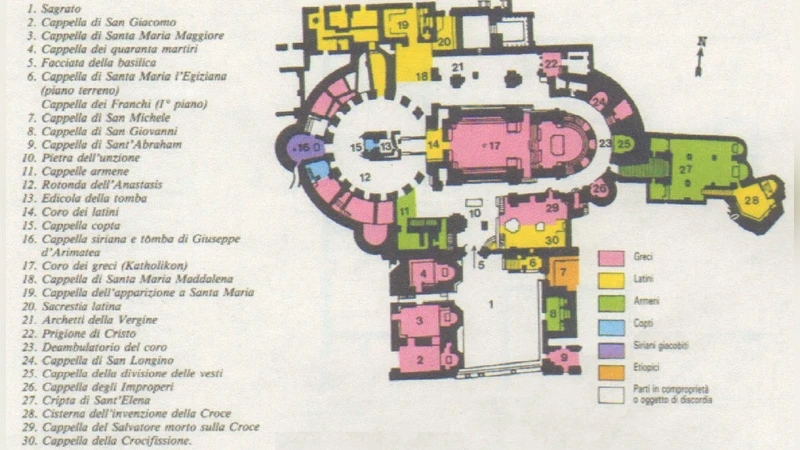
On the spur of Calvary the Shroud appears. On this rock the Scriptures are fulfilled, and this rock, located exactly to the West of the Temple of Jerusalem, becomes mystically the new orient, place of the Resurrection of the Lord. The alignements between the three holy places for the three monotheistic religions, the Anastasis, the Temple, now Dome of the Rock, and the Chapel of the Ascension with the East-West axis are here measured and commented both from an astronomical and topographic point of view, enlighted by the urbanistic roman concepts of Vitruvius and the catechesis of saint Cyril bishop of Jerusalem 13 years after the inauguration of the Constantinian buildings at the Holy Sepulcre.
💡 Research Summary
The paper investigates the precise alignment of three sacred sites in Jerusalem—the Church of the Holy Sepulchre (Anastasis), the Temple (now the Dome of the Rock), and the Chapel of the Ascension—and interprets this alignment through astronomical, topographic, architectural, and theological lenses. Using modern GPS and GIS measurements, the author demonstrates that the three structures lie almost perfectly on an east‑west axis: the Dome of the Rock is roughly 800 m west of the Holy Sepulchre, while the Ascension Chapel is about 1 km east. This linear arrangement mirrors the Roman architectural principle articulated by Vitruvius, who advocated that the east should be treated as the sacred direction and the west as the realm of death and finality.
From an astronomical perspective, the east‑west orientation coincides with the behavior of the sun at the equinoxes. At the spring and autumn equinoxes, sunrise occurs over the Ascension Chapel, while sunset passes directly over the Holy Sepulchre. The author argues that this solar choreography reinforces Christian symbolism: the “new dawn” of resurrection is associated with the east, and the “final darkness” of death with the west. By comparing Jewish tradition—where the ancient Temple faced east—with Islamic practice—where the Dome of the Rock faces west toward Mecca—the study highlights a shared reverence for the cardinal directions across Judaism, Christianity, and Islam.
A central component of the analysis is the theological commentary of Saint Cyril of Jerusalem, written thirteen years after the Constantinian construction of the Holy Sepulchre. Cyril repeatedly refers to the Holy Sepulchre as the “New Orient,” not as a geographic east but as a spiritual orientation toward resurrection. He interprets the western placement of the Temple as emblematic of Christ’s death, while the eastern placement of the Ascension Chapel symbolizes his resurrection and ascension. The paper meticulously cross‑references Cyril’s homilies with the measured alignments, showing how his theological narrative was likely informed by, and in turn reinforced, the physical layout of the city.
The author further situates the alignment within the broader context of late‑Roman urban planning. Vitruvius’ emphasis on axial order as a means to convey civic and religious meaning is seen as a design framework that deliberately linked the three holy places, creating a monumental “east‑west axis” that visually and symbolically unites the three monotheistic faiths. This axis functions as a “geographic theology,” where spatial relationships embody doctrinal concepts.
In conclusion, the paper argues that the east‑west alignment of the Holy Sepulchre, the Dome of the Rock, and the Ascension Chapel is not accidental but a consciously engineered synthesis of astronomy, Roman architectural theory, and early Christian theology. This synthesis produces a powerful visual metaphor that integrates the death‑resurrection narrative of Christianity with the broader sacred geography shared by Judaism and Islam. The study opens new avenues for interdisciplinary research, suggesting that future work should explore how this alignment influenced liturgical practices in the early Byzantine period and what lessons it may offer for contemporary sacred‑space design.