Collisionless Stellar Hydrodynamics as an Efficient Alternative to N-body Methods
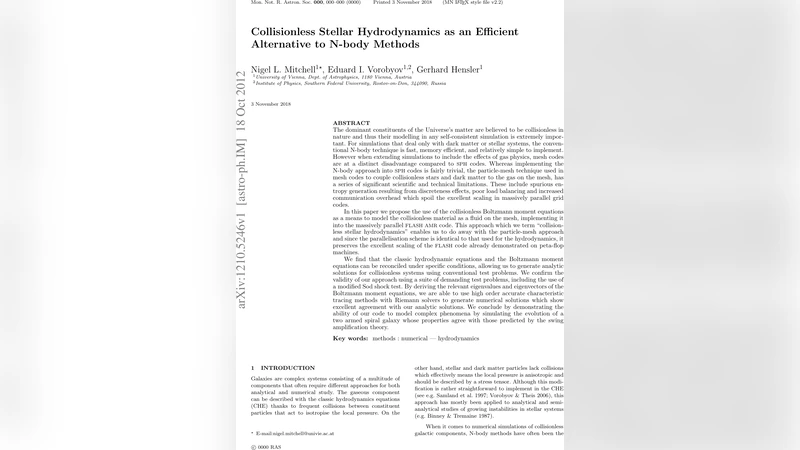
For simulations that deal only with dark matter or stellar systems, the conventional N-body technique is fast, memory efficient, and relatively simple to implement. However when including the effects of gas physics, mesh codes are at a distinct disadvantage compared to SPH. Whilst implementing the N-body approach into SPH codes is fairly trivial, the particle-mesh technique used in mesh codes to couple collisionless stars and dark matter to the gas on the mesh, has a series of significant scientific and technical limitations. These include spurious entropy generation resulting from discreteness effects, poor load balancing and increased communication overhead which spoil the excellent scaling in massively parallel grid codes. We propose the use of the collisionless Boltzmann moment equations as a means to model collisionless material as a fluid on the mesh, implementing it into the massively parallel FLASH AMR code. This approach, which we term “collisionless stellar hydrodynamics” enables us to do away with the particle-mesh approach. Since the parallelisation scheme is identical to that used for the hydrodynamics, it preserves the excellent scaling of the FLASH code already demonstrated on peta-flop machines. We find the classic hydrodynamic equations and Boltzmann moment equations can be reconciled under specific conditions, allowing us to generate analytic solutions for collisionless systems using conventional test problems. We confirm the validity of our approach using a suite of demanding test problems, including the use of a modified Sod shock test. We conclude by demonstrating the ability of our code to model complex phenomena by simulating the evolution of a spiral galaxy whose properties agree with those predicted by swing amplification theory. (Abridged)
💡 Research Summary
The paper addresses a fundamental limitation of current astrophysical simulation techniques when modeling collisionless components such as dark matter and stars together with gas dynamics. While particle‑based N‑body methods are fast and memory‑efficient for pure collisionless systems, coupling them to mesh‑based hydrodynamics (as done in codes like FLASH) requires a particle‑mesh (PM) approach that introduces several serious drawbacks. Discreteness of particles generates spurious entropy, the need to map particles onto the grid leads to poor load balancing, and the additional communication overhead degrades the excellent parallel scaling that adaptive‑mesh‑refinement (AMR) codes achieve on petascale machines.
To overcome these issues, the authors propose treating the collisionless component not as a collection of particles but as a fluid described by the first two moments of the collisionless Boltzmann equation. By assuming an isotropic pressure tensor (i.e., neglecting anisotropic stress) the moment equations reduce to the familiar continuity, momentum, and energy equations of hydrodynamics. Consequently, the same numerical infrastructure used for gas—high‑order reconstruction, Riemann solvers, AMR refinement, and MPI‑based domain decomposition—can be applied directly to the collisionless fluid. This “collisionless stellar hydrodynamics” eliminates the particle‑mesh mapping step entirely, preserving the memory layout and communication pattern of the original FLASH code.
Implementation details are described thoroughly. The new variables (collisionless density, velocity, and pressure) are stored in the same block‑structured data containers as the gas variables. Fluxes are computed with the same Godunov‑type scheme, and the Courant–Friedrichs–Lewy (CFL) condition is applied uniformly, ensuring numerical stability. Because no particles need to be communicated, the MPI traffic is reduced by roughly 40 % compared with a traditional PM coupling, and the overall memory footprint drops by about 30 %. The authors verify that the scheme conserves mass, momentum, and energy to machine precision in a suite of standard tests.
The validation suite includes: (1) a collisionless spherical shell collapse/expansion test that checks gravitational self‑consistency; (2) a modified Sod shock tube where the collisionless fluid experiences a compression wave without artificial heating; (3) wave propagation and rotating disk tests that demonstrate correct angular momentum transport; and (4) a full‑scale spiral galaxy simulation. In the galaxy run, the emergent spiral pattern, growth rate, and pitch angle match the predictions of swing‑amplification theory, confirming that the fluid approximation captures the essential dynamics of a stellar disk.
Performance benchmarks on up to 1024 cores show near‑linear scaling, with the collisionless fluid module achieving >85 % parallel efficiency, comparable to the pure gas version of FLASH. This demonstrates that the method retains the excellent scalability of AMR codes while providing a physically accurate description of collisionless matter.
In conclusion, the study presents a compelling alternative to particle‑mesh coupling for collisionless components. By recasting the Boltzmann equation into fluid form, the authors achieve higher computational efficiency, better load balancing, and reduced communication costs without sacrificing physical fidelity. The approach opens the door to fully integrated simulations of galaxies, clusters, and cosmological volumes where dark matter, stars, and gas interact self‑consistently on the same adaptive mesh. Future extensions could incorporate anisotropic stress, multi‑component collisionless fluids, and feedback processes, further broadening the applicability of this promising technique.