Introduction to clarithmetic III
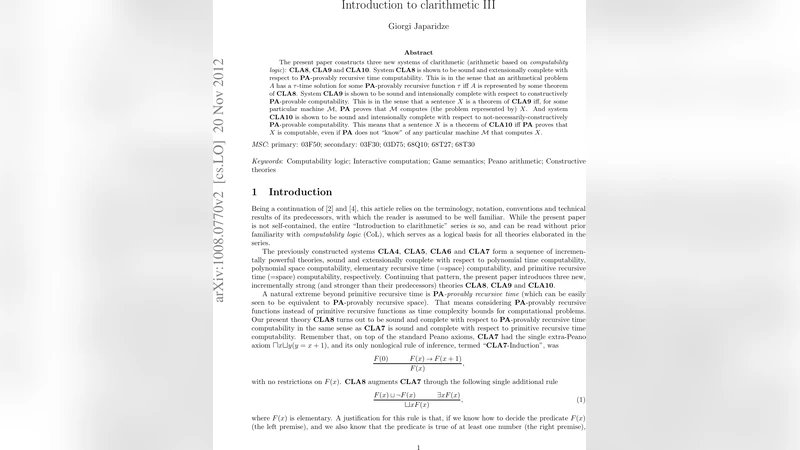
The present paper constructs three new systems of clarithmetic (arithmetic based on computability logic — see http://www.cis.upenn.edu/~giorgi/cl.html): CLA8, CLA9 and CLA10. System CLA8 is shown to be sound and extensionally complete with respect to PA-provably recursive time computability. This is in the sense that an arithmetical problem A has a t-time solution for some PA-provably recursive function t iff A is represented by some theorem of CLA8. System CLA9 is shown to be sound and intensionally complete with respect to constructively PA-provable computability. This is in the sense that a sentence X is a theorem of CLA9 iff, for some particular machine M, PA proves that M computes (the problem represented by) X. And system CLA10 is shown to be sound and intensionally complete with respect to not-necessarily-constructively PA-provable computability. This means that a sentence X is a theorem of CLA10 iff PA proves that X is computable, even if PA does not “know” of any particular machine M that computes X.
💡 Research Summary
The paper “Introduction to Clarithmetic III” presents three new formal systems—CLA8, CLA9, and CLA10—within the framework of clarithmetic, an arithmetic built on Computability Logic (CoL). The authors extend the earlier series (CLA1–CLA7) by addressing two major limitations: the restriction to PA‑provably polynomial‑time computability and the lack of a clear distinction between constructive and non‑constructive existence proofs of algorithms.
CLA8 targets “PA‑provably recursive time computability.” It augments Peano Arithmetic (PA) with two time‑bounded operators, ⊓ₜ and ⊔ₜ, which respectively express a choice and an existence under a specific time bound t. The system requires that the bound t be a function whose totality and recursive nature are provable in PA. The authors prove two central meta‑theorems: (1) Soundness – every theorem of CLA8 corresponds to an actual algorithm that solves the represented arithmetical problem within the PA‑provable time bound t; (2) Extensional Completeness – if an arithmetical problem A admits a t‑time solution for some PA‑provably recursive t, then A is representable as a theorem of CLA8. Thus CLA8 captures exactly the class of problems solvable in a time bound that PA can certify as recursive.
CLA9 moves from extensional to intensional (constructive) completeness. It introduces a “Witness‑Introduction” rule: if PA proves that a specific Turing machine M computes the problem X, then X can be introduced as a theorem of CLA9. Consequently, a CLA9 theorem not only asserts that X is computable but also provides a concrete algorithmic witness. The paper shows that CLA9 is intensionally complete with respect to constructively provable computability: a sentence X is a CLA9 theorem iff PA can exhibit a particular machine M together with a proof that M solves X. Soundness follows because the witness M can be extracted from any CLA9 proof, guaranteeing an actual strategy in the CoL game semantics.
CLA10 relaxes the witness requirement entirely. Its sole existence rule permits the introduction of X as a theorem whenever PA proves the mere statement “X is computable,” without supplying any specific machine. This captures “non‑constructively PA‑provable computability.” The authors prove that CLA10 is also intensionally complete, now with respect to the weaker notion that PA can assert computability even when it cannot point to a concrete algorithm. Soundness is established by a meta‑argument that any PA proof of existence can be transformed, via standard recursion‑theoretic techniques, into an actual algorithm (though not necessarily known to PA).
All three systems are interpreted through CoL’s game‑theoretic semantics: problems are games, proofs are strategies, and the new operators encode time constraints or existence of winning strategies. The paper details how PA proofs are embedded into CLA‑proofs, how the new rules preserve consistency, and how the systems maintain the desirable property that every theorem corresponds to a genuine computational solution.
The significance of these results lies in unifying complexity‑theoretic notions (recursive time bounds), constructive logic (witness‑based existence), and classical provability (non‑constructive existence) within a single logical framework. CLA8 shows that any PA‑certifiable time bound yields a sound and complete arithmetic for that bound. CLA9 demonstrates that constructive proofs of algorithmic existence can be internalized as theorems, while CLA10 shows that even non‑constructive existence statements can be captured without sacrificing soundness.
Future directions suggested include extending the hierarchy to super‑recursive bounds (e.g., exponential time), integrating other logical systems such as linear logic or type theory, and developing automated proof assistants that exploit the CLA8‑CLA10 infrastructure for program synthesis and verification. The work thus provides a robust platform for further exploration of the interplay between formal arithmetic, computability, and complexity.
Comments & Academic Discussion
Loading comments...
Leave a Comment